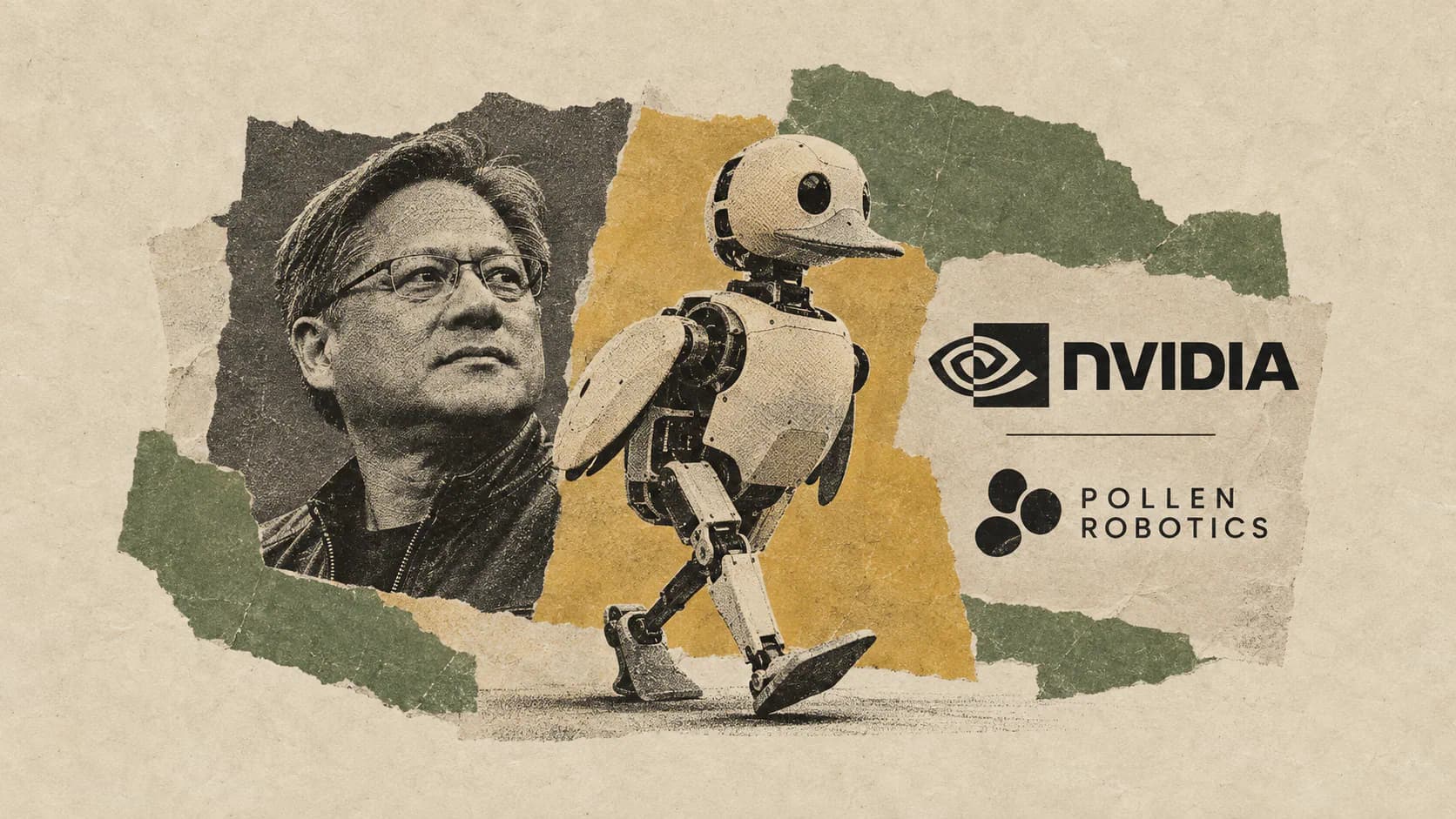
Microduck preorders surpassed 20,000 after Jensen Huang demonstrated the small walking robots at Nvidia’s GTC Berlin conference, according to Hugging Face CEO Clem Delangue, as reported by TechCrunch on October 23, 2026.
The October 21 demonstration showed the robots waddling, sitting, playing dead and performing somersaults on voice command. Behind that performance is a more interesting product proposition: buyers get a robot with pre-trained behaviors, plus software for teaching it different ones.
The preorder total is an executive-reported figure, without an audited sales disclosure in the supplied evidence. It is a concrete signal of demand for programmable physical-AI products, but it is not a count of delivered robots. TechCrunch reports that deliveries are expected in time for Christmas; that remains an expectation, not a verified shipping commitment.
What Buyers Get for $399
Pollen Robotics lists Microduck at an introductory price of $399 before taxes and shipping, with August 27, 2026 given as the preorder opening date.
The base package includes the robot, a battery, a USB-C cable and a game controller. Buyers can choose among four colorways, which Pollen describes as the same robot underneath different shells.
| Published detail | What Pollen lists |
|---|---|
| Size and weight | 25 cm tall; 800 g |
| Actuation | 15 motors |
| Sensors | Camera, LiDAR and two inertial measurement units |
| Movement control | 50 Hz onboard policy loop |
| Included behaviors | Seven trained policies |
| Base package | Robot, battery, USB-C cable and game controller |
Pollen’s named behaviors include walking, sitting and standing, kicking, grabbing with the beak, roller skating and getting back up from its back. Roller skating requires the skates to be fitted. The page advertises seven shipped policies, although its supplied text names only those six behavior categories.
These are manufacturer-described capabilities, not independently measured results. There are no supplied reliability figures for walking, recovery or object grabbing.
Three optional packs expand the package:
- Charger pack, $39: a dual charger and two batteries.
- Dev pack, $119: three spare motors, five motor cables, two batteries, a dual charger, 10 NFC tags, Hugging Face credit, a screwdriver and screws.
- Accessory pack, $39: a laser pointer, NFC polaroid, two rollers, a ball and 10 NFC tags.
The developer pack looks most relevant to someone planning repeated experiments because it includes replacement motors and cables. The published description does not specify the amount of Hugging Face credit, so I would not count it as covering a particular training budget.
There is also a practical distinction between the stage presentation and the purchase specification. TechCrunch describes voice commands during the demonstration, while Pollen lists a game controller in the box. The cited product details do not explain the onstage voice-control setup, so buyers should not assume that every part of Huang’s demonstration is a documented home setup.
How Skills Move From Simulation to Hardware
Pollen identifies MuJoCo as the physics simulator used to train Microduck’s policies. Its published workflow has four stages:
- Train in simulation, either on the owner’s machine or through Hugging Face Jobs.
- Deploy the resulting policy to the physical robot.
- Refine the simulation, retrain and deploy again.
- Publish the policy for other owners to use or develop further.
A policy is the learned controller behind a behavior. In reinforcement learning, training adjusts that controller using feedback about how well it performs a task. For Microduck, the intended result is a controller that produces useful physical movement, such as walking at a requested velocity or recovering from a fall.
The simulated robot is where that learning happens. Instead of requiring every training attempt to take place on a physical Microduck, the workflow uses a software model of the robot and its environment. The trained policy is then transferred to the hardware.
That transfer is the consequential step. A controller that succeeds in a simulated environment still has to work with real motors, contact surfaces and physical variation. Pollen’s explicit refine, retrain, redeploy stage matters because it acknowledges an iterative workflow. Owners have a route for changing the simulated setup when a learned behavior needs adjustment.
The evidence does not supply transfer-success measurements, training times or compute requirements. Pollen describes deployment as a one-step process, but that describes the deployment interface, not how much work it takes to train a good behavior.
What the 50 Hz Loop Actually Means
Pollen lists a 50 Hz onboard policy loop. That means the movement policy runs 50 times per second, corresponding to a nominal interval of 20 milliseconds between iterations.
That figure is useful because it describes how frequently the learned controller operates. It is not a measurement of end-to-end voice-command latency, nor does it tell us how long training takes.
Training and execution are separate stages. The published design places the policy loop onboard after deployment, while training can happen locally or through Hugging Face Jobs. A buyer therefore does not need to interpret every movement as a fresh remote AI request.
My view is that this separation is the product’s strongest technical idea. The included policies give owners something usable immediately, while the training tools expose the mechanism that produces movement. That makes Microduck more adaptable than a robot whose behavior can only change through manufacturer updates.
What Remains Customizable After Shipping
Pollen says the SDK, simulation and full reinforcement-learning training stack are available on GitHub, and describes the software stack as Apache-2.0 licensed. It also says every shipped movement policy is published and retrainable. Those claims appear on the Microduck product page.
The documented customization extends across several layers:
- Application development: use the SDK as the software interface for building around the robot.
- Behavior training: retrain policies that control movement.
- Simulation changes: adjust the simulated setup before another training run.
- Sharing: publish a behavior so other owners can build on it.
Frequently Asked Questions
3 questions
1How Much Does Microduck Cost?
The introductory price is $399 before taxes and shipping. Optional charger, developer and accessory packs cost extra.