
Sakana AI announced Sakana Namazu Small on November 25, 2026, introducing a 30-billion-parameter reasoning model built on NVIDIA’s Nemotron 3 Nano pretrained base. Sakana says it handled continued pretraining and post-training in-house, focusing on web-search research, long-document understanding, and answers grounded in supplied evidence.
The Namazu Small announcement is a model reveal, not a public weights or API launch. Sakana plans to offer the model on premises and says it will explain availability in early-to-mid December 2026. The announcement provides no download, public API access, pricing, or final deployment terms.
Sakana’s published benchmark results suggest a specific strength: working with information retrieved from the web or supplied in documents. The same table shows weaker results on several questions answered from internal knowledge alone. That distinction matters for enterprises considering a Japanese-focused research assistant, because document analysis and unaided factual recall are different capabilities.
What Sakana Namazu Small Is
Sakana Namazu Small is a 30B-parameter LLM in Sakana AI’s Namazu family, which the company defines as models built on open models and finished using its post-training techniques.
For this model, Sakana started with NVIDIA Nemotron 3 Nano’s pretrained base. The company then applied both continued pretraining and post-training, including newly developed techniques alongside methods used for earlier Namazu models.
| Detail | What Sakana announced |
|---|---|
| Model | Sakana Namazu Small |
| Total parameters | 30 billion |
| Pretrained base | NVIDIA Nemotron 3 Nano |
| Sakana’s training work | Continued pretraining and post-training |
| Model type | Reasoning LLM |
| Intended work | Conversation, web research, long-document reading, evidence-based answers |
| On-premises status | Planned; details due early-to-mid December 2026 |
| Public weights or API | Not provided in the announcement |
“Small” describes the model’s place within the Namazu family. Sakana presents its 30B scale as suitable for organizations considering operation on their own computing infrastructure. That is a positioning statement, however, not a published hardware specification.
The precise base-model name also matters. Namazu Small is built on Nemotron 3 Nano; readers following Zeniteq’s separate coverage of NVIDIA Nemotron 3 Nano Omni should keep those product names distinct.
How Sakana Trained Namazu Small
Sakana Namazu Small uses NVIDIA’s pretrained Nemotron 3 Nano base, with Sakana responsible for the subsequent continued-pretraining and post-training stages.
The important technical distinction is where Sakana began. The company did not describe Namazu Small as a foundation model pretrained from scratch. It took an existing pretrained model and performed additional training to shape its capabilities.
Sakana describes continued pretraining and post-training as stages where it develops abilities needed for particular uses, including agentic behavior and conversation. For Namazu Small, the stated priorities were gathering information through web search, understanding long documents, and producing answers supported by evidence.
The company also calls Namazu Small a reasoning model, designed to organize relevant information and work through complex questions step by step. Readers seeking background on that model category can find related material in Zeniteq’s coverage of Sebastian Raschka’s reasoning-model course.
The announcement explains the training sequence and goals, but it does not provide enough detail to reconstruct Sakana’s training process. The published results therefore support analysis of the resulting capability profile, not a conclusion about which individual training technique caused each improvement.
Namazu Small Benchmarks Favor Research and Grounded Answers
Sakana Namazu Small outperformed NVIDIA Nemotron 3 Nano and Nemotron 3 Super on the average of 25 benchmarks in Sakana’s own evaluation. Individual results show substantial variation across tasks.
Sakana compared its 30B model with NVIDIA’s post-trained Nemotron 3 Nano, labeled 30B-A3B, and Nemotron 3 Super, labeled 120B-A12B. The Super model has roughly four times as many total parameters as Namazu Small. The comparison models were NVIDIA’s post-trained versions, not the pretrained base that Sakana used as its starting point.
Selected results from Sakana’s benchmark appendix show both the gains and the exceptions. Higher scores are better in the comparisons below.
| Benchmark | Nemotron 3 Nano | Nemotron 3 Super | Namazu Small |
|---|---|---|---|
| BrowseComp | 29.3 | 36.1 | 73.5 |
| DeepSearchQA | 70.7 | 65.4 | 84.3 |
| FRAMES | 82.2 | 86.0 | 85.0 |
| HealthBench | 47.5 | 53.7 | 40.6 |
| LLM-jp LongBench | 67.0 | 60.0 | 86.0 |
| LongBench-Cite | 67.4 | 68.3 | 80.2 |
| LongBench v2 | 44.3 | 53.1 | 45.7 |
| FaithEval | 51.2 | 59.1 | 78.3 |
| SimpleQA Verified | 9.1 | 18.1 | 6.8 |
| Japanese SimpleQA | 9.2 | 24.9 | 8.0 |
These are vendor-published results, not independently reproduced measurements.
The largest selected web-search gain is on BrowseComp: Namazu Small scores 73.5 against Super’s 36.1, a difference of 37.4 points. On LLM-jp LongBench, its 86.0 score exceeds Super’s 60.0 by 26 points. LongBench-Cite and FaithEval also show sizable improvements.
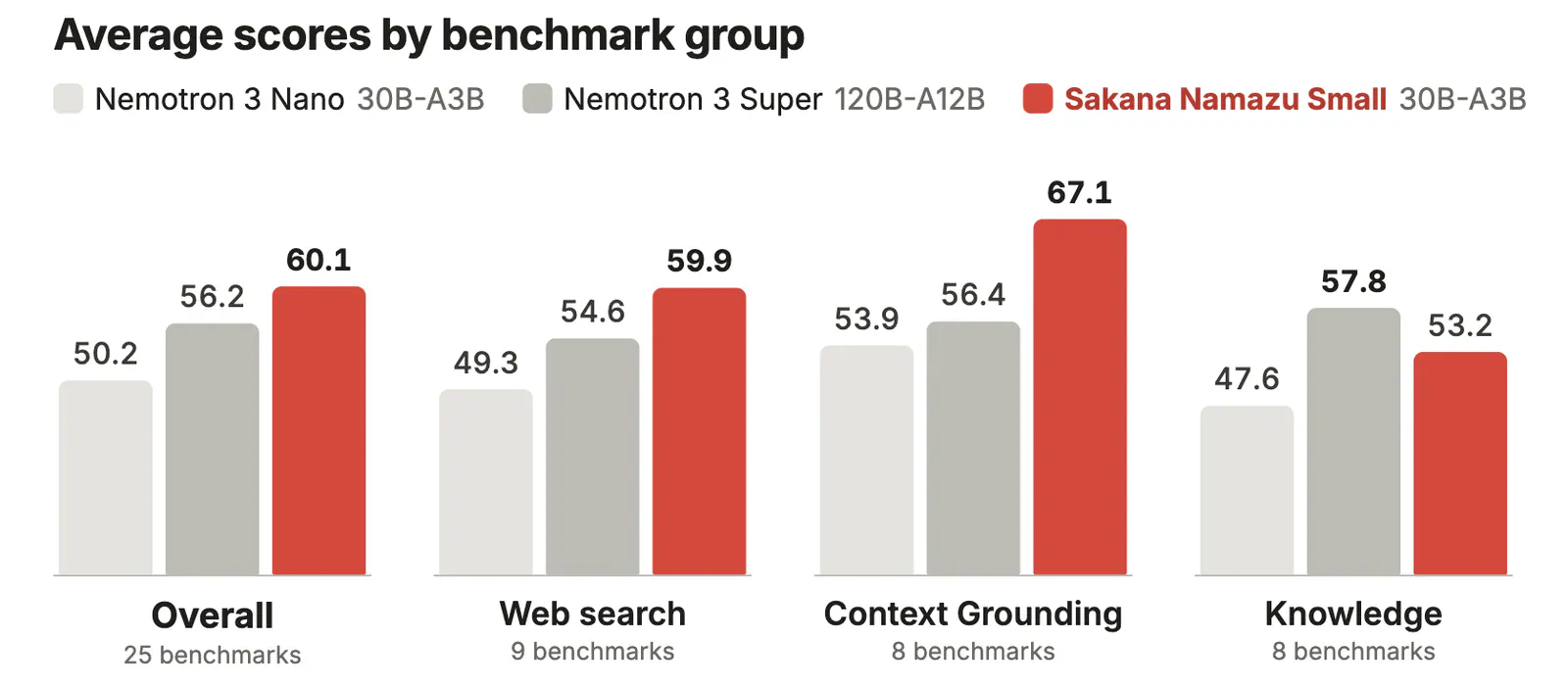
Image: Sakana AI.
Those results support Sakana’s emphasis on research and evidence-based document work. They suggest that access to relevant material is central to the model’s intended value.
The knowledge results provide an important boundary. Namazu Small scores 6.8 on SimpleQA Verified and 8.0 on Japanese SimpleQA, below both NVIDIA comparison models. Sakana explicitly acknowledges that performance has not improved substantially on tasks relying only on the model’s internal knowledge.
The model also trails Super on LongBench v2 and trails both comparison models on HealthBench. Its average lead across 25 tests should therefore be read as an aggregate result, not a claim that it wins every research, document, or specialist task.
Evaluation Settings Matter
Sakana evaluated Namazu Small in reasoning mode with a 262,144-token context length and a 32,768-token maximum output length. It used temperature 1.0, top-p 0.95, and no top-k setting. The NVIDIA models also ran in reasoning mode, using their respective recommended inference settings.
These conditions matter when interpreting the scores. The context setting describes how much material could be available during evaluation, while the output limit permits lengthy generated responses. Neither figure establishes response speed, concurrency, memory requirements, or the configuration customers will eventually receive.
The different model-specific settings also mean this is a comparison of configured systems, not an experiment in which every inference parameter was held identical. Sakana’s table is useful for identifying promising workloads, but it cannot settle deployment cost or production performance.
Intended Uses: Documents, Citations, and Web Search
Sakana Namazu Small is intended for everyday conversation and enterprise work centered on finding, reading, and explaining information.
Sakana highlights two main workflows:
- Long-document questions and summaries: Reading internal documents or reports, combining information from multiple materials, and answering with citations.
- Web-search research: Investigating recent news or industry developments, gathering information across sources, and repeating searches when one query is insufficient.
The benchmark pattern makes this positioning more meaningful than a general claim of better reasoning. Stronger source-grounding scores, combined with weaker results on some internal-knowledge tests, point toward evaluating Namazu Small as a tool that works from evidence.
For example, an enterprise assessment could ask whether the model correctly combines facts from several supplied reports and cites the supporting passages. That would test the capability Sakana emphasizes more directly than asking it to recall isolated facts without documents.
Web-search use adds another operational consideration. A model intended to run on premises may still need an approved route to external search services for current-information research. Conversely, internal-document work needs a way to supply the relevant material. Sakana’s announcement describes those intended tasks but does not yet specify the packaged search, document-ingestion, or access-control setup.
On-Premises Availability Remains Pending
Sakana Namazu Small is planned for on-premises availability, with further details promised in early-to-mid December 2026. That window is for an availability announcement, not a confirmed deployment date.
The distinction is especially important for enterprise planning. A 30B parameter count provides a useful indication of scale, but it is insufficient to size a production installation. Hardware needs also depend on the eventual deployment configuration, supported context length, and workload.
Before treating Namazu Small as a deployable option, buyers still need answers to practical questions:
- What hardware and serving configurations will Sakana support?
- What licensing, pricing, and support terms will apply?
- How will organizations obtain and update the model?
- Which search and document-processing components will be included?
- What performance will be available for their required context lengths and concurrent users?
The announcement does not resolve those questions. Sakana’s plan is relevant to organizations seeking greater control over where inference runs, but the procurement and infrastructure assessment must wait for the promised details.
Namazu Small Is Separate From Sakana’s Sawara Plans
Sakana Namazu Small is distinct from Sawara, the separate foundation-model project discussed in TechCrunch’s November 28 reporting.
TechCrunch reported that Sakana AI CEO David Ha said the company was targeting a smaller Sawara model for early 2027, followed by a larger version. That schedule should not be confused with Namazu Small’s December on-premises information update.
Ha also discussed demand for domestic AI alternatives and on-premises deployment in sensitive applications. As he told TechCrunch: “Japan needs on-premises deployment capabilities.”
The two projects address that broader direction through different development paths. Namazu Small builds on NVIDIA’s pretrained base and adds Sakana’s training work. Sawara is the separate effort to develop Sakana’s own foundation model.
For enterprises, the immediate Namazu Small decision is narrower: determine whether its evidence-centered capability profile fits a real workload, then examine the December availability details before committing to a deployment plan.
Frequently Asked Questions
3 questions
1When Will Namazu Small Be Available On Premises?
Sakana plans to share on-premises availability details in early-to-mid December 2026. It has not given a confirmed deployment date in the announcement. Organizations should treat that period as the expected information update, with hardware requirements, pricing, licensing, and delivery arrangements still to be clarified.
2Are Namazu Small Weights or an API Available?
The November 25 announcement does not provide public model weights or public API access. It introduces the model and describes a planned on-premises offering. NVIDIA’s underlying Nemotron 3 Nano being an open model does not, by itself, establish the distribution terms for Sakana’s trained Namazu Small model.
3How Does Namazu Small Compare With Nemotron?
Sakana reports a higher average across 25 benchmarks than NVIDIA Nemotron 3 Nano and Nemotron 3 Super. Its strongest published gains include web-search research and grounded document tasks. Results are mixed elsewhere: Namazu Small trails both on SimpleQA Verified and Japanese SimpleQA. These comparisons come from Sakana’s evaluation.


