
Ant Group’s Afu announced the LingSante medical AI family on November 23, 2026, opening weights for two models: Ant Group’s LingSante-3.1-flash and LingSante-3.1-air-VL. Researchers and developers can download the models through the LingSante-3.1-flash and LingSante-3.1-air-VL repositories.
The larger model targets complex medical reasoning and agent workflows, with 560 billion total parameters and a context window of up to one million tokens. The smaller model combines text, images and video, using 124 billion total parameters.
Both use mixture-of-experts architectures, activating only a fraction of their parameters for each token. That reduces computation compared with activating the entire network, but it does not turn either download into a small model.
The release also needs a clear evidence boundary. Ant’s benchmark and product claims are vendor-reported. A separate InclusionMed evaluation places flash fifth on its initial benchmark portfolio. Neither downloadable weights nor benchmark rankings establish that these models are safe for unsupervised diagnosis.
LingSante-3.1-flash vs. air-VL: The Main Differences
Ant Group’s LingSante-3.1-flash emphasizes long-context reasoning, while LingSante-3.1-air-VL emphasizes native multimodal health tasks with a smaller parameter footprint.
| Specification | LingSante-3.1-flash | LingSante-3.1-air-VL |
|---|---|---|
| Total parameters | 560 billion | 124 billion |
| Active parameters per token | About 25 billion | 5.5 billion |
| Active share, calculated | About 4.5% | About 4.4% |
| Context window | Up to 1 million tokens | Not specified in the opened evidence |
| Input emphasis | Text reasoning and agent workflows | Text, images and video |
| Architecture | Mixture of experts | Native multimodal mixture of experts |
| Repository license designation | MIT | MIT |
| Intended evaluation users | Researchers and developers building complex medical reasoning systems | Researchers and developers building multimodal health applications |
The published figures in the flash repository and air-VL repository describe two different deployment envelopes. Flash has roughly 4.5 times as many total parameters and active parameters as air-VL. Their activation proportions are almost identical.
That distinction matters when interpreting the names. “Flash” is a product label, not a measured promise of low latency on a particular server. Likewise, “air” identifies the smaller option within this family; 124 billion total parameters still represents a substantial model.
The broader announcement also introduced LingSante-Pulse for risk prediction, LingSante-MedGuard for safety and LingSante-Live for real-time multimodal consultation. The first phased open-weight release covers the two core models. Teams should not assume the other named components are included in those downloads or that their capabilities automatically accompany either model.
For background on the family’s positioning, Zeniteq’s earlier LingSante coverage provides additional context.
LingSante-3.1-flash: Long Context With Large Storage Needs
Ant Group’s LingSante-3.1-flash combines 560 billion total parameters, about 25 billion active parameters per token and support for up to one million tokens of context.
A context window is the amount of tokenized material a model can handle within an interaction. Tokens are text units, not a fixed number of words or medical records. Flash’s stated limit creates room for large document collections, long histories and multi-step workflows. It does not guarantee that every fact inside that window will be retrieved or interpreted correctly.
The flash repository’s chat template also includes tool-calling support. It defines how function descriptions, calls and tool responses are represented in a conversation. Developers still need an application layer that executes permitted tools, validates arguments and manages failures.
For medical applications, those controls are consequential. A model producing a tool-call message is different from a system being authorized to alter a record, send a patient message or trigger a clinical action.
Active Parameters Are Not the Full Memory Requirement
Mixture-of-experts routing selects part of the model for each token. The active count helps explain computation, but deployments still need access to the full set of weights, whether held in accelerator memory or managed through other storage and offloading arrangements.
Simple weight-storage arithmetic illustrates the difference:
| Illustrative weight representation | Flash: 560B parameters | air-VL: 124B parameters |
|---|---|---|
| 16-bit, two bytes per parameter | About 1,120 GB | About 248 GB |
| 4-bit, half a byte per parameter | About 280 GB | About 62 GB |
These are calculated raw-weight sizes in decimal gigabytes, not measured hardware requirements or claims about supported quantization. They exclude quantization metadata, runtime buffers, context caches and other serving overhead. Four-bit representation can also change model behavior, so the calculation is not a recommendation to deploy either model at that precision.
The practical implication is straightforward: 25 billion active parameters do not make flash a 25-billion-parameter storage problem. Its one-million-token context can add substantial runtime memory demands, depending on implementation and workload.
Teams evaluating flash should therefore measure three separate things: model-loading requirements, memory use at their actual context lengths, and latency under realistic concurrency. The headline parameter count alone cannot answer those questions.
LingSante-3.1-air-VL: Multimodal Inputs, Smaller Footprint
Ant Group’s LingSante-3.1-air-VL is a native multimodal mixture-of-experts model with 124 billion total parameters and 5.5 billion active parameters per token, intended for text, image and video health tasks.
The air-VL chat template contains explicit image and video markers. That documents how those input types are represented in the conversation format. It is useful integration evidence, although it does not measure the model’s accuracy on a scan, photograph or video.
The smaller total parameter count makes air-VL the more plausible starting point for a resource-constrained multimodal evaluation. Its lower active count also suggests a smaller expert-computation burden per token, all else being equal. Actual throughput will depend on hardware, serving software, routing and the media-processing workload.
“Local deployment” should therefore be read as deployment on infrastructure a team controls, not as a promise that the model fits on an ordinary laptop or edge device. Even the illustrative four-bit raw-weight estimate is about 62 GB before overhead.
Multimodal applications add another integration layer. Developers need to establish how media are decoded, resized or sampled and passed through the model’s supported processing path. Changing those choices can change what information reaches the model. A video-capable interface alone says little about whether a particular clinical event remains visible after preprocessing.
The opened evidence does not specify a separate air-VL context length, so flash’s one-million-token limit should not be carried across to the smaller model.
The Chat Templates Have Different Reasoning Defaults
The published templates expose a small but consequential setup difference: flash defaults its thinking option to off when the setting is absent, while air-VL defaults it to on.
That is a documented template behavior, not a measured quality or latency result. Evaluators should explicitly set the option and record it with their test configuration. Otherwise, a comparison can silently combine different reasoning settings, making results harder to interpret or reproduce.
LingSante-3.1-flash Benchmarks: Fifth on InclusionMed
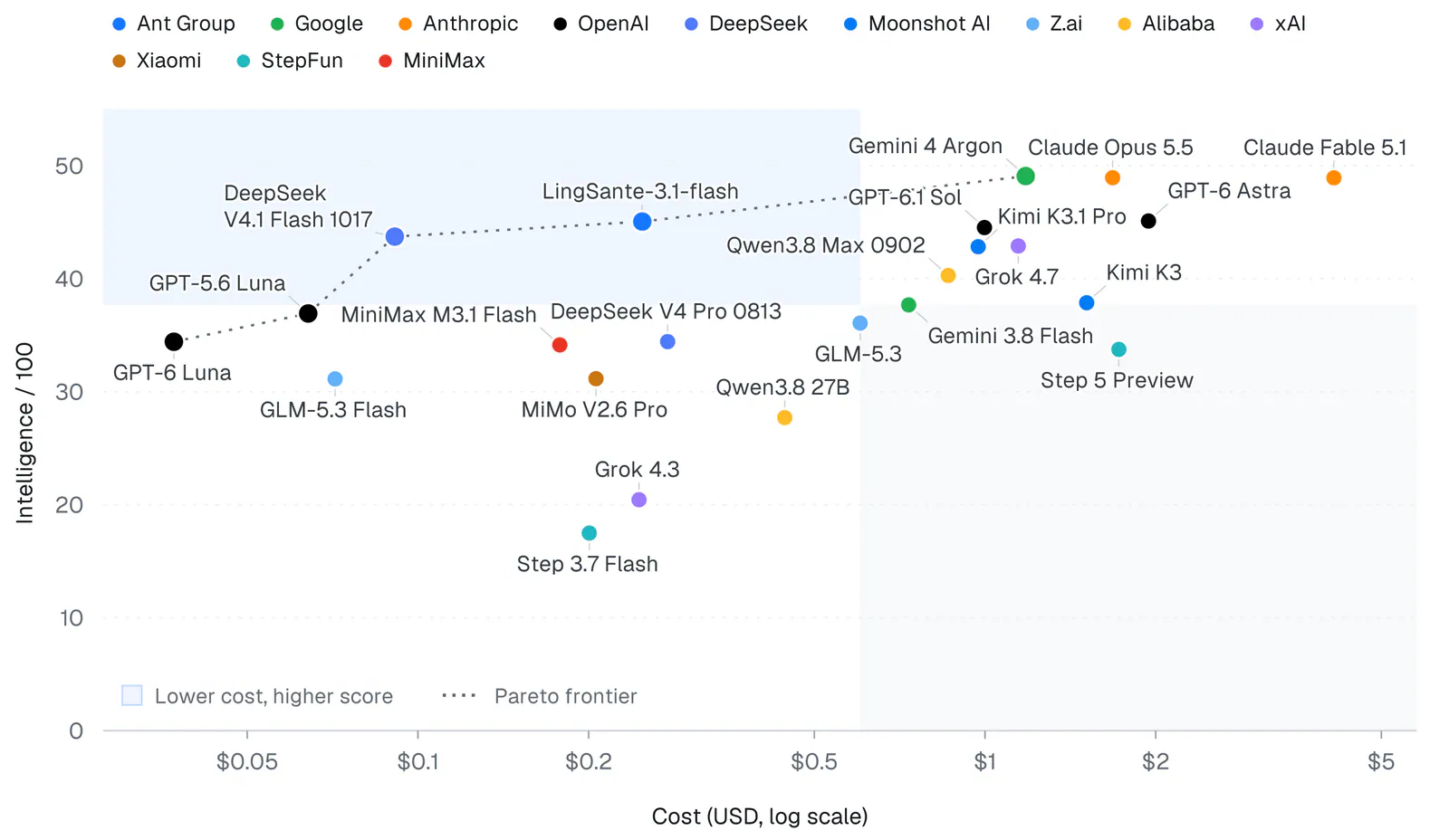
Ant Group’s LingSante-3.1-flash ranked fifth overall with a score of 45.1 in the independent InclusionMed Index’s November 22, 2026 update.
The InclusionMed repository reports an initial portfolio of five benchmarks covering 23 models. Its overall index is the equally weighted mean of those five benchmark scores. The initiative organizes evaluation around healthcare roles and AI capabilities, while explicitly identifying gaps in coverage.
| Evidence | Reported result | What it supports |
|---|---|---|
| Ant Group’s marketing | Broad first-place positioning | A vendor claim requiring benchmark-specific scrutiny |
| InclusionMed Index | Fifth overall, score 45.1 | A ranking on its initial five-benchmark portfolio |
| InclusionMed cost-performance analysis | On the observed Pareto frontier | A favorable tradeoff within the measured models and pricing assumptions |
The independent result does not support a universal number-one interpretation of Ant’s marketing. It also does not prove that every vendor benchmark claim is wrong: different task selections, model sets and scoring methods can produce different rankings. A like-for-like comparison requires the same benchmark versions and evaluation conditions.
InclusionMed’s cost-performance finding has a similarly specific meaning. A model on the observed Pareto frontier is not dominated by another measured option that is both cheaper and better under that evaluation’s definitions.
The index estimates cost using recorded token usage and published prices, averaging across the five benchmarks. Those economics are not a quote for self-hosting flash. Local costs depend on hardware utilization, memory, electricity, engineering and workload shape.
The dates also deserve precision. InclusionMed’s entry is dated November 22, one day before the formal announcement, and repository materials show earlier availability. The public announcement date should not be treated as the first appearance of every artifact. Zeniteq’s AI model release timeline provides a broader release-history reference.
LingSante Licensing and Clinical Validation Limits
Ant Group’s LingSante-3.1-flash and LingSante-3.1-air-VL repositories identify an MIT license and include medical-use warnings.
The license designation makes the weights more accessible for inspection, adaptation and controlled deployment. Teams should still review the actual repository terms and applicable obligations before incorporating either model into a product.
Legal permission and clinical suitability answer different questions. An open-weight release provides access to model artifacts; it does not supply regulatory clearance, demonstrate patient benefit or establish safety for unsupervised diagnosis and treatment.
The model materials should therefore be read alongside task-specific evidence. The opened sources do not provide independent clinical validation sufficient to justify autonomous patient care. InclusionMed adds useful independent benchmark evidence, but its five-benchmark portfolio is not a clinical trial.
For a controlled evaluation, the published specifications suggest a practical split:
- Choose flash as the first candidate when the research problem centers on long text collections, complex reasoning or tool-assisted workflows.
- Choose air-VL as the first candidate when images or video are essential and a smaller model footprint matters.
- Validate the exact deployment configuration, including model revision, precision, context length, media preprocessing and thinking settings.
- Define human review and action boundaries before connecting outputs to patient-facing messages, clinical records or operational tools.
These are deployment implications drawn from the documented features, not results from testing either model. Weight access makes evaluation possible; the institution deploying the system still has to establish whether its specific workflow is reliable enough.
Frequently Asked Questions
3 questions
1What Is the Difference Between LingSante-3.1-flash and air-VL?
Flash is the larger reasoning model, with 560 billion total parameters, about 25 billion active per token and up to one million tokens of context. Air-VL has 124 billion total parameters and 5.5 billion active per token, with native text, image and video support. Both repositories identify an MIT license.
2Can LingSante Be Used Safely for Medical Diagnosis?
The published evidence does not establish safety for unsupervised diagnosis. The model materials include medical-use warnings, and benchmark performance is not clinical validation. Researchers can evaluate the downloadable weights, but patient-facing use requires evidence and safeguards appropriate to the specific task, population and deployment setting.
3Did LingSante-3.1-flash Rank First Independently?
Not on the cited InclusionMed evaluation. Its November 22, 2026 update placed flash fifth overall with a score of 45.1 across five benchmarks and on the observed cost-performance frontier. That is a bounded independent result, separate from Ant Group’s broader first-place marketing claim.


