
Alibaba Cloud released Qwen-Audio-3.1-Live on November 23, 2026, according to its model release changelog. The Model Studio service supports full-duplex voice conversations and can delegate work while continuing to interact with the user.
The key addition is the division of labor. A foreground voice model handles the conversation. An application or configured backend model handles tasks that need business tools or more reasoning. The voice model can then speak progress updates and results without requiring the conversation to stop while that work runs.
Alibaba documents two delegation modes, WebSocket and WebRTC integration paths, and per-second session pricing. Developers also need to account for separate backend-model charges, unsupported features and an inconsistency in the published quickstart.
How Qwen-Audio-3.1-Live Splits Conversation and Tasks
Alibaba’s Qwen-Audio-3.1-Live supports text and audio input and output, full-duplex conversation, and function calling, according to its Model Studio model page. Alibaba Cloud Model Studio supplies the inference service.
Full duplex allows two-way voice interaction without requiring a rigid sequence of completed user and assistant turns. The delegation feature addresses a separate problem: what happens when an assistant needs time to look something up or reason through a request.
Alibaba’s design assigns those responsibilities to different components:
- Foreground voice model: Listens, asks questions, responds in speech, and communicates task progress or results.
- Application or backend model: Handles delegated work, such as a business-system lookup or complex reasoning.
- Business tools: Connect through function calling in either delegation mode.
The developer guide’s order-lookup example makes the separation concrete. The voice model can collect an order number, delegate the lookup, and share updates or the result in speech while the conversation remains active.
The practical benefit is conversational continuity. A slow business API no longer has to occupy the same conversational turn as every spoken response. That does not make the underlying lookup faster; it gives the voice interface useful work to do while it waits.
This distinction also helps place the release alongside Zeniteq’s coverage of OpenAI GPT-Live-1’s full-duplex API. Full-duplex interaction describes how conversation flows. Delegation describes where task execution happens. Developers evaluating voice agents need to examine both.
Client Mode Versus Responses Mode
Qwen-Audio-3.1-Live offers Client mode for application-managed tasks and Responses mode for tasks handled by a configured backend model through Model Studio. Both support business-tool integration through function calling.
| Delegation mode | Who handles the background work? | Integration implication |
|---|---|---|
| Client | The developer’s application | The application receives the task, performs the work and returns the result |
| Responses | A backend model invoked by Model Studio | The developer configures the backend model that Model Studio calls |
These responsibilities are described in Alibaba’s delegation overview.
Client mode is the more direct fit for an existing application workflow. If an application already knows how to query an order database, it can handle that task and return the result to the voice frontend. That follows from the documented application-managed execution path; an additional reasoning model is not required merely to perform a lookup.
Responses mode fits requests that benefit from a separate reasoning model. Model Studio invokes the configured backend model and returns its result to the foreground voice model. The voice frontend can continue interacting while that happens.
The architecture therefore separates two choices that are often bundled together: how the assistant talks and how it completes work. Teams can keep deterministic business operations in their application or configure an LLM backend where reasoning is useful.
Applications still need to distinguish a progress update from a completed result. “The lookup is running” and “the order has shipped” represent different task states. A conversational frontend that remains active during execution makes that distinction especially important.
Connecting Qwen-Audio-3.1-Live
Qwen-Audio-3.1-Live has documented WebSocket and WebRTC integration paths. Alibaba’s quickstart guide provides a Python recording-based example and points developers to a browser example for microphone interaction.
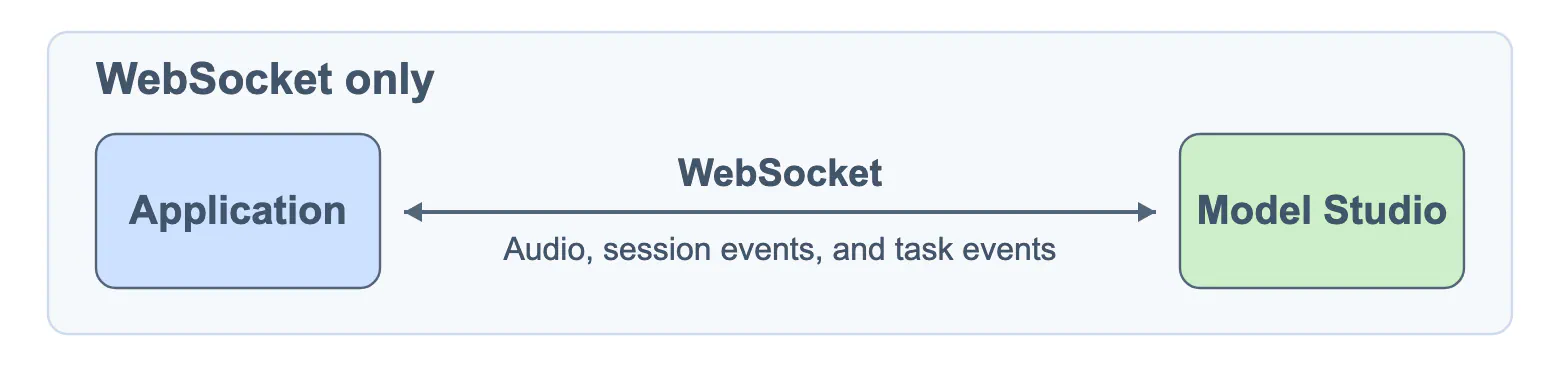
Both connection setups begin with WebSocket. In the WebSocket-only setup, one connection carries audio, transcripts and task events.
The Python quickstart requires an API key, Python, FFmpeg and the websockets package. It converts a recording to 16 kHz, 16-bit, mono PCM, sends the audio and saves the response as 24 kHz, 16-bit, mono audio. Long-term API keys should remain on the application server, and keys are region-specific.
The following excerpt shows the session settings used for duplex interaction and client-managed delegation:
session = {
    "model": SESSION_MODEL,
    "modalities": ["text", "audio"],
    "turn_detection": {"type": "duplex"},
    "delegation": {"type": "client"},
}
send("session.update", session=session)
The excerpt configures text and audio output, duplex turn detection and Client mode. It is part of the documented example, not a complete client or evidence of an executed test. The guide says audio transmission begins only after the server sends session.updated.
A Model Identifier Mismatch in the Quickstart
The published Qwen-Audio-Live quickstart contains an important inconsistency: its WebSocket URL selects qwen-audio-3.1-live, while its SESSION_MODEL variable is set to qwen-audio-4.0-realtime-preview.
The supplied documentation does not explain that mismatch. Developers should resolve the conflicting identifiers before treating the example as a reliable configuration for Qwen-Audio-3.1-Live. The discrepancy is not evidence that the two model IDs are interchangeable.
That is a consequential setup detail because model selection appears in two places. Copying the example without checking both could leave the intended service ambiguous.
Qwen-Audio-3.1-Live Pricing and Limits
Qwen-Audio-3.1-Live is billed by connected session duration in seconds, with a three-second minimum once the connection is established. Alibaba’s published pricing lists different rates for Singapore and Beijing.
Frequently Asked Questions
3 questions
1What Is the Difference Between Client and Responses Mode?
Client mode gives the application responsibility for delegated tasks and returning results. Responses mode has Model Studio invoke a configured backend model. In both modes, Qwen-Audio-3.1-Live can continue the conversation while work runs, and both support business-tool integration through function calling.


