
NVIDIA published a Nemotron 3.5 Parse implementation guide on November 26, 2026, adding synthetic training datasets, a fine-tuning recipe, and a DFlash2 speculator for faster inference. The update gives developers more resources for customizing document-processing pipelines.
Nemotron 3.5 Parse itself arrived earlier. NVIDIA’s model card lists October 20, 2026 as its release date on both Build.NVIDIA.com and Hugging Face. The November announcement is an implementation update, separate from that original launch.
For teams building document retrieval-augmented generation, or RAG, and agents, the guide addresses two different problems: improving extraction on particular document types and reducing the time spent generating structured output. Those require different interventions, and NVIDIA’s published results help explain where each fits.
What Nemotron 3.5 Parse Produces
NVIDIA Nemotron 3.5 Parse converts page images into machine-readable text with semantic layout classes, reading order, and bounding boxes. Its output distinguishes elements such as headings, paragraphs, tables, and charts, giving downstream software more structure than a plain OCR transcript.
The 630.8-million-parameter model combines a C-RADIOv4-SO400M vision encoder with a 10-layer mBART decoder. Dynamic rectangular image preprocessing adapts the input shape to the page, while an adapter compresses the visual sequence before the decoder generates text.
That structure matters for retrieval. A table’s contents can be transcribed correctly while still becoming misleading if values lose their row or column relationships. Reading order similarly affects whether a multi-column document becomes coherent text.
Developers also need to handle the output format correctly. Parse returns a string encoding text, classes, and content-normalized bounding boxes. NVIDIA instructs developers to scale horizontal coordinates by the evaluated image width and vertical coordinates by its height. Postprocessing utilities can convert supported table or chart-associated text into formats including HTML, Markdown, JSON, and CSV.
The practical implication is that model inference is only one stage of integration. Coordinate conversion and structured-output handling still need to match the application consuming the results.
Three Synthetic Datasets for Fine-Tuning
NVIDIA’s November 26 Nemotron 3.5 Parse guide releases three synthetic datasets used in the model’s training, with images, annotations, generation documentation, and training formats.
| Dataset | Examples | Training focus |
|---|---|---|
| Synthetic Charts V1 | 9.98 million | Chart categories, series, and numerical values |
| Synthetic Tables V1 | 1 million | Rows, columns, headers, and cell relationships |
| OCR Synthetic Multilingual v2 | 7.9 million | Multilingual OCR and structured page reading across fonts and layouts |
NVIDIA says developers can use these image-and-target pairs to fine-tune document models or create new variations for a target document type or language.
Synthetic generation provides a useful training mechanism: start with known structured content, render it as an image, then train the parser to recover the original structure. For tables, this supplies explicit relationships between cells. For charts, it supplies known series and values against which extraction can be checked.
NVIDIA highlights charts without printed numerical labels as one application. Parse can infer values from axes and bar heights. That is a different operation from recognizing printed digits: the model must interpret geometry.
For a developer, the dataset categories suggest a targeted adaptation strategy. A pipeline struggling with table relationships has a different training need from one struggling with multilingual text. Selecting examples that resemble the actual failure is more defensible than treating all 18.88 million examples as equally relevant. The published dataset sizes describe available training material, not an expected accuracy gain for a particular workload.
How NVIDIA Trained for More Reliable Output
NVIDIA Nemotron 3.5 Parse used supervised fine-tuning followed by reinforcement learning with verifiable rewards, or RLVR, according to the new guide.
Supervised fine-tuning taught the model to map page images to structured targets across text, layout, tables, charts, and multilingual documents. NVIDIA then used Group Relative Policy Optimization, or GRPO, to improve extraction quality and completion behavior.
The reward checks can assess whether a chart extraction recovers the correct series and values, produces usable structure, and finishes without repetitive generation. This allows different valid representations of a page to receive credit without requiring one exact token sequence.
NVIDIA reports the following matched comparison of development checkpoints:
| Metric | SFT checkpoint | After GRPO |
|---|---|---|
| Overall evaluation score | 66.24 | 71.38 |
| Pages with loop-flagged output | 126 | 29 |
| Outputs reaching the 9,000-token limit | 185 | 35 |
These are NVIDIA’s development results, separate from the final released model. The company reports about 77% fewer loop-flagged outputs, with table and chart scores improving by 5.18 and 4.15 points respectively.
The completion figures have operational significance beyond the aggregate score. A parser that repeats content or exhausts its output allowance can consume decoding time without delivering a usable page. The comparison therefore supports evaluating fine-tuned models on repetition and completion, alongside extraction accuracy.
It also explains why reproducing only the supervised stage would not reproduce NVIDIA’s entire training process: the later reward-based stage explicitly targeted behavior that ordinary target matching may leave unresolved.
DFlash2 Speeds Up Nemotron 3.5 Parse Decoding
NVIDIA’s DFlash2 speculator accelerates Nemotron 3.5 Parse by proposing multiple output tokens for the main model to verify together.
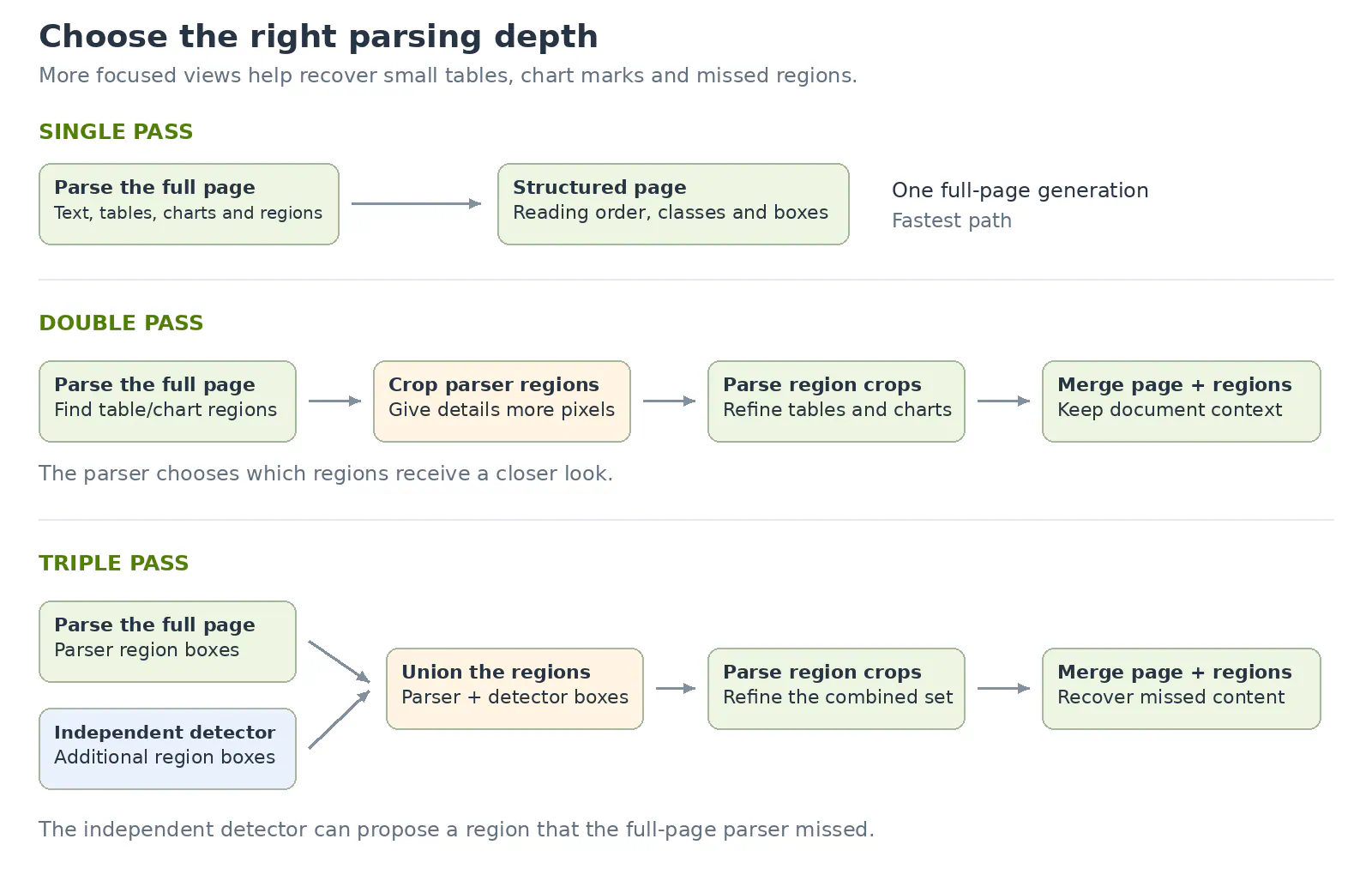
Document parsing can require long outputs because the decoder must generate both content and structure. DFlash2 uses a small draft model to propose up to 32 tokens ahead. In NVIDIA’s measured 32-token configuration, roughly 14 draft tokens were accepted on average, producing about 15 output tokens of progress per verification step when including the target token.
NVIDIA measured native single-pass throughput on one H200 GPU using BF16, a 16-bit numerical format, across the same 2,078 pages. Parse 3.5 results were medians of three trials.
| Concurrent requests | Without speculation | With DFlash2 | Reported throughput gain |
|---|---|---|---|
| 1 | Absolute rate not specified in the excerpt | Absolute rate not specified in the excerpt | 7.62× |
| 512 | 13.48 pages/second | 20.44 pages/second | 1.52× |
The figures are NVIDIA’s measurements and have not been independently reproduced here.
Concurrency changes the practical interpretation. At one concurrent request, accepting multiple tokens per verification step can substantially reduce sequential decoding work. At 512 concurrent requests, the reported relative benefit is smaller, though throughput still rises by 6.96 pages per second.
For an interactive document-upload service, the low-concurrency result is the more relevant starting point for evaluation. A bulk-processing system should pay closer attention to the saturated throughput result. Neither workload should assume that the headline 7.62× gain applies across all operating conditions.
What Developers Should Evaluate First
Nemotron 3.5 Parse now has published resources for data adaptation and decoding acceleration, but the appropriate starting point depends on the pipeline’s bottleneck.
- Incorrect content or structure: Use representative failures to select relevant synthetic data and evaluate fine-tuning.
- Repetitive or unfinished output: Track completion and looping explicitly, following the concerns addressed by NVIDIA’s RLVR stage.
- Correct but slow extraction: Evaluate speculative decoding at the concurrency expected in deployment.
- Incorrect downstream placement or formatting: Check coordinate scaling and postprocessing before attributing the problem to model accuracy.
Serving configuration also needs care. NVIDIA’s model card distinguishes standard Transformers generation from its vLLM integration: Transformers uses the normal decoder, while the vLLM plugin enables the bundled one-step multi-token prediction head. That one-token lookahead is separate from DFlash2’s larger draft proposals. A working inference setup therefore does not automatically mean DFlash2 is active.
For related deployment context, Zeniteq has covered running Nemotron 3.5 locally on NVIDIA DGX Spark, with broader product coverage in the NVIDIA topic hub. Parse deployments still need their own workload-specific validation, as NVIDIA’s model card recommends.
Frequently Asked Questions
3 questions
1Is Nemotron 3.5 Parse a New Model Release?
No. NVIDIA’s model card lists October 20, 2026, as the release date for Nemotron 3.5 Parse on Build.NVIDIA.com and Hugging Face. The November 26 guide builds on that existing model with synthetic datasets, fine-tuning guidance, and a DFlash2 speculator for faster inference.
2What Synthetic Datasets Are Available?
NVIDIA’s guide lists Synthetic Charts V1 with 9.98 million examples, Synthetic Tables V1 with 1 million, and OCR Synthetic Multilingual v2 with 7.9 million. Each includes images, annotations, generation documentation, and training formats. Developers can use the pairs for fine-tuning or create variations for specific documents and languages.
3How Much Faster Is DFlash2?
NVIDIA reports 7.62× higher throughput at concurrency 1 and 1.52× at concurrency 512 compared with Nemotron 3.5 Parse with speculation disabled. Those measurements used one H200 in BF16. At concurrency 512, throughput increased from 13.48 to 20.44 pages per second in the company’s benchmark.


