
Microsoft published an ARTEX defender guide on November 25, 2026, detailing how the AI-powered penetration-testing framework coordinates attacks and which behaviors security teams can hunt. Microsoft Threat Intelligence says state-sponsored and financially motivated groups have integrated ARTEX into their tooling.
The defensive guidance is the news here, not a new framework launch. ARTEX came out in July 2026, and both Microsoft and Google had already reported malicious use. The new document pulls architecture, network and system activity, hunting guidance, and mitigations into one reference.
Microsoft says ARTEX can move from reconnaissance to persistent, privileged access in minutes, depending on the attacker’s configuration and the target’s defenses. That conditional claim makes the guide’s practical question urgent: which controls can interrupt an automated sequence before an analyst has time to investigate?
How ARTEX Turns Goals Into Attack Commands
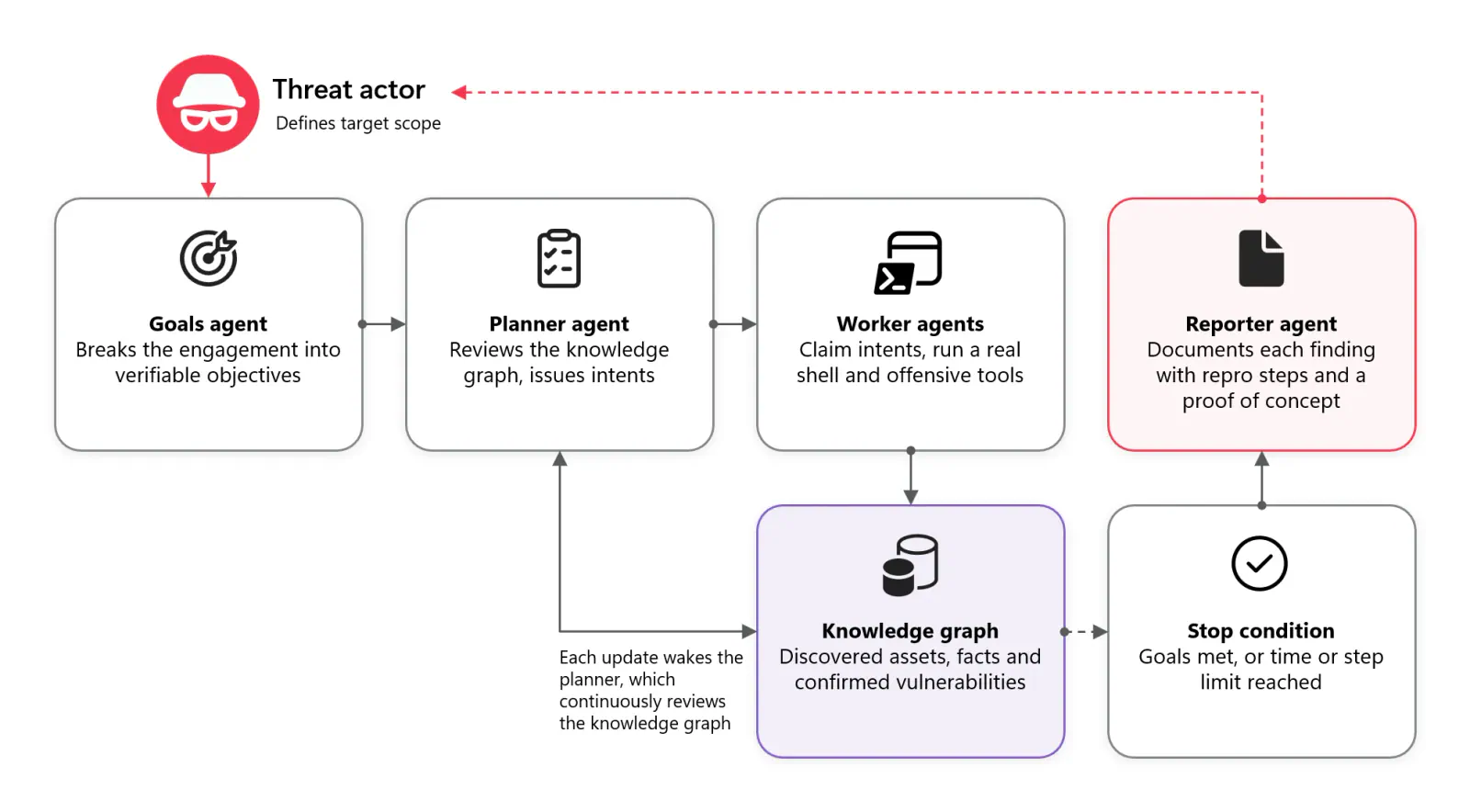
ARTEX uses a Go-based backend to coordinate multiple large language model agents, according to Microsoft’s November 25 guide. An embedded Next.js interface provides the web console, while PostgreSQL handles storage.
The workflow separates objectives, planning, and execution:
| Component | Documented role | Defensive significance |
|---|---|---|
| Goals model | Defines verifiable objectives | The framework can assess progress toward an attacker’s objective |
| Planner | Reviews a knowledge graph and issues intents | Findings from earlier actions can shape subsequent steps |
| Worker agents | Execute intents using a real shell and offensive tools | Activity produces network requests, commands, and system changes defenders can investigate |
The knowledge graph tracks discovered systems and action results. That feedback loop matters: ARTEX can use what it learns to choose another action without requiring a person to manually interpret every tool result.
Microsoft describes ARTEX primarily as a web application penetration-testing tool. Its built-in guidance covers vulnerabilities such as SQL injection, server-side template injection, XML external entity injection, file-upload flaws, authentication bypass, and insecure direct object references.
Microsoft also states that ARTEX “does not introduce new attack techniques.” The change is orchestration: familiar tools can be selected, retried, and chained by agents with little or no human involvement.
The defensive implication is that recognizable exploitation behaviors still matter, but the time between them may shrink. A failed probe followed immediately by a modified attempt and a successful next-stage action deserves more attention than any one request viewed alone.
What Microsoft and Google Have Observed
Microsoft attributes ARTEX adoption to Storm-0940, Storm-3358, Onyx Sleet, Pearl Sleet, Crystal Typhoon, and Salt Typhoon. Its November 25 guide describes campaigns involving exposed secrets in public repositories, supply-chain compromise, and exploitation of internet-facing systems.
Earlier reports establish that this activity predates the new guide:
| Published report | Reported observations |
|---|---|
| Google Threat Intelligence Group and Mandiant, October 30 | Agentic frameworks used in incident-response cases since late August; ARTEX capabilities included Active Directory reconnaissance, privilege escalation, cloud profiling, and web-shell deployment |
| Microsoft, November 6 | Storm-3358 targeting financial organizations using ARTEX alongside conventional automation; exploitation included anonymous file upload and server-side request forgery |
| Microsoft, November 25 | Consolidated architecture and defensive guidance, with six named threat groups integrating ARTEX into their tooling |
Google’s October 30 research also describes UNC7228 activity overlapping with Microsoft’s Storm-0940 tracking. That overlap provides additional context, but the vendors’ reports should not be treated as wholly separate counts of attacks.
Google says ARTEX’s original repository was removed by its creator in October, while forks continued to circulate. Repository removal therefore gives defenders no reason to retire detections.
These are vendor threat-intelligence assessments drawn from their respective visibility. They establish reported operational use, but they do not provide a universal success rate or a standardized time-to-compromise benchmark. Zeniteq’s earlier coverage of Microsoft’s account of ARTEX reaching Key Vault in five minutes provides related campaign context.
ARTEX Detection: Hunt Sequences, Then Inspect Tools
ARTEX’s most durable detection signal is behavioral, according to Microsoft: varied requests in a short period, repeated attempts with changes, and rapid progression into subsequent attack stages.
Microsoft says ARTEX does not obfuscate malicious activity by default. Attackers can still change source IP addresses and user-agent strings, making a fixed indicator useful as a clue but unreliable as the entire detection strategy.
Network Signals Worth Correlating
Microsoft’s November 6 investigation identifies common tools used by ARTEX, including Nmap, curl, wget, Python HTTP clients, Norma SDK WebFetch, and headless Chromium through Playwright.
| Observable activity | What it can tell defenders | Important limitation |
|---|---|---|
| Many different requests in a brief interval | Possible automated exploration of an application or API | High request volume alone is insufficient |
| Variations on the same technique | An agent may be adapting after errors or failed attempts | Conventional scanners can also retry |
| Rapid movement from probing to exploitation or credential use | Separate events may form one attack sequence | Correlation needs context across relevant logs |
| Recognizable tool traffic or default user agents | Can help identify tooling involved in suspicious activity | Attackers can change these characteristics |
The useful analytical step is to combine variety, adaptation, and progression. A default Python user agent is weak evidence by itself. The same client testing several vulnerability classes, adapting requests, and then participating in post-exploitation activity presents a stronger investigative lead.
That is a synthesis of Microsoft’s documented behaviors, not a supplied detection rule or a tested threshold. The opened reporting provides no universal request count or time window suitable for every environment.
System Activity Connects Probing to Compromise
Microsoft’s financial-sector report describes ARTEX agents using netcat and curl to download remote-access tooling. Storm-3358 deployed WISP, vshell, and AdaptixC2 for persistence and lateral movement.
The report also describes web shells on compromised servers, credential theft, and compromised cloud identities used for persistence and data exfiltration.
For defenders, those observations suggest connecting external application activity with subsequent host and identity events:
- Investigate suspicious web activity alongside shell execution and unexpected downloads.
- Check whether a compromised web server acquired new persistence mechanisms.
- Trace stolen or exposed credentials into later cloud-account activity.
- Expand an investigation beyond the original server when lateral movement appears.
None of these behaviors uniquely identifies ARTEX. Their value is detecting the intrusion and reconstructing its progression, even when the specific agent framework remains uncertain.
Prioritized ARTEX Mitigations
Microsoft’s ARTEX guidance prioritizes reducing internet-facing exposure, protecting credentials and secrets, and limiting lateral movement. Google’s recommendations converge on the same underlying controls, adding explicit emphasis on control-plane isolation, short-lived credentials, least privilege, and segmentation.
The comparison points to a practical implementation order:
| Priority | Action | Why it matters for ARTEX |
|---|---|---|
| 1 | Identify exposed assets and prioritize exploitable paths | Removes starting points the framework can repeatedly probe |
| 2 | Secure secrets and constrain credential privileges | Limits what an exposed or stolen credential can unlock |
| 3 | Segment systems and isolate control planes | Restricts the paths available after an initial compromise |
| 4 | Correlate network, endpoint, and identity behavior | Makes rapid multi-stage activity easier to recognize |
| 5 | Prepare automated containment | Reduces dependence on manual response during a fast-moving attack |
Microsoft points customers toward Microsoft Defender Vulnerability Management for prioritizing exposed paths. It also recommends enabling automatic attack disruption in Microsoft Defender XDR to contain attacks and isolate affected devices. The available capabilities depend on the products and protections deployed.
The cross-vendor lesson is specific: reducing reachable paths and credential power remains useful even when attacker infrastructure changes. Those controls constrain what the planner can successfully do next; blocking a single user agent leaves the underlying opportunity intact.
Zeniteq’s prior coverage of the FBI’s ARTEX warning offers additional context for teams assessing response urgency.
Where Deception Fits
Microsoft’s November 6 report describes honeypots, decoys, tarpits, and fake wins as ways to divert autonomous agents:
- Honeypots and decoys offer attractive targets without exposing legitimate assets.
- Tarpits consume an agent’s time and budget.
- Fake wins present convincing evidence that an objective is complete, potentially causing the agent to stop.
Microsoft says these controls reduced traffic reaching real assets in its testing. The published excerpt provides no quantitative effectiveness measure, so defenders should treat deception as an additional containment and detection layer, not a substitute for fixing exposure or protecting identities.
The architecture explains its potential value. ARTEX chooses actions using discovered information and reported results. A controlled decoy can influence that feedback loop while giving defenders an observable interaction to investigate.
Frequently Asked Questions
3 questions
1What Is New in Microsoft’s ARTEX Guide?
Microsoft’s November 25, 2026 guide consolidates ARTEX’s architecture, capabilities, detection signals, and defensive recommendations. ARTEX itself was released in July, and malicious use had already been reported. The new value is a broader implementation reference connecting the framework’s agent workflow with network behavior, system activity, and mitigation priorities.
2Can Defenders Detect ARTEX Without Fixed Indicators?
Yes. Microsoft recommends looking for varied requests in short periods, retries with modifications, and rapid progression between attack stages. Default tool characteristics can provide supporting clues, but attackers can change IP addresses and user agents. These behaviors support investigation; they do not uniquely prove that ARTEX caused the activity.
3Which ARTEX Defenses Should Teams Prioritize?
Start with internet-facing exposure, credential and secret protection, and restrictions on lateral movement. Microsoft and Google both emphasize these established controls alongside behavioral detection. Microsoft additionally recommends automatic attack disruption in Defender XDR, while its earlier reporting describes deception techniques that can divert agents and generate investigative signals.


