
OpenAI has begun testing Private Inference with a small group of customers, moving its confidential-computing offering from a preview promise into customer use. In a November 25, 2026 announcement, CEO Sam Altman said testing was underway and invited interested organizations to contact @shekar4x.
Embedded X posts load a script from platform.twitter.com and are paused until you allow embedded media.
The status matters: OpenAI’s Private Intelligence page labels Private Inference “Alpha” and “API Preview”. It is not generally available. OpenAI says the service combines confidential computing with strict, verifiable controls designed to protect prompts and responses while a model processes them.
For enterprises, the practical development is an opportunity to request access and evaluate the controls. The announcement is not yet enough to plan a production deployment: the public materials leave pricing, model support and several security implementation details unanswered.
What OpenAI’s Private Inference Alpha Changes
OpenAI Private Inference’s Alpha API Preview is now being tested by customers, according to Altman, following the company’s earlier DevDay preview.
OpenAI’s DevDay 2026 recap described Private Inference as coming in the fall. Altman’s November 25 post supplies the next concrete milestone: a small customer group is using it in testing. The announcement does not identify those customers or give a cohort size.
2125638790593274259Private Inference sits within OpenAI Private Intelligence, the company’s collection of business privacy protections. That broader offering includes access restrictions, data ownership commitments, agent permissions and security controls. Zeniteq’s earlier coverage of OpenAI Private Intelligence’s bundled privacy controls provides background on that structure.
The distinction between the umbrella and the individual feature is important. An organization using another Private Intelligence protection should not assume that Private Inference is enabled for its requests. The current public status supports a narrower conclusion: OpenAI has an alpha cohort and is inviting expressions of interest.
For sensitive enterprise workloads, that is a meaningful step. A public preview describes a proposed protection; customer testing creates an opportunity to examine how it fits an actual application, security review and procurement process. The announcement provides no customer results, however, so it offers no basis for judging performance or deployment readiness.
How Private Inference Protects Data During Processing
OpenAI Private Inference’s Alpha API Preview targets prompts and responses during model processing, using confidential computing and verifiable controls, according to OpenAI’s product page.
That focus addresses a different part of the data lifecycle from encryption in transit or deletion after a request. Transport encryption protects information as it moves between systems. Retention controls govern what remains afterward. Processing-time protections concern the period when the service is actively using the information to generate an answer.
Sulat’s explanation of confidential computing describes workloads running inside a hardware-protected environment, often called a trusted execution environment. The purpose is to restrict access to data in use, including access by the infrastructure operator. Sulat also explains that verification commonly involves attestation: hardware-backed evidence about the environment or code handling the workload.
Those concepts explain the intended security model, but they are not a published implementation specification for OpenAI Private Inference. OpenAI has not publicly detailed its hardware, attestation process, supported models, regions, pricing, eligibility criteria or general-availability date in the materials reviewed here.
Why “Verifiable” Matters to Enterprise Buyers
A verifiable control can, in principle, give a customer evidence to check instead of relying entirely on a provider’s assurance. The consequential question is what that evidence covers.
For example, a security team evaluating Private Inference should ask whether verification identifies the processing environment, which software configuration it covers and how the application responds if verification fails. These are evaluation questions, not documented features of OpenAI’s alpha.
The reasoning is straightforward: a confidential-computing claim is useful only within a defined boundary. Enterprises need to know which parts of their request path fall inside that boundary and which remain governed by other controls. A protected model-processing stage should not be assumed to cover an application’s own logs, connected tools or downstream storage.
Private Inference vs. Zero Data Retention
OpenAI Private Inference’s Alpha API Preview protects a different stage of processing from OpenAI Zero Data Retention, which the company says prevents retention of prompts and model responses after processing for eligible API workflows.
The simplest distinction is during processing versus after processing. Neither description should be substituted for the other.
| Protection | What OpenAI says it addresses | Published status or scope |
|---|---|---|
| Private Inference | Protecting prompts and responses while the model processes them through confidential computing and verifiable controls | Alpha; API Preview; small customer test group |
| Zero Data Retention | Not retaining prompts or model responses after processing | Available for eligible API workflows |
| Zero Data Retention with Private Safety Processing | Enabling automated safety reviews without giving OpenAI personnel access to the underlying content | Described separately from the Private Inference alpha |
OpenAI’s Private Intelligence page defines the processing-time and post-processing protections separately. Altman’s announcement and the DevDay recap describe the personnel-access protection for automated safety reviews.
This separation has a practical consequence for security questionnaires. An answer about retention does not, by itself, answer who can access data during inference. Likewise, a processing-time protection does not settle what an application stores after receiving the response.
An enterprise assessing a workload should therefore document both requirements: how its data is protected while being processed, and what retention rules apply afterward. The product names describe related controls, but the controls address different risks.
Where Private Safety Processing Fits
OpenAI’s Zero Data Retention with Private Safety Processing addresses automated safety review, while OpenAI Private Inference’s Alpha API Preview addresses model processing. Altman mentioned both in the same announcement, but they remain distinct capabilities.
The additional technical detail comes from secondary reporting. Sulat reports that Private Safety Processing encrypts flagged or sampled records into customer-controlled storage with a 30-day time to live. According to that report, only a hardware-attested safety runtime with human access disabled can decrypt those records.
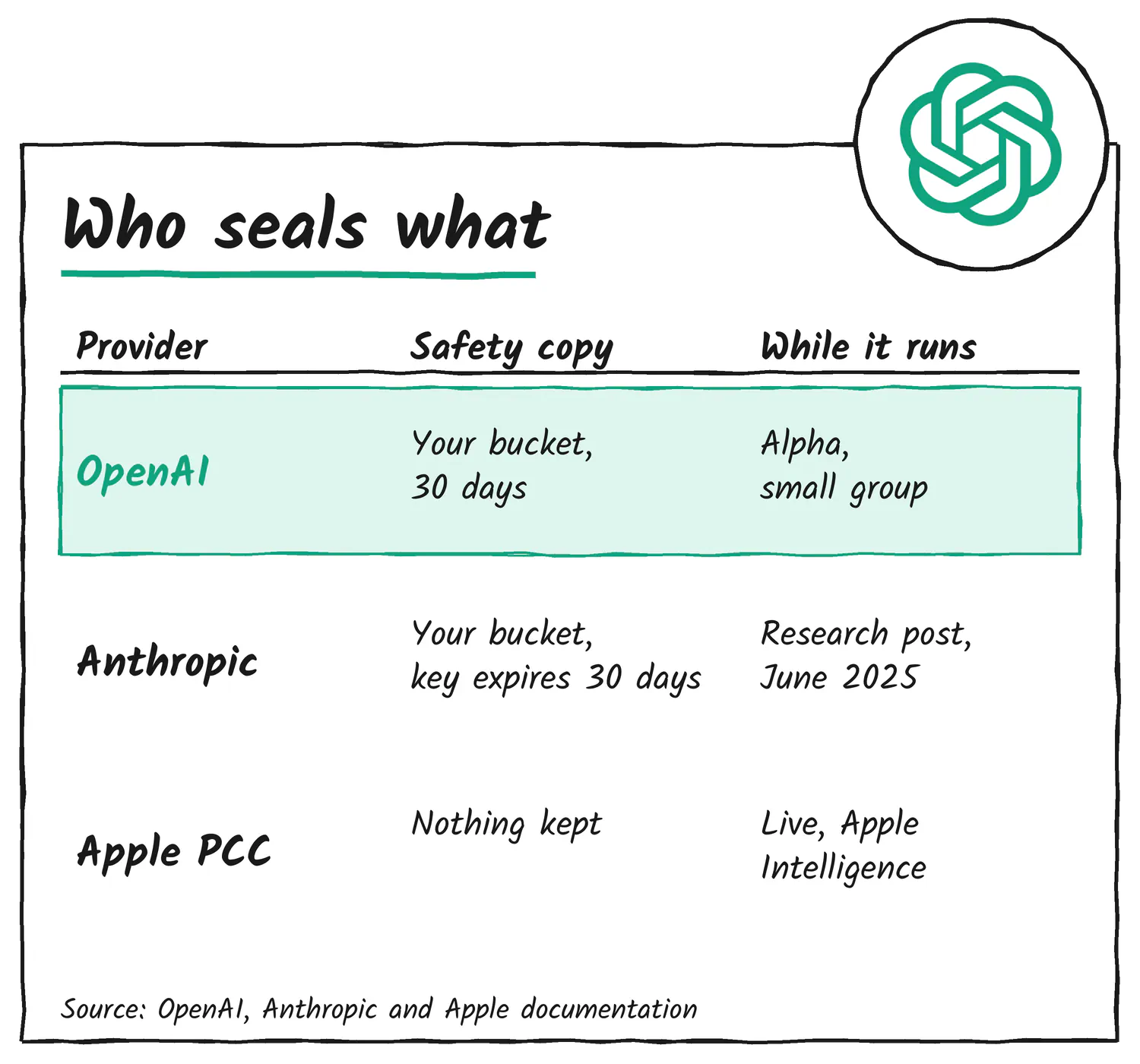
Those mechanics are not independently verified by the other opened sources. They should be understood as Sulat’s account of Private Safety Processing, not as confirmed architecture for Private Inference.
The distinction also clarifies why broad claims about “no storage” can mislead. OpenAI’s general description of Zero Data Retention concerns prompts and responses after processing, while Sulat describes a separate encrypted record path for safety processing. Enterprises evaluating that combination should ask OpenAI how the workflow-specific retention terms, customer-controlled storage and deletion rules fit together.
Zeniteq’s prior coverage of OpenAI bringing safety review to Zero Data Retention explains the background to that separate capability. Its inclusion alongside Private Inference does not establish that every alpha request uses the same safety-processing configuration.
How Enterprises Can Request Private Inference Access
OpenAI Private Inference’s Alpha API Preview has a public expression-of-interest route: Altman directed interested organizations to contact @shekar4x on X.
That invitation is not a promise of acceptance or a published onboarding process. Organizations can use it to begin a discussion, then ask for the technical and commercial terms needed to assess a pilot.
A focused request should describe the workload and seek answers in four areas:
- Coverage: Which models, API features and deployment regions support Private Inference?
- Verification: What evidence can the customer inspect, and how are attestation failures handled?
- Data handling: Which processing stages are protected, and how do retention, safety review and application logging interact?
- Operating terms: What pricing, latency expectations, support arrangements and alpha restrictions apply?
These questions follow directly from the gap between the documented promise and the undisclosed implementation. A model-processing protection could be valuable for sensitive business information, but its usefulness depends on whether the supported configuration matches the application.
Security and procurement teams should also keep compliance claims scoped to the specific service. OpenAI’s Private Intelligence page lists broader assurance offerings, including audits, certifications and support for eligible regulated services. That page alone is not evidence that every listed assurance applies to the Private Inference alpha.
For now, the actionable change is access to an evaluation conversation. Enterprises can request a place in testing while keeping production commitments conditional on documented coverage, verification and operating terms.
Frequently Asked Questions
3 questions
1Is OpenAI Private Inference Generally Available?
No. OpenAI labels Private Inference Alpha and API Preview, and Sam Altman says it is being tested with a small group of customers. The official Private Intelligence page does not provide a general-availability date, and the announcement does not identify the participating organizations.
2How Can an Organization Request Access?
Interested organizations can contact @shekar4x on X, the contact named in Altman’s November 25 announcement. The invitation provides a way to express interest, but it does not guarantee access. The public announcement supplies no eligibility criteria, onboarding timetable or pricing for the alpha.
3How Is Private Inference Different From Zero Data Retention?
Private Inference is designed to protect prompts and responses while the model processes them. Zero Data Retention means OpenAI does not retain prompts or model responses after processing for eligible API workflows. OpenAI’s product descriptions distinguish these two stages, so enterprises should evaluate processing-time protection and retention requirements separately.
Sources (4)
- 01x.comNovember 25, 2026 announcement (opens in a new tab)
- 02openai.comPrivate Intelligence page labels Private Inference “Alpha” and “API Preview” (opens in a new tab)
- 03openai.comDevDay 2026 recap described Private Inference as coming in the fall (opens in a new tab)
- 04news.sulat.comSulat’s explanation of confidential computing (opens in a new tab)


