
The FBI issued a FLASH advisory on November 13, 2026, warning that attackers have weaponized ARTEX, an AI-powered penetration-testing framework, to automate intrusions worldwide. Some attacks progressed “from initial targeting to privileged access in under three hours,” according to BleepingComputer’s account of the advisory.
The warning covers financial services, government, technology, defense, healthcare and other sectors. The FBI says multiple threat actors have abused the framework since at least August 2026. November 15 and November 16 news coverage followed the advisory; those publication dates should not replace its original November 13 date.
For defenders, the consequential detail is the short interval between selecting a target and obtaining elevated permissions. Automated attacks can generate conspicuous traffic while still moving faster than an organization’s investigation process.
The incident totals also need careful handling. More than 2,250 downstream Microsoft 365 tenants were associated with attempted authentication in the ConnectWise campaign. That is not a count of 2,250 confirmed data breaches.
How ARTEX Compresses an Intrusion
ARTEX is a penetration-testing framework written in Go that connects to external large language models. According to BleepingComputer’s reporting, supported models include Anthropic Claude, OpenAI GPT and DeepSeek. Attackers supply objectives, which the framework turns into tasks and commands for specialized agents.
The framework can automate several stages of an intrusion:
- Reconnaissance: examining internet-facing systems and identifying potential entry points.
- Vulnerability discovery and exploitation: finding weaknesses and attempting to use them.
- Privilege escalation: seeking permissions beyond the initial foothold.
- Data access and exfiltration: locating information and moving it out of the environment.
These are familiar attack stages. The change is how quickly software can connect them, repeat them and pursue multiple targets simultaneously.
Microsoft’s October 21 investigation describes agents operating continuously and attempting multiple breach paths in parallel. In the campaign it investigated, ARTEX accelerated reconnaissance, password spraying and abuse of cloud applications.
Password spraying means trying a small set of likely passwords across many accounts. Cloud application abuse follows a different path: attackers use an application identity and its existing permissions to reach resources. Both can benefit from automation without requiring the discovery of a previously unknown vulnerability.
The three-hour figure describes observed cases, not a universal performance guarantee. It measures the interval from initial targeting to privileged access in some intrusions, not the time required for every attack or a promise that data theft was completed within that window. The published accounts do not provide a controlled benchmark against human operators.
My reading is that the operational concern is the removal of pauses between steps. A weakness that once left defenders time to investigate may now feed directly into the next automated action.
Who Is Most Exposed
The FBI highlights overlooked systems, including partner portals, employee applications, legacy services and third-party integrations, according to BleepingComputer.
That makes this broader than a warning for organizations developing AI. A company can be exposed through an old public-facing application, weak credentials or permissions granted to a supplier’s cloud integration.
Three categories deserve particular attention:
- Internet-facing services with weak authentication or unresolved vulnerabilities.
- Cloud applications with broad permissions or unexpected credential changes.
- Third-party integrations whose credentials remain valid after the relationship ends.
The third category matters because terminating a contract does not automatically terminate technical access. Credentials and application permissions have to be removed separately.
Removing ARTEX’s original repository has not eliminated the threat. BleepingComputer reports that the developer took it down on October 8, but the FBI says forks, archived copies, localized versions and a commercial edition remain available. Repository removal cannot recall copies already distributed.
ConnectWise: 2,250 Tenants Is Not 2,250 Breaches
Microsoft attributed the ConnectWise supply-chain campaign to Storm-0940, a China-state-aligned threat actor. Its October 21 report says the actor used ARTEX to accelerate scanning, reconnaissance, password spraying and OAuth application abuse.
In this case, compromised application identities provided a route into downstream Microsoft 365 environments. Those applications already held customer-granted permissions, allowing attackers to authenticate without an interactive user sign-in.
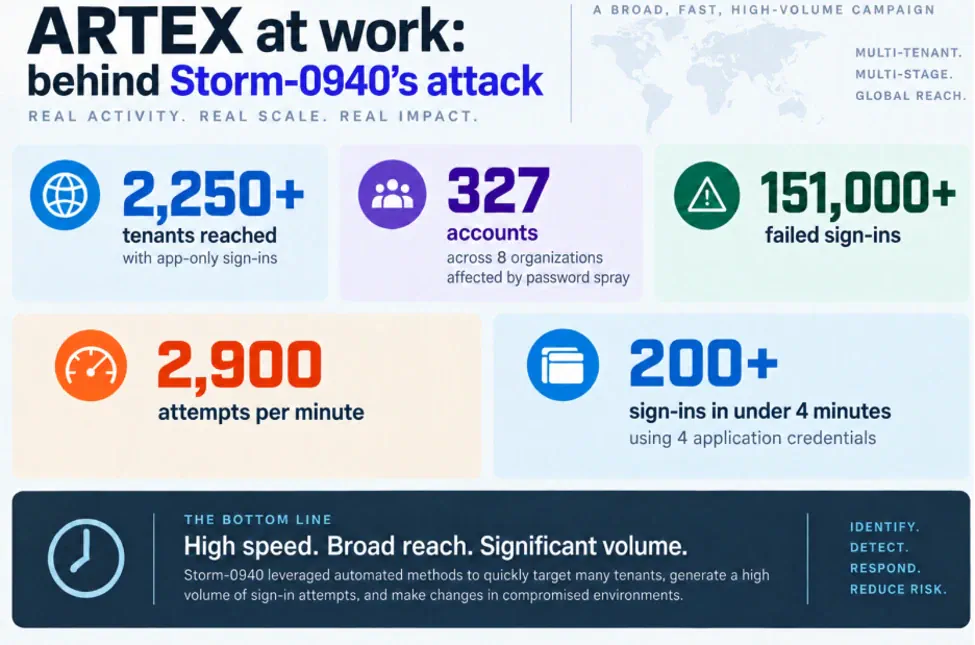
An application identity, also called a service principal in this context, represents software accessing cloud resources. Its activity can therefore appear in different logs from an employee’s ordinary sign-ins. Reviewing only human account logins would leave part of this attack path unexamined.
The reporting uses different language for the campaign’s scale. BleepingComputer says attackers attempted authentication against more than 2,250 downstream tenants. TechCrunch’s November 16 account describes access to at least 2,250 customer environments.
Microsoft’s first-party investigation supplies the essential qualification:
“the presence of an affected application or successful threat actor authentication does not necessarily indicate that customer data was accessed or exfiltrated.”
Those distinctions produce a more useful way to interpret the evidence:
| Observed stage | What it tells defenders | What still needs investigation |
|---|---|---|
| Affected application present | A potentially exposed integration exists | Whether an attacker used it |
| Authentication attempted | An attacker tried to access the tenant | Whether authentication succeeded |
| Authentication succeeded | The attacker authenticated through an identity | Which resources or data were accessed |
| Credential or privilege changes | Follow-on activity may enable persistence or expanded access | Whether changes succeeded and what they enabled |
| Data access or exfiltration confirmed | Investigators have evidence of data impact | The scope and sensitivity of affected information |
The defensible description is more than 2,250 tenants targeted through authentication attempts, with confirmed follow-on activity in multiple environments. The published evidence does not support labeling every tenant a confirmed data breach.
Microsoft observed reconnaissance through Microsoft Graph, application credential changes and attempts to modify privileges. Graph is an API surface for Microsoft cloud resources, making its activity relevant to reconstructing what an application identity did after authentication.
Microsoft also says this campaign did not result from a compromise of, or vulnerability in, its corporate systems, products or services. The documented route involved abuse of compromised application identities and previously granted access.
South Korea and Barracuda Show Other Exposure Paths
The FBI advisory also references attacks on South Korean financial institutions involving personal information belonging to approximately 67,000 people, BleepingComputer reports. That is the FBI-attributed figure, not an independently verified victim count.
A separate incident described by TechCrunch illustrates the danger of stale supplier access. In an ARTEX-linked attack against Barracuda, criminals reportedly found an exposed credential for a third-party service that had not been revoked after the vendor relationship ended.
Frequently Asked Questions
3 questions
1When Did the FBI Issue the ARTEX Warning?
The FLASH advisory is dated November 13, 2026. Later news reports appeared on November 15 and November 16.


