On November 16, 2026, the US Commerce Department's Bureau of Industry and Security (BIS) released an AI chip remote access rule that requires a license before advanced US chips go to any data center, anywhere, that rents more than 12 million TPP of compute to companies headquartered in China, Macau or other Country Group D:5 destinations. That threshold is roughly 758 Nvidia H100s.
The same interim final rule adds a license requirement for advanced chips shipped to Indonesia, Malaysia, Singapore, Thailand and Brazil, tightens rules for chip foundries and packagers, and formally scraps the never-enforced AI Diffusion Rule.
This piece explains how the control works, does the arithmetic on the threshold, lays out who's exempt and who's exposed, and flags the parts of the text that don't yet add up.
Key takeaways
- 12 million aggregate TPP is the trigger: any data center, at one site or across linked sites, that gives China- or Macau-parented companies more compute than that needs a license for the US chips inside it.
- Five countries now need a license for advanced chips: Indonesia, Malaysia, Singapore, Thailand and Brazil. US-parented buyers are excluded only if the exporter files monthly reports.
- Existing data centers already serving D:5-parented customers have 90 days from the effective date to get a license, so the installed base is covered, not just new shipments.
- Commercial recommender systems are carved out, but anything that generates text, images, code or other content does not qualify, even if it also recommends.
- Proof falls on suppliers: a foreign data center that can't or won't show its customer due diligence is a red flag that presumptively gives the exporter "knowledge" of a violation.
- The clock hasn't started: the rule takes effect on Federal Register publication, which was still a placeholder in the text BIS posted, and comments run 60 days after that.
What does the AI chip remote access rule actually do?
The rule controls cloud access indirectly, by attaching conditions to the chips. BIS can't license a login, so it licenses the shipment of hardware to any data center it knows will serve restricted companies at scale.
According to the BIS press release dated November 16, 2026, the interim final rule was "written by and at the direction of the Department of Treasury and the National Security Council." Its stated goal is that existing chip restrictions can't be sidestepped through data centers in third countries.
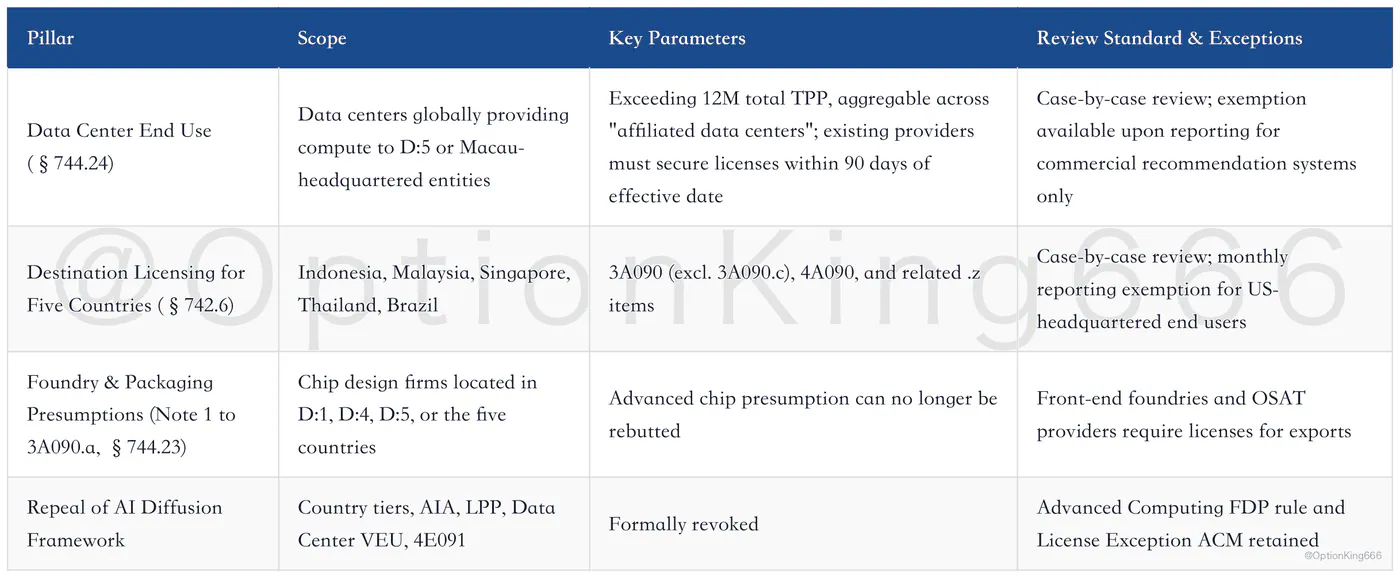
The rule text, RIN 0694-AK50, "Addressing Remote Access to Advanced Semiconductors" runs to 132 pages and has four parts:
| Part | Where in the EAR | What it does |
|---|---|---|
| Data center end-use control | New § 744.24 | License needed if chips go to a data center serving more than 12M aggregate TPP to D:5- or Macau-parented firms |
| Five-country license | § 742.6(a)(6)(iii)(A)(1) | License needed for advanced chips to Indonesia, Malaysia, Singapore, Thailand, Brazil |
| Foundry and packager presumptions | Note 1 to 3A090.a, § 744.23 | Fewer ways for chip designers in licensed destinations to escape the "advanced chip" presumption |
| AI Diffusion Rule rescission | Parts 740, 748, 774 | Removes country tiers, License Exception AIA, Data Center VEU and the model-weights control (ECCN 4E091) |
One oddity in the text is worth knowing before you search for it. The rule uses "Super Intelligence" or SI wherever older rules said "artificial intelligence," citing Executive Order 14434. An "advanced SI chip" in this rule is what earlier rules called an advanced AI chip.
Which chips are covered?
The data center control covers items in ECCNs 3A090 (except 3A090.c), 4A090 and the related .z entries, plus their software and technology. In plain terms, that's advanced AI accelerators and the servers built around them.
An analysis by 456X Semi-AI notes that this scope reaches the H100 and H200 generations, not only Blackwell and newer chips as earlier press leaks had suggested.
How does the 12 million TPP threshold work?
The license is triggered when a data center "is providing or will provide" access to more than 12,000,000 aggregate TPP to or for D:5- or Macau-parented companies. That count can be met at one site or across linked data centers.
TPP (total processing performance) is the export-control measure of a chip's raw compute: roughly its peak operations per second multiplied by the bit length of the operation. The rule defines aggregate TPP as the sum of TPP across all covered chips or systems in a group.
What does 12 million TPP buy?
Not much, by 2026 standards. BERI's analysis of the rule uses TPP values derived from Nvidia datasheets to convert the threshold into GPU counts, and those numbers check out:
| Chip | Approx. TPP per chip | Chips to reach 12M TPP |
|---|---|---|
| Nvidia H100 SXM / H200 | 15,832 | about 758 |
| Nvidia B200 | about 36,000 | about 333 |
| Nvidia B300 | about 54,000 | about 222 |
The H100 figure is consistent with BIS's own past math. 456X points out that the now-revoked LPP license exception equated 26.9 million TPP with 1,699 H100 equivalents, which works out to about 15,830 TPP per chip.
A few hundred GPUs is a mid-sized training cluster.
That's small enough to catch a single tenant's dedicated pod at a regional cloud provider, and far below the scale of a typical long-term neocloud contract, which 456X puts at 50 to 100 MW citing SemiAnalysis.
Why "linked data centers" matters
You can't dodge the count by splitting a cluster across buildings. The rule defines linked data centers as facilities whose networking lets them "share resources, balance workloads, and replicate data as a unified whole," and it says this includes digitally linked infrastructure, not only physical links.
The threshold is also aggregate across all restricted customers. A provider with several modest China-parented tenants can cross 12 million TPP without any single one of them being large.
Who counts as a restricted customer?
The control applies to compute provided "to or for" companies headquartered in Macau or a Country Group D:5 destination, or whose ultimate parent is headquartered there. Country Group D:5 is the US list of arms-embargoed destinations, and it includes China.
"For" is doing a lot of work. The rule says the term also covers a data center giving remote access to a non-D:5 customer that is training models for, participating in training for, or supplying models to a D:5 company. So a joint venture or model partner can pull an otherwise unrestricted customer into scope.
BIS also restates a standard from its 2023 rules. A restricted company that's the "exclusive or primary (greater than 50 percent of total compute) remote end user" of a data center's capacity is treated as the party the export is for.
The diligence burden is explicit. The rule says data centers must check direct and indirect ownership so that companies "cannot circumvent new controls through corporate restructurings or spinoffs."
How does the knowledge standard shift diligence onto data centers?
The control turns on "knowledge", the Export Administration Regulations' term for knowing or having reason to know a fact. An exporter only needs a license if it knows the chips are headed for a prohibited use, so the rule spells out what counts as knowing.
Note 3 to § 744.24(a)(1) of the interim final rule sets out the expectation on suppliers in these words:
A foreign data center declining or being unable to provide information sufficient to verify compliance with this end use control shall be considered a red flag that presumptively provides you with "knowledge" unless you are able to resolve that red flag before proceeding with the transaction.
That sentence is the mechanism.
Chip vendors and server makers will ask data centers for their know-your-customer records, and data centers will ask their tenants for ownership details. BERI expects ownership attestations, use attestations and change-of-use notice clauses to show up in neocloud and colocation contracts as a result.
The rule also closes three other gaps:
- Later changes in use. New § 744.24(e) treats a switch from a permitted use to a prohibited one as an in-country transfer that needs BIS authorization, and exporters shipping without a license must tell recipients so.
- Second-hand possession. The prohibition applies whether or not the current holder was a party to the original shipment.
- De minimis. Folding US chips into foreign-made servers doesn't take them outside the control when anyone in the chain knows about the prohibited use.
Which countries need a license, and who is exempt?
Exports, reexports and in-country transfers of advanced chips to or within Indonesia, Malaysia, Singapore, Thailand and Brazil now need a license. The rule describes them as presenting "a higher-than-normal risk of diversion," and it lets the Commerce Secretary add countries after consulting the Secretary of State or the National Security Advisor.
Applications are reviewed case by case. One factor is how well each country enforces export controls and cooperates with BIS.
The US-parent exclusion
Shipments to an end user headquartered in the US, or whose ultimate parent is, don't need the five-country license. The catch is reporting under new § 743.10, and each report must include:
- Name, addresses and phone number of every party, plus the ultimate parent of the consignee and end user.
- The ultimate destination and any end users that aren't the consignee.
- Each product's ECCN, product name, SKU, TPP and quantity.
- The date of each export, reexport or transfer.
Reports are due by the first business day of the month after the transaction, filed through a BIS web portal.
There's no matching exclusion for companies headquartered in Europe, Japan or India. As BERI notes, chips going into their capacity in those five countries move under a license.
The recommender carve-out
Compute used only for a commercial recommender system is exempt from the data center control. The rule defines that as a tool "exclusively designed and exclusively used to rank, filter, or suggest" products, services or content, and it excludes any system that generates text, images, audio, video or software, "regardless of whether the system also performs recommendation functions."
In practice, e-commerce and short-video ranking can keep running abroad. Large language model training and inference can't use this exemption.
How did remote access become the loophole?
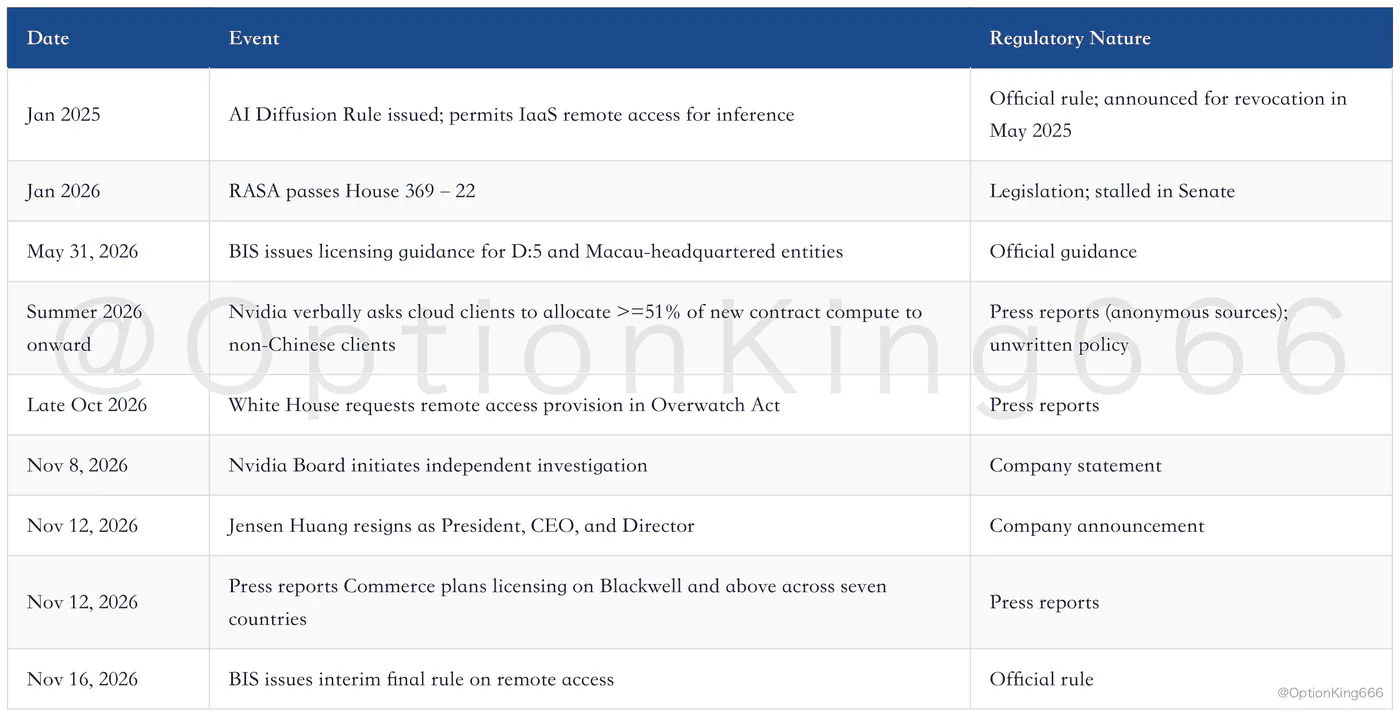
Remote access was left open on purpose, then grew into a major channel. The AI Diffusion Rule of January 2025 permitted cloud access for inference, and when BIS dropped that rule in May 2025, remote access had no systematic control at all.
The gap had numbers attached. 456X cites an Institute for Progress estimate from October 2026 that by the end of 2027 nearly a third of China's effective AI compute would come from remote access to US chips.
Congress moved first but stalled. The Remote Access Security Act, which would treat remote GPU use as an export, passed the House 369 to 22 in January 2026 and hasn't cleared the Senate, according to BERI.
| Date | Event | Type |
|---|---|---|
| January 2025 | AI Diffusion Rule issued, allowing cloud access for inference | Rule |
| May 2025 | BIS announces it will rescind the AI Diffusion Rule | Agency statement |
| January 2026 |
Frequently Asked Questions
6 questions
1What is the US AI chip remote access rule?
The US AI chip remote access rule is an interim final rule BIS released on November 16, 2026. It requires a license to send advanced US AI chips to any data center worldwide that gives companies headquartered or ultimately parented in China, Macau or other D:5 countries more than 12 million aggregate TPP of compute. It also requires licenses for advanced chips to Indonesia, Malaysia, Singapore, Thailand and Brazil, and formally rescinds the AI Diffusion Rule.