
Google DeepMind announced AlphaGenome 2 on November 11, 2026, introducing a DNA-sequence AI model that predicts how genetic variants affect particular tissues, cell types and cell states. Researchers can access it through the AlphaGenome API for non-commercial research. Commercial research access is a separate private preview through Google Cloud.
The central change is biological specificity. A variant might alter gene activity in one immune-cell population while having little effect elsewhere. AlphaGenome 2 lets researchers specify that population, or supply single-cell data describing a newly profiled state, instead of relying on predictions across broad tissue categories.
DeepMind says the model was trained using more than 107 million individual cell profiles, alongside bulk data from human and mouse samples across 68 tissues. Its announcement reports substantially improved variant detection. For researchers, the more consequential feature may be the ability to ask where a predicted effect occurs.
From Tissue Averages to Specific Cell States
AlphaGenome 1 took a roughly million-letter DNA sequence and produced fixed, parallel predictions across many tissues and experimental measurements. That approach provided broad coverage, but bulk tissue measurements combine signals from different cell populations.
A variant acting in a relatively small population can be difficult to interpret through that average. Even closely related cells can read the same DNA differently, depending on their regulatory machinery and current biological state.
AlphaGenome 2 changes the input structure. It takes both a DNA sequence and a biological condition, defined as a tissue, cell type or cell state. DeepMind says that condition enters every stage of the model’s architecture, directing predictions toward one biological context at a time.
The model retains readouts such as gene expression, histone modifications and chromatin accessibility, while adding DNA methylation predictions. These describe different aspects of gene regulation: expression measures gene activity, accessibility concerns whether regulatory machinery can reach DNA, and methylation records chemical modifications to DNA. DeepMind’s announcement describes the architectural change and supported readouts.
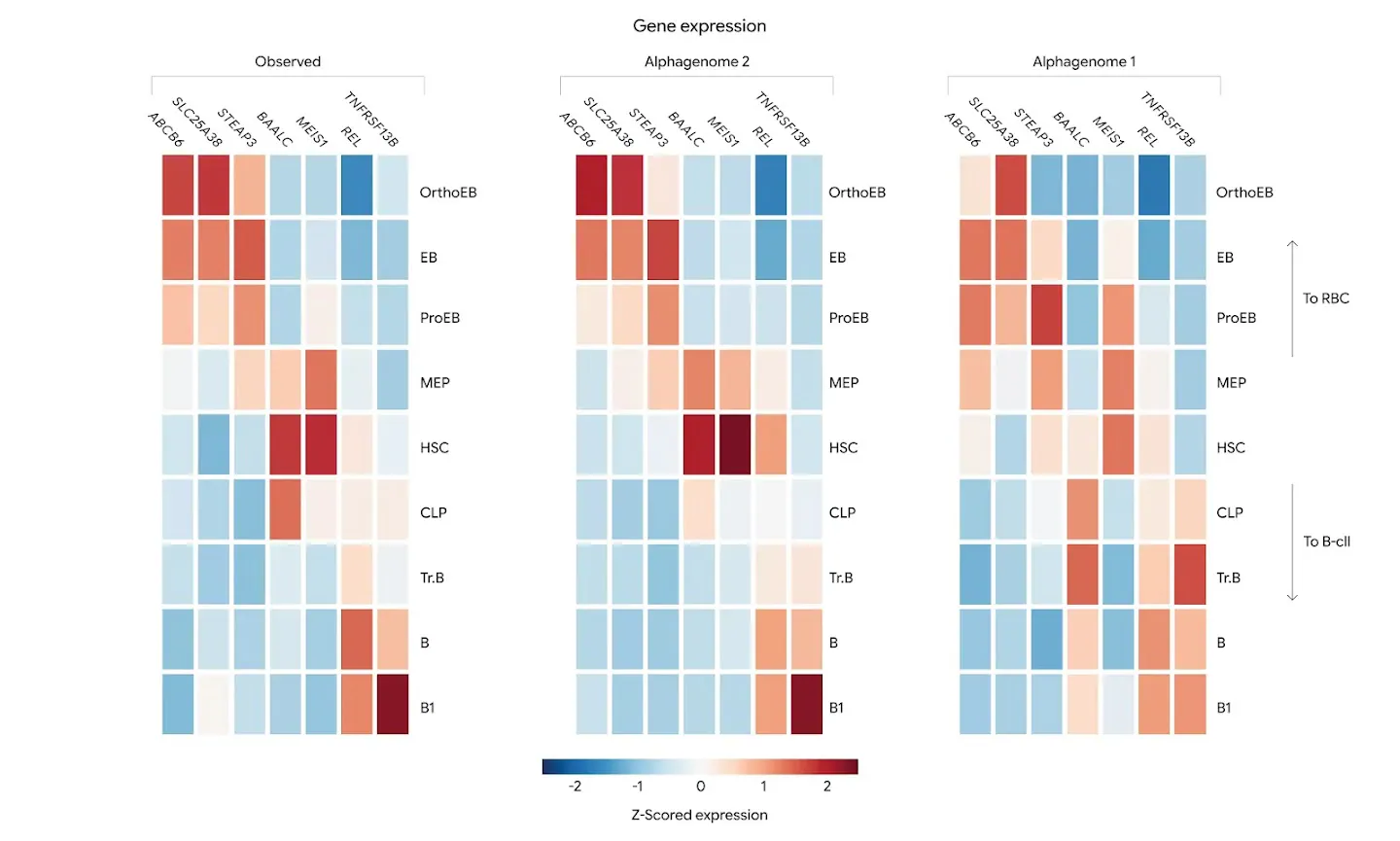
My view is that this makes the model more useful for choosing experiments. A predicted regulatory effect becomes more actionable when it points to a particular cell population. It can help researchers decide which cells to investigate, alongside which variant and gene deserve attention.
How Researchers Can Use the API Now
The AlphaGenome documentation recommends AlphaGenome 2, available through alphagenome.models.v2, for new analyses. Researchers have two main ways to specify the biological context.
Start With a Reference Condition
The simplest route is a predefined condition selected through condition=. The supported_conditions method lists available tissues, primary cell types and cell lines.
That method lists human conditions by default. Mouse conditions require the mouse organism setting. Individual methods such as predict_interval, predict_variant and score_variant take one condition per call.
For a comparison across conditions, the documentation provides batch methods, including predict_variants and score_variants, with matching condition inputs.
A useful analysis would keep the DNA region and variant fixed while changing the requested condition. Researchers could then compare the predicted reference-to-alternate effect across several relevant cell types.
That is an important distinction: a cell with high baseline expression of a gene is not necessarily the cell in which a variant has its strongest predicted effect. Comparing the variant-induced change helps separate those questions. This is a practical implication of the conditional interface, not a reported experimental result.
Supply a Newly Profiled Cell State
Expression conditioning lets researchers provide their own human single-cell RNA-sequencing data through cell_conditioning= and cell_condition_name=. The model encodes up to 256 cells to define a state, without explicit fine-tuning on that dataset.
This offers a route to studying conditions missing from a reference catalog, such as a newly profiled disease-associated cell state. The supplied cells describe the context in which the model should predict DNA effects; researchers are not training a fresh model for each experiment.
The documentation warns that substantially different data may contain variation the model fails to capture. I would treat a recognizable reference condition as the starting point when one fits the experiment, then use expression conditioning when the custom state is central to the biological question. That follows the documentation’s own reference-first guidance.
Choose the Sequence Window Carefully
AlphaGenome 2 accepts four input widths. The API names are convenient labels, but their exact lengths are worth checking:
| API sequence-length setting | Exact length |
|---|---|
SEQUENCE_LENGTH_16KB | 16,384 base pairs |
SEQUENCE_LENGTH_100KB | 131,072 base pairs |
SEQUENCE_LENGTH_500KB | 524,288 base pairs |
SEQUENCE_LENGTH_1MB | 1,048,576 base pairs |
The documentation recommends the largest window for best accuracy. Calling resize expands or crops an interval around its center using actual flanking reference-genome sequence, without zero-padding. Gradient-prediction methods accept only the 100KB and 1MB settings.
These details matter when comparing analyses: changing the sequence window changes the surrounding DNA available to the model. A fair comparison across cell conditions should keep that context consistent. The API FAQ documents the supported widths and resizing behavior.
Imputed Predictions Need Their Own Evidence Labels
AlphaGenome 2 also supports cross-modality imputation. Given a measurement such as single-cell gene activity, it can predict another property, such as chromatin accessibility, that was not measured for that condition.
That creates useful experimental leads, but it also creates an interpretation problem: two predicted tracks can look equally concrete while having different levels of supporting evidence.
The API addresses this through an imputation_mode field in each track’s metadata:
| Label | Meaning in the documentation |
|---|---|
observed | The measurement was available in training for that condition. |
imputed_supported | The measurement was absent, but can be imputed from a measured modality in that condition. |
imputed_exploratory | The imputation is not benchmarked and should be treated as a hypothesis. |
Frequently Asked Questions
3 questions
1Which Reference Genomes Does AlphaGenome 2 Support?
The API supports human hg38 and mouse mm10. Interval uses zero-based, half-open coordinates; Variant accepts a one-based position. Mixing these conventions can shift the analyzed location. These conventions are documented in the API FAQ.


