NVIDIA Unveils Rubin HPC GPU and Vera CPU Racks | Zeniteq
Loading
Zeniteq is now available on mobile for iPhone, iPad and Apple Watch.Download nowLearn more
NVIDIA Unveils Rubin HPC GPU and Vera CPU Racks
Vera CPU racks are expected in early 2027, while the simulation-focused Rubin HPC GPU is scheduled for 2028, giving NVIDIA’s scientific-computing push two distinct launch windows.
NVIDIA is expanding its scientific computing portfolio with the Vera CPU rack platform and Rubin HPC GPU, targeting distinct computational bottlenecks. Vera racks, launching in 2027, feature 192 custom Olympus CPUs with 16,896 total cores and massive memory bandwidth, designed to accelerate legacy CPU-based simulations. Meanwhile, the 2028 Rubin HPC GPU focuses on irregular, sparse-data workloads common in engineering and analytics. By addressing both memory-intensive CPU tasks and GPU-accelerated simulation, NVIDIA aims to shorten the feedback loops in agentic research workflows, though prospective buyers must await independent benchmarks to validate these performance projections.
NVIDIA announced two additions to its scientific-computing lineup at SC26 on November 16, 2026: a Vera CPU rack-scale platform for memory-intensive workloads and Rubin HPC, a GPU designed for simulation and data processing.
The products address related workloads but have separate delivery schedules. Dell Technologies, HPE, Lenovo and Supermicro are expected to offer Vera CPU racks beginning in early 2027. Rubin HPC is expected in 2028.
Together, the announcements extend NVIDIA’s platform ambitions beyond mainstream AI training and inference into the calculations that scientific AI agents invoke to evaluate ideas. The useful distinction is architectural: Vera targets CPU-based scientific applications, while Rubin HPC targets GPU-accelerated simulation and analytics. Neither announcement provides independent performance measurements. (Vera announcement, Rubin HPC announcement)
Vera CPU Racks Put Memory Movement at the Center
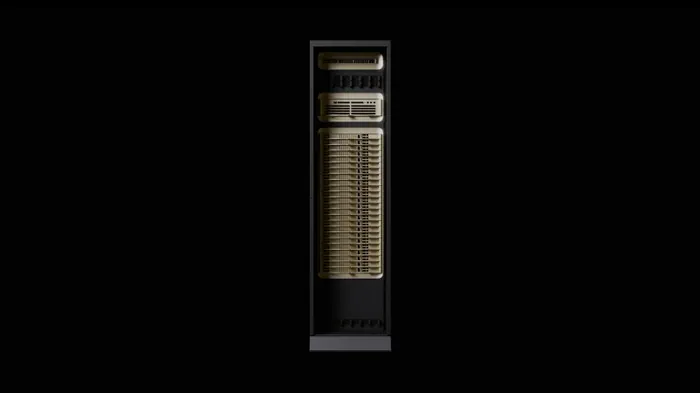
NVIDIA’s Vera rack combines 192 CPUs with Quantum-X800 InfiniBand networking, approximately 300TB of memory and 1 petabyte of storage. The fully liquid-cooled system uses NVIDIA’s MGX design and reuses NVL72 rack components, including chassis, power distribution and cooling infrastructure.
Each Vera processor has 88 custom Olympus cores, supports 176 threads and provides up to 1.2TB/s of memory bandwidth. NVIDIA describes Vera as its first fully custom data-center CPU.
Component
NVIDIA’s Announced Specification
Processors per rack
192 Vera CPUs
Cores and threads per CPU
88 Olympus cores, 176 threads
Memory technology
Serviceable SOCAMM2 LPDDR5X modules
Memory bandwidth per CPU
Up to 1.2TB/s
Aggregate rack memory bandwidth
More than 200TB/s peak
Total rack memory
Approximately 300TB
Storage
1PB
Networking
Quantum-X800 InfiniBand
Cooling
Fully liquid-cooled
Each 1U tray integrates eight Vera CPUs, NVMe storage and management hardware. Across 192 processors, the published core count works out to , calculated as 192 × 88. That describes the amount of processing hardware; it is not a prediction of application performance. ()
The bandwidth figures deserve similar care. Multiplying the advertised per-CPU maximum by 192 gives a theoretical sum of 230.4TB/s, consistent with NVIDIA’s stated aggregate peak of more than 200TB/s. That total represents bandwidth distributed across the processors. It should not be read as a promise that one application task can draw data from the entire rack at that rate.
This distinction matters for scientific software. A workload may move data quickly within each processor’s local memory and still spend substantial time exchanging information between processors. NVIDIA pairs Vera with InfiniBand and SHARP In-Network Computing, which it says reduces time spent coordinating calculations.
My view is that the memory and communication details are more useful starting points than the rack’s core count. For simulations that repeatedly stream large datasets or synchronize work across nodes, keeping processors supplied with data can matter as much as adding execution resources.
Rubin HPC is a new GPU within the Vera Rubin platform, designed specifically for simulation and data processing in science, engineering and analytics.
NVIDIA’s announcement identifies three principal features:
More than 50,000 CUDA cores on a single GPU.
Sparse-data acceleration intended to keep those cores supplied with data.
Seventh-generation NVLink for GPU-to-GPU connectivity.
The design rationale centers on a recurring scientific-computing pattern: an application retrieves scattered values from a large dataset, performs calculations and repeats the process at scale. NVIDIA lists sparse matrix operations, stencil computations, sorting and reductions among the patterns Rubin HPC is intended to accelerate. (NVIDIA’s Rubin HPC announcement)
A sparse matrix stores relatively few meaningful entries compared with its full dimensions. Processing it efficiently involves finding and moving those entries without spending excessive effort on empty positions. Stencil calculations, common in grid-based simulations, repeatedly update values using neighboring points. Both examples help explain why a larger arithmetic engine alone may leave performance bottlenecks untouched.
NVIDIA says Rubin HPC will scale data movement alongside computation. Seventh-generation NVLink addresses another part of that problem: communication between GPUs when work spans multiple devices.
The announcement does not disclose enough detail to quantify the improvement. It provides no Rubin HPC application benchmark, memory-bandwidth figure, power specification or floating-point throughput table. The CUDA core count therefore cannot support a numerical comparison with existing scientific GPUs.
I’d treat the sparse-data emphasis as the more consequential technical detail for now. It identifies the bottleneck NVIDIA is trying to address. The core count describes scale, but useful simulation speed will depend on how effectively the hardware moves data and how well the application maps to it.
NVIDIA’s Benchmarks Need Workload-Specific Reading
NVIDIA reports performance gains for Vera on two scientific applications, but the wording differs between them.
For OpenFOAM’s motorBike Large airflow simulation, NVIDIA says its tests delivered 1.9 times the performance and 2.4 times the performance per watt of x86 systems. For the Weather Research and Forecasting model, or WRF, it reports projected gains of 1.6 times the performance and twice the energy efficiency.
Workload
Performance Claim
Efficiency Claim
Evidence Described by NVIDIA
OpenFOAM motorBike Large
1.9× x86 performance
2.4× performance per watt
NVIDIA’s tests
Weather Research and Forecasting model
1.6× x86 performance
2× energy efficiency
Projected gains following NVIDIA benchmarking
These are vendor-reported tests and projections, not independent benchmarks. The newsroom summary does not identify the comparator CPU models or full system configurations. It links to a separate performance brief, but the announcement alone is insufficient for a like-for-like procurement comparison. (NVIDIA’s performance claims)
The distinction between the two rows matters. OpenFOAM’s figures are presented as test results; WRF’s gains are explicitly projected. Describing both as measured results would overstate the evidence.
The x86 comparison also needs a defined baseline before it can say much about competition. Processor generation, node count, memory configuration, compiler settings and workload size can all affect a simulation benchmark. A result against one x86 configuration is not a universal ranking of CPU architectures.
Performance per watt is a separate metric from absolute speed. NVIDIA’s 2.4× OpenFOAM efficiency claim does not mean the entire facility’s electricity bill falls by the same factor. Storage, networking, cooling, utilization and the amount of work completed all affect operating costs.
For a prospective buyer, the useful next comparison would use the same solver, dataset, numerical settings and scaling target across candidate systems. The published ratios are a reason to investigate Vera, not enough information to size a cluster or calculate its payback period.
DKRZ Provides an Adoption Signal, Not a Rubin Deployment
Germany’s climate-computing center DKRZ has selected Vera CPUs for its planned HLRE-5 supercomputer. NVIDIA says the Bull-built system is expected to be available in early 2028 and will support climate simulation and AI research.
Its disclosed configuration includes Vera CPUs, GB200 Grace Blackwell systems and Quantum-2 InfiniBand. That is important because it differs from both headline products: HLRE-5 is not described as a Rubin HPC deployment, and its listed network is not the Quantum-X800 used in the new Vera rack announcement. (NVIDIA’s DKRZ disclosure)
DKRZ’s selection is a concrete institutional commitment to Vera. It does not validate NVIDIA’s benchmark ratios or establish how the final supercomputer will perform.
The dates also describe different milestones. Partner availability for Vera racks begins in early 2027; DKRZ’s complete system is expected in early 2028; Rubin HPC has a separate 2028 availability window. Those schedules should remain separate in procurement and infrastructure planning.
What This Changes for Agentic Science
Scientific agents can propose candidate materials, molecules or designs, then invoke simulations to evaluate them. Results feed back into the next selection or refinement step. NVIDIA positions Rubin HPC as an accelerator for those simulations and points to CUDA-X libraries as optimized implementations of relevant algorithms. (NVIDIA’s explanation of the workflow)
The practical insight is that an AI-driven research workflow can become limited by its tools. Generating more candidate designs has limited value if evaluating each one takes too long. Faster simulation could let a team assess more candidates or obtain feedback sooner.
That does not translate directly into an equal acceleration in discovery. Physical experiments, data preparation, model accuracy and decisions about which hypotheses deserve attention remain separate constraints. Faster computation shortens one part of the process.
Vera addresses another important part of that workflow: existing CPU-based scientific applications. NVIDIA’s rack announcement explicitly targets unaccelerated workloads, including climate modeling and molecular dynamics. That gives the CPU platform a role even where software has not been moved to GPUs.
The two launches therefore suggest a broader strategy than supplying hardware for the AI model itself. NVIDIA is pursuing the simulation, memory movement and coordination work surrounding that model, including applications that remain CPU-heavy.
For research centers, I’d separate the immediate software assessment from the later hardware decision. Vera’s earlier schedule makes compiler compatibility, memory behavior and application scaling relevant planning tasks now. Rubin HPC remains a 2028 option whose fit will become clearer when NVIDIA publishes fuller specifications and application-level results.
Frequently Asked Questions
3 questions
1
When Will Vera CPU Racks and Rubin HPC Be Available?
Vera CPU racks are expected from Dell, HPE, Lenovo and Supermicro beginning in early 2027. Rubin HPC is expected in 2028. These are announced availability windows, not confirmation of current general availability.
2
What Software Support Has NVIDIA Announced for Vera?
NVIDIA says HPC SDK 26.11 is available with compilers and libraries optimized for Vera. It also announced a public beta of a next-generation Fortran compiler intended to support existing Fortran programs without requiring a rewrite. (NVIDIA’s software announcement)
3
Can Rubin HPC’s CUDA Core Count Predict Simulation Speed?
No. More than 50,000 CUDA cores describes one hardware resource. Simulation speed also depends on numerical precision, memory access, communication and software behavior. NVIDIA’s announcement does not provide application benchmarks that turn that core count into a measured speedup.