
NVIDIA introduced Nemotron for Science on November 16, 2026, pairing its existing Nemotron 3.5 Super VL model with a chemistry dataset, scientific evaluations and recipes for adapting the model to specialized research. The announcement centers on resources for building scientific agents, not a newly trained foundation model. NVIDIA’s announcement says the model and the nearly 50,000-question LitmusBench v0.2 dataset are available now on Hugging Face.
Nemotron 3.5 Super VL had already appeared in NVIDIA’s October 15 technical introduction. The science release adds a more concrete route from that general-purpose multimodal agent model to chemistry and life-science workflows.
The useful question for researchers is how much of the adaptation work NVIDIA has made reusable. The package supplies data, evaluation material and a training workflow, while its partner examples show specific applications that still need to be assessed on their own terms.
What Researchers Can Download Now
NVIDIA describes Nemotron for Science as a collection of models, datasets, tools and recipes. Its components serve different stages of a research project:
| Component | What it provides | Practical role |
|---|---|---|
| Nemotron 3.5 Super VL | The existing open multimodal model | A starting point for interpreting scientific text, images and documents, generating code and calling tools |
| LitmusBench v0.2 | Nearly 50,000 chemistry-reasoning questions | Material for evaluating capabilities and post-training models |
| Scientific evaluations | Published assessments across scientific tasks | Reference points for judging the base model |
| Post-training recipes | A workflow using experimental records, NeMo Gym and NeMo RL | Instructions for building a task-specific training environment |
The announcement identifies the model and dataset as available on Hugging Face. NVIDIA’s accompanying technical guide explains how to turn experimental data into a reinforcement-learning environment.
That combination is more useful to a research team than a benchmark chart alone. A score tells researchers where a model performed well; a dataset and a recipe give them something they can adapt to their own measurements.
Open availability still requires a licensing check. Teams planning commercial use or redistribution should inspect the actual model and dataset terms before incorporating them into a project.
LitmusBench Adds Chemistry Data, With a Version-Label Caveat
LitmusBench v0.2 draws on molecular properties and experimental drug-discovery data. NVIDIA describes questions involving properties such as solubility and how the human body processes molecules. The dataset supports both training and evaluation, giving teams a shared resource for measuring chemistry reasoning and adapting models to it. Source: NVIDIA
The documentation has a naming inconsistency worth catching before writing experiment configurations. The newsroom announcement calls the dataset LitmusBench v0.2, while the technical post calls its chemistry resource NVIDIA Nemotron Litmus-Bench V2.0. Those pages do not resolve the difference. Researchers should record the exact repository revision they use instead of assuming the labels are interchangeable.
The dataset’s dual purpose also creates an evaluation responsibility. I’d reserve untouched test data before adapting a model, then report performance on that held-out material separately. A model improving on questions used during training answers a different question from whether it can handle unfamiliar chemistry.
Nearly 50,000 questions provide a substantial starting point, but question count alone cannot establish coverage of a lab’s compounds, assays or operating conditions. The relevant check is whether the examples and targets resemble the decisions the eventual agent will make.
How the Post-Training Recipe Works
NVIDIA’s technical guide uses drug-metabolism prediction as its worked example. Given a parent compound and the enzyme transforming it, the model predicts the resulting metabolite. The example draws on MetxBioDB, which contains experimentally confirmed biotransformation reactions.
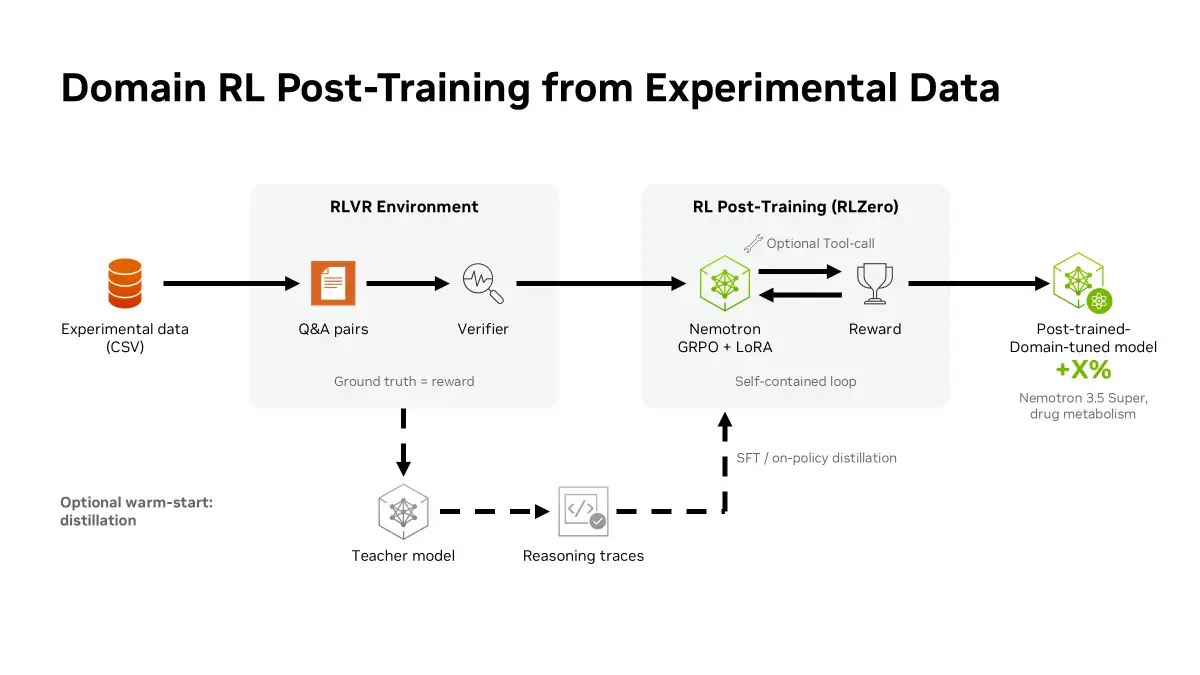
The workflow uses reinforcement learning with verifiable rewards, often shortened to RLVR. Instead of asking people to rank every model response, it derives a reward from experimental reference data.
From Experimental Records to a Reward
The documented recipe follows four main steps:
- Prepare experimental records. Start with a CSV containing inputs, relevant conditions and measured outcomes. Molecular structures can be represented as SMILES strings, a text notation describing atoms and bonds.
- Create model prompts. Convert records into question-answer or user-assistant pairs. For the metabolism task, the input includes the parent molecule and enzyme; the target is the experimentally observed metabolite.
- Build a scoring environment. NeMo Gym supplies the environment infrastructure. A verifier compares the model’s prediction with the reference outcome and returns a reward.
- Apply reinforcement learning. NeMo RL supplies the post-training framework, using those rewards to improve performance on the defined task.
For this example, the verifier compares molecular fingerprints, numerical representations of structural features, using Tanimoto similarity. For the binary fingerprints described in the guide, the score is the size of the intersection divided by the size of the union. It ranges from 0 to 1, with higher values indicating more similar fingerprints.
That detail matters because the scoring rule defines what the training process rewards. Fingerprint similarity measures structural resemblance. It cannot, by itself, tell a researcher that a predicted molecule will behave as intended in a biological experiment.
NVIDIA says the scoring layer can also incorporate cheminformatics libraries, simulators or a live autonomous laboratory. My view is that the verifier is the most consequential design choice in this recipe: a model can become better at satisfying a computational proxy without improving equally on the scientific outcome a team actually needs.
What NVIDIA Reports About Training Gains
The technical page’s automated summary reports a 12% accuracy improvement from supervised fine-tuning, followed by a further 17% improvement from reinforcement learning, at a 16,384-token output budget. These are NVIDIA’s reported figures; the summary provides no baseline or clear relative-versus-percentage-point interpretation, so they should not be added into a claimed 29-percentage-point gain. Source: NVIDIA technical guide
The output budget is an important condition. Allowing longer responses gives a reasoning model more generation capacity, but can also increase latency and inference work. Teams comparing recipes should keep that budget visible alongside accuracy.
The guide also describes optional distillation before RL: a stronger teacher model generates reasoning examples to warm-start the student. That introduces another practical tradeoff, since generating those examples becomes part of the adaptation process and its cost.
Partner Results Show Specific Uses, Not a General Ranking
NVIDIA’s announcement includes results from chemistry, materials research and molecular-simulation workflows. These are vendor-reported results from NVIDIA and named collaborators. The announcement cites no independent replication.
Frequently Asked Questions
3 questions
1Is Nemotron for Science a New Foundation Model?
No. It packages the existing Nemotron 3.5 Super VL model with scientific data, evaluations and post-training recipes.


