
Z.ai announced GLM-5.4 on November 23, 2026, introducing its first flagship model built on a Loop Transformer architecture. The company describes a 750-billion-parameter model adapted from GLM-5, with 28 shared layers run twice to increase computational depth without adding parameters.
GLM-5.4 is available in Z.ai Chat, Z.ai’s ZCode development environment, and every GLM Coding Plan tier. That product availability needs separating from infrastructure access: the pay-per-token API is still coming, and Z.ai plans to release weights only after additional safety hardening.
The architectural promise is deeper reasoning from reused weights. The practical tradeoff is that repeated computation still takes work, and Z.ai acknowledges that GLM-5.4 can spend too long reasoning. Its published performance figures remain vendor claims, without launch-day benchmark tables that would let developers make a controlled comparison.
How GLM-5.4’s Loop Transformer Works
GLM-5.4 increases effective computation by passing information through shared model layers more than once. Z.ai’s ZCode documentation describes the mechanism as a group of weight-sharing layers running in a loop, allowing deeper processing without increasing parameter count.
Z.ai’s launch description specifies a block of 28 shared layers evaluated twice. That amounts to 56 layer applications through that block, but it should not be read as the total depth of the whole model. The important distinction is between stored parameters and computation performed.
Parameters are the learned values that define a model’s transformations. Reusing a layer means applying those learned values again to an updated internal representation. Each pass can perform additional processing without requiring another separately trained copy of the layer.
That is a meaningful architectural choice, but it does not make deeper computation free. A second pass still requires execution. Keeping parameter count unchanged therefore does not, by itself, establish lower response latency or cheaper serving.
Z.ai claims GLM-5.4 reaches the intelligence level of models in the two-to-three-trillion-parameter class and benefits more as reasoning chains become longer. Its documentation also claims that the model thinks with fewer tokens. These are vendor comparisons, not independently established equivalences.
The distinction matters because parameter count is not a standardized performance score. Matching another model requires named tasks, comparable settings, and measured results. A claim about “2–3T-class” intelligence supplies none of those details on its own.
The useful architectural takeaway is narrower: GLM-5.4 tries to extract more reasoning from the same weights by spending additional computation inside the network. Whether that delivers better answers per second, per token, or per dollar needs separate evidence for each measure.
GLM-5.4 Access and Coding Plan Quotas
GLM-5.4 is available through Z.ai’s products and all GLM Coding Plan tiers, including the Start trial and legacy V1 plans. The ZCode FAQ confirms access across plans, while distinguishing eligibility from the new token allowance.
| Plan | GLM-5.4 access | Documented quota treatment |
|---|---|---|
| Lite, Pro, Max | Included | 1.5× as many usable tokens as GLM-5.3 on the same quota |
| Team | Included | Included in the 1.5× allowance |
| Start trial | Includes GLM-5.4 quota | Trial access confirmed; no separate multiplier specified |
| Legacy V1 | Included | Existing benefits unchanged; excluded from the 1.5× allowance |
The 1.5× figure describes how far the same plan quota goes when using GLM-5.4 compared with GLM-5.3. It is not a published API price cut, a speed guarantee, or evidence that completed tasks cost one-third less. A task that generates substantially more reasoning tokens could still consume more of a subscriber’s allowance.
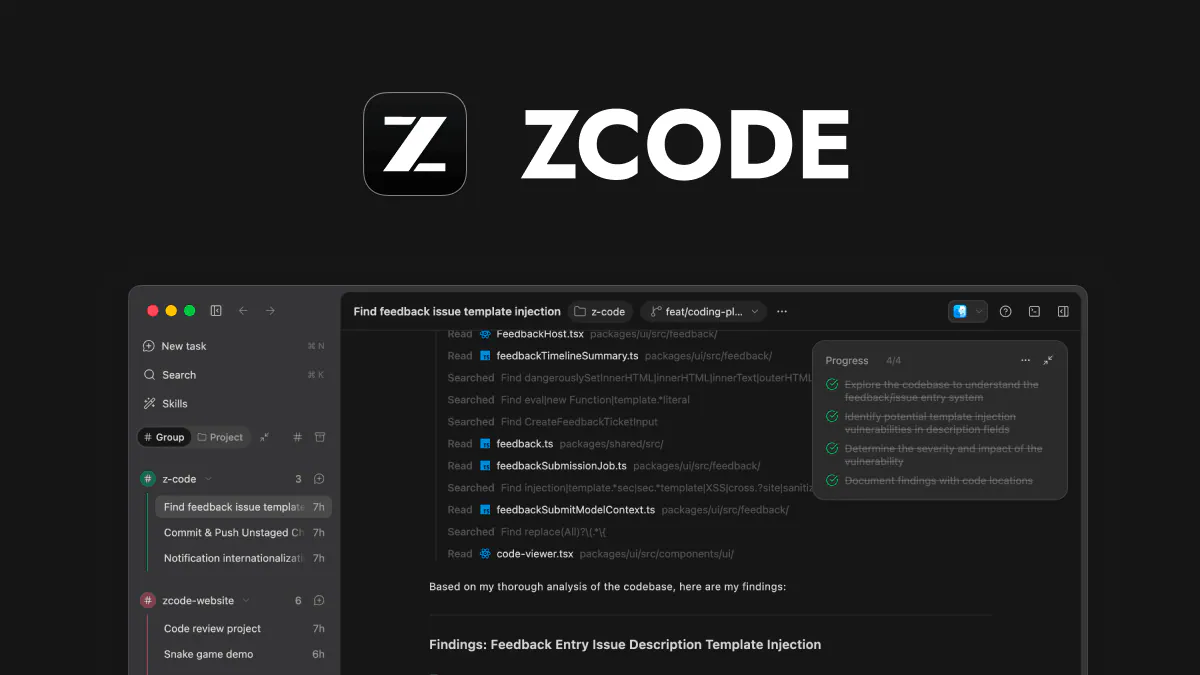
ZCode’s previous additional 1.5× promotion has ended. The application now receives the same quota as other coding tools that support the Coding Plan, so subscribers should not multiply the two allowances together.
Z.ai also says GLM-5.4 is available through other compatible coding tools. In those tools, the documented model identifier is glm-5.4; the FAQ specifies glm-5.4[1m] for Anthropic’s Claude Code.
These integrations should not be confused with a generally available pay-per-token endpoint. A subscription-backed coding integration and an API for arbitrary applications are different access arrangements, even when API keys appear in the sign-in process.
ZCode itself is free to install, but using model services still requires an appropriate plan, key, or supported service connection. Existing subscribers gain another model choice; a free desktop application does not make inference universally free.
ZCode Adds 1M Context and Thinking Controls
GLM-5.4 in ZCode supports a one-million-token context window, text, image, video and file inputs, and three reasoning-effort settings. The documented context and thinking controls include an important operational detail: automatic compaction begins near 966,000 tokens.
| ZCode capability | Documented behavior |
|---|---|
| Context window | 1 million tokens |
| Automatic compaction | Begins near 966,000 tokens |
| Inputs | Text, images, video and files |
| Thinking levels | Low, High and Max |
| Default thinking level | Max |
A context window is the amount of tokenized material a model can work with during an interaction. It is not a guarantee that every fact in a large repository will receive equal attention or remain available verbatim throughout a long task.
ZCode’s compaction threshold makes that distinction concrete. Developers should treat the one-million-token figure as a working capacity with context management, not permanent, lossless memory.
Z.ai positions ZCode as an Agentic Development Environment. Its workflow documentation describes keeping goals, files, terminal results, browser context and Git state together, so an agent can move between planning, implementation and verification within one task.
Goal mode, invoked with /goal, adds another iteration mechanism: the agent checks progress after each round and continues if the goal has not been met. That is separate from the model’s internal layer reuse. One loop is inside the neural network; the other is an application workflow that can involve further model calls, tools and verification.
The distinction helps explain why a long task can consume substantial time even when text generation is fast.
Managing Long Reasoning and Quota Use
GLM-5.4 defaults to Max thinking effort in ZCode. Z.ai’s FAQ explicitly addresses cases where the model thinks for a long time and uses quota quickly, recommending lower effort for simple questions and small, well-defined edits.
To change the setting:
- Click the model name at the bottom right of the composer.
- Adjust the Effort slider.
- Alternatively, press , or on macOS, to cycle through levels.
Frequently Asked Questions
3 questions
1Which Plans Include GLM-5.4?
GLM-5.4 is included in Lite, Pro, Max and Team Coding Plans, plus Start trial access and legacy V1 plans. The ZCode FAQ says current Coding Plan and Team users receive 1.5× as many usable tokens as with GLM-5.3 on the same quota. Legacy V1 plans retain existing benefits and are excluded from that multiplier.


