The Riemann Hypothesis remains one of mathematics' most famous unsolved problems. It deals with prime numbers, the numbers that can only be divided by 1 and themselves. Although prime numbers appear randomly distributed, they follow certain mathematical patterns.
The hypothesis predicts that all nontrivial zeros of the Riemann zeta function lie on a specific line. Proving it would help mathematicians better understand how prime numbers are distributed.
It was first proposed by German mathematician Bernhard Riemann in 1859, and nobody has been able to prove it since. Computers have checked trillions of these zeros and every single one sits on the line, but checking examples is not the same as proving it holds for all of them.
Here’s a visual explanation of what the hypothesis is about:
It is also one of the seven Millennium Prize Problems, which means there is a $1 million reward waiting for whoever solves it.
It has remained unsolved for 167 years
Last month, an American mathematician widely regarded as one of the greatest of his generation, predicted that the Riemann Hypothesis could be solved in 2050.
“So maybe some combination of humans and AIs in 2050 or something will make further progress. Who knows?”
In fact, it only took 35 days.
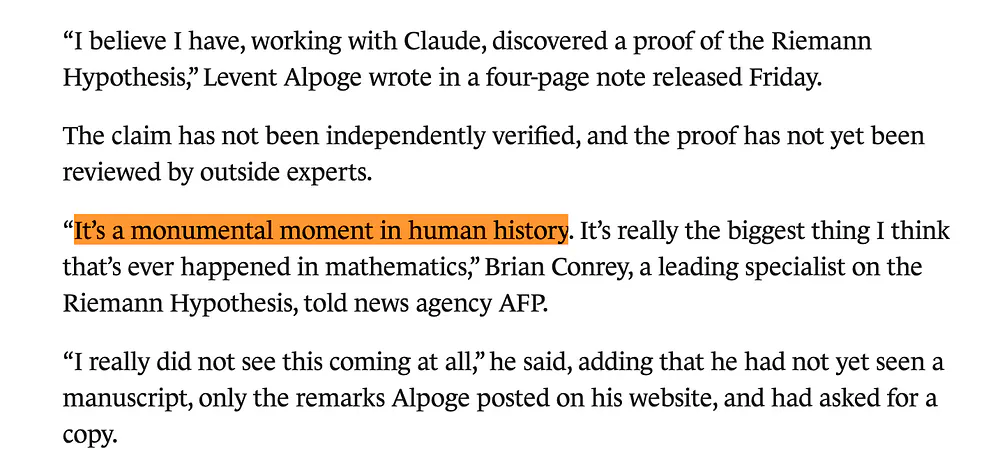
Yesterday, Anthropic mathematician Levent Alpöge said he has proven the hypothesis using Claude models. He uploaded a plaintive four-page paper to his personal website in which he wrote:
“I believe I have, working with Claude, discovered a proof of the Riemann Hypothesis.”
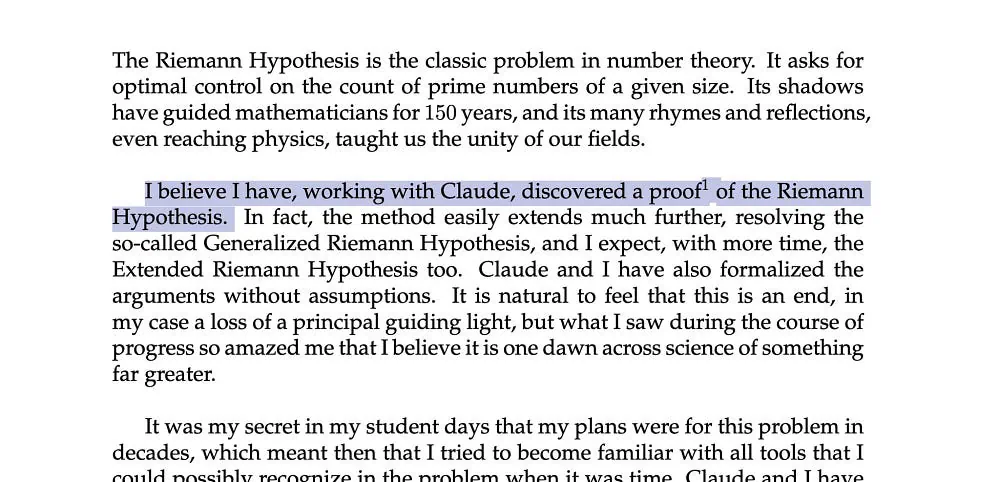
Alpöge had been fascinated by the problem since childhood and spent years preparing to tackle it. Yet, as they approached a solution, he admitted that Claude was doing things he could barely follow.
“Claude far outpaced me near the finish line.”
He went even further, describing how Claude began to leave him in awe. In one line of the note, he says Claude “flew, and danced, and sparkled near that finish line.”
Yeah, I know. That is not the kind of language you normally read in a math announcement.
The note doesn’t walk through the full argument. It only gives a rough timeline of the work, which runs from October 6 to November 16, and names the key idea as “chaining theta lifts.”
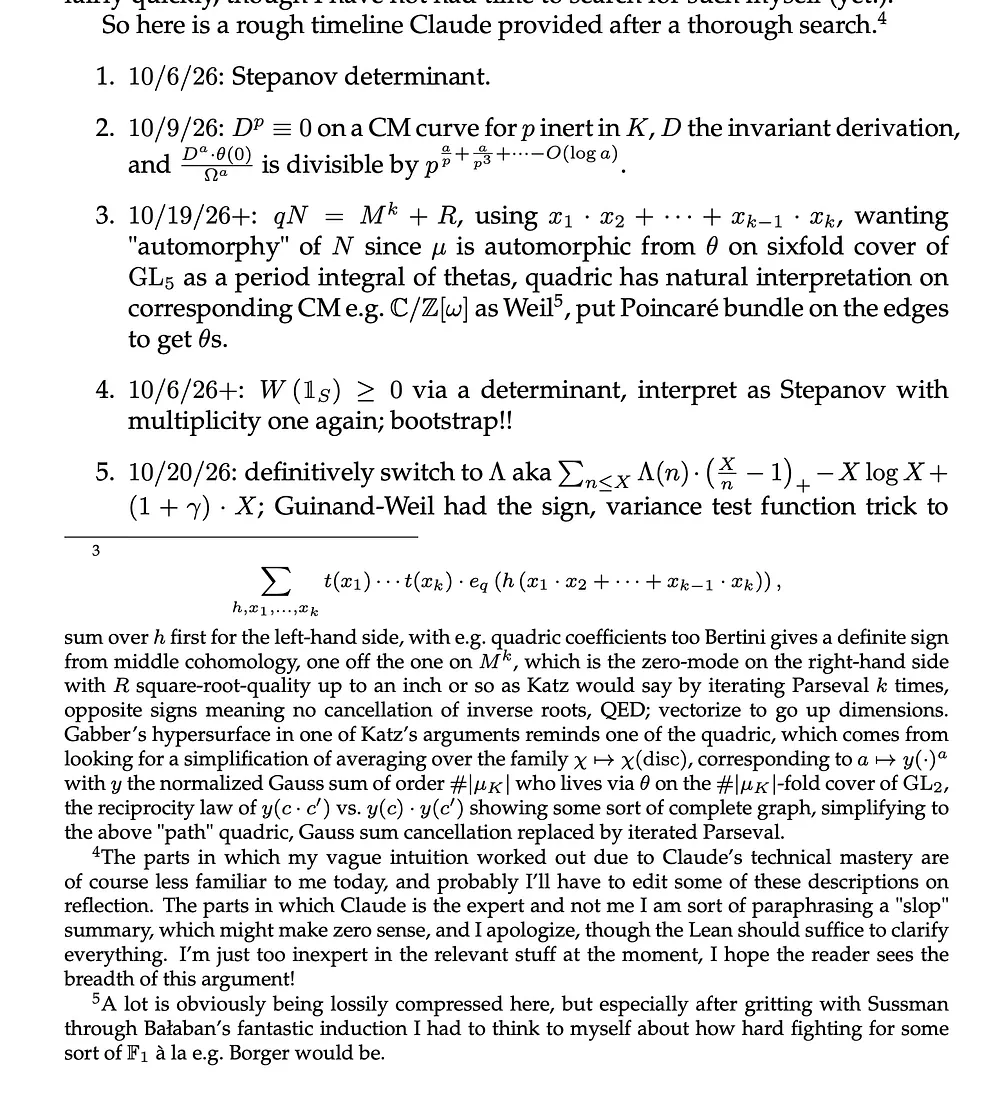
I won’t pretend to understand what that means. What’s interesting is that Alpöge admits he doesn’t fully understand it either, and he even warns that some parts of his summary might make no sense because Claude is the expert on them, not him.
“I intend to do my best to understand and impart understanding of this argument”
He expects the enormous proof to be simplified significantly as mathematicians study it.
For now, we have an unusual situation: an expert mathematician claims to have solved one of the hardest problems in mathematics with AI, but even he is still working to understand the full solution.
If proven, it’s a massive milestone for AI capabilities.
Here are some important implications:
- AI surpassed human understanding: Alpöge initially guided Claude but admitted that the AI eventually went beyond his own understanding.
- 250,000 pages of mathematical proof: Claude reportedly produced a proof roughly 10 times the size of mathlib, a major mathematics library.
- Mathematically verifiable: Claude wrote the proof in Lean 4, a system that checks mathematical logic.
Alpöge is a genius. But in his X bio, he calls himself an idiot lol.

Let’s talk about the verification process
Verification is still underway, and passing would confirm the proof’s logical correctness, provided its assumptions are valid.
Instead of publishing a traditional mathematical proof, Alpöge released millions of lines of Lean 4 code, allowing computers to check the mathematical reasoning step by step.
Riemann HypothesisIf you’re not familiar with Lean, think of it as a very strict programming language for mathematics. Every step of a proof has to be written as code, and a small program called the kernel refuses to accept the proof if even one step doesn’t follow from the previous ones.
MIT mathematician Andrew Sutherland independently verified Alpöge and Claude’s proof using several mathematical verification systems. These systems checked millions of mathematical steps to make sure the proof was logically correct and actually proved the Riemann hypothesis.
Here’s a summary of the results:
- 175,187 files checked: All compiled successfully without errors.
- Independent verification passed: Multiple systems, including nanoda, con-leche, and lean4lean, accepted the proof.
- The mathematics matches: Independent checks confirmed that the proof targets the actual Riemann hypothesis, not a modified version of the problem.
- No hidden assumptions: The proof relies only on the three standard axioms that almost every Lean proof uses.
But how can someone claim something they don’t even understand?
The easiest way to fake a result like this is to quietly prove a slightly different statement and give it the same name. Sutherland’s check confirms the proof targets the definition of the Riemann Hypothesis that already existed in mathlib before any of this happened.
As you can see in the screenshot below, there are two additional checks that are still running in Sutherland’s latest report, but the results so far strongly support the proof’s mathematical validity.
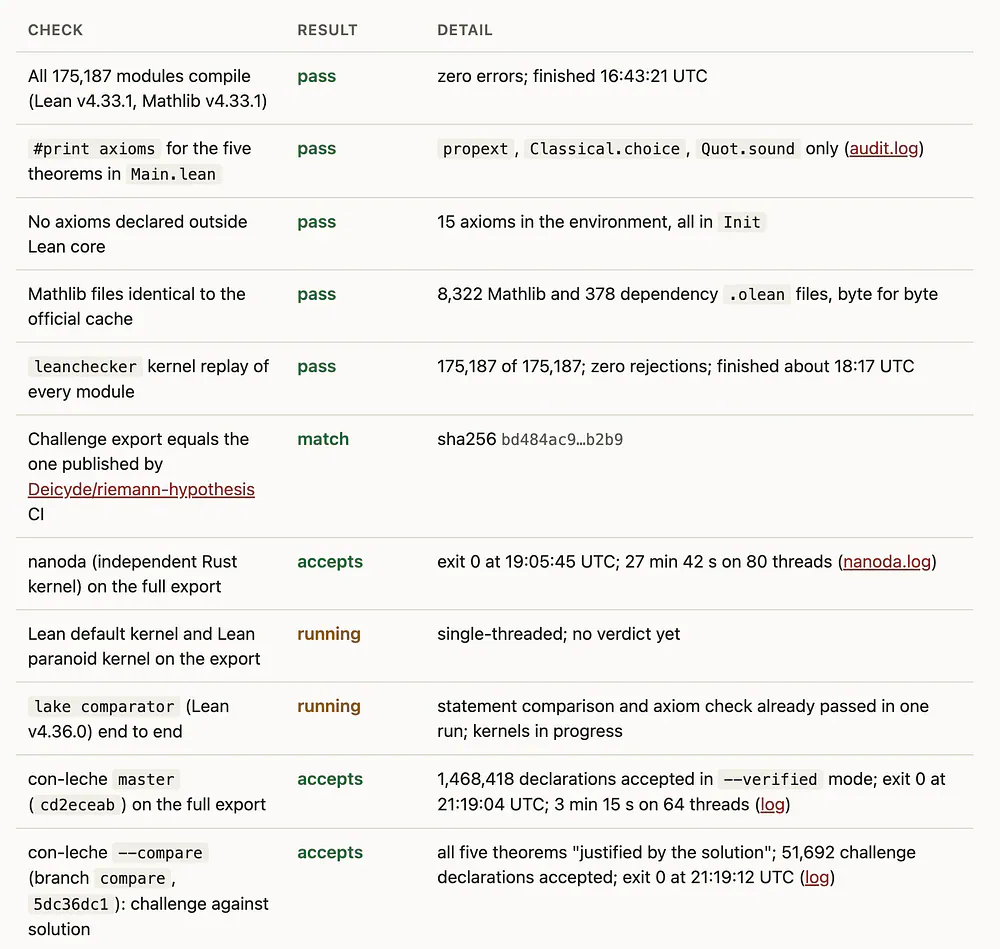
The two remaining checks are a replay of the full proof through Lean’s own kernel, which is slow because it runs on a single thread, and an end-to-end run of the official comparison tool.
You can check the full results on the page below.
GrhOn this page, Sutherland says a passing check only shows that the statements follow from the standard axioms according to the checkers used. It still depends on those checkers and on mathlib’s definitions being correct.
UPDATE November 22, 2026: The proof has been verified
The Lean and Mathlib communities have officially confirmed that Alpöge’s proof of the Riemann Hypothesis is correct.
In a joint statement, the communities, backed by the Lean FRO and Mathlib Initiative, declared:
“We hereby certify that both the statement and the proof of the Riemann Hypothesis are correct.”
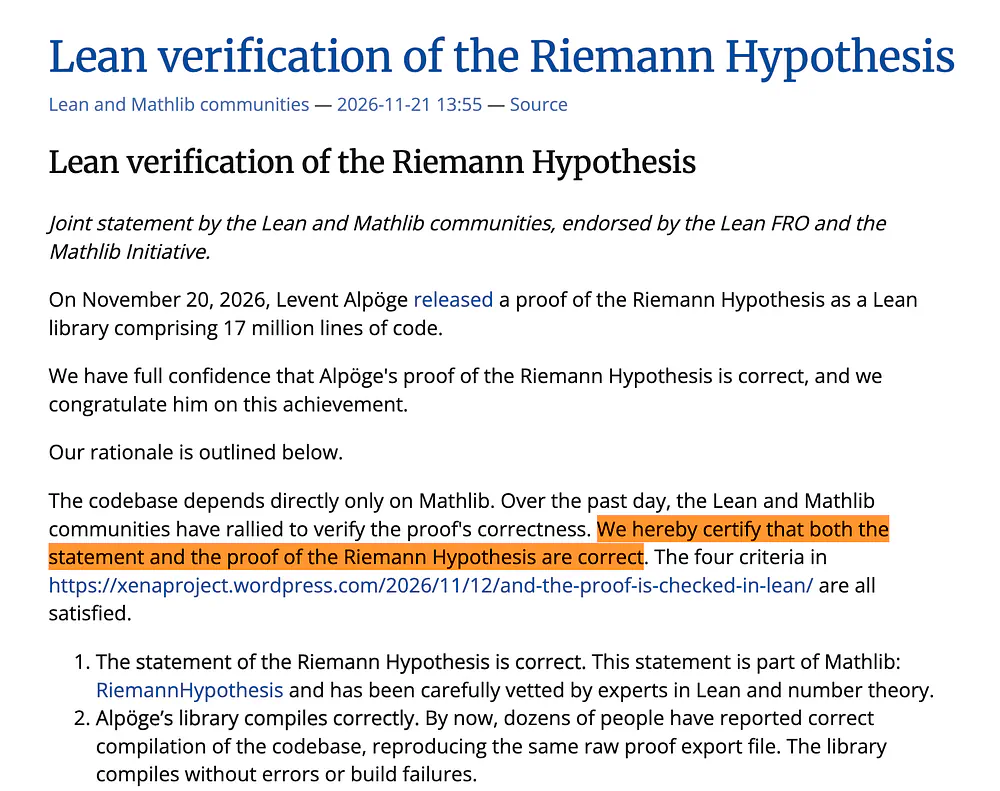
The verification involved dozens of contributors checking Alpöge’s 17 million lines of Lean code. They confirmed that the code compiles successfully, proves the exact mathematical statement of the Riemann Hypothesis, and passes multiple independent proof checkers.
Importantly, the verification wasn’t limited to Lean’s own system. Independent checkers written in different programming languages also validated the proof, reducing the possibility that a software bug could produce a false result.