
Anthropic announced Skills over MCP in public beta on November 24, 2026, alongside general availability for Tasks and Elicitation in Claude and Claude Code. File Uploads, a fourth capability, is coming soon. Together, the changes let Model Context Protocol servers supply workflow instructions, continue long-running operations and ask users for information during a job.
Developers should treat these as separate rollout tracks. The Anthropic announcement gives each feature different availability, and the MCP documentation adds another distinction: the Skills extension specification is final, but SDK and host support is still being implemented.
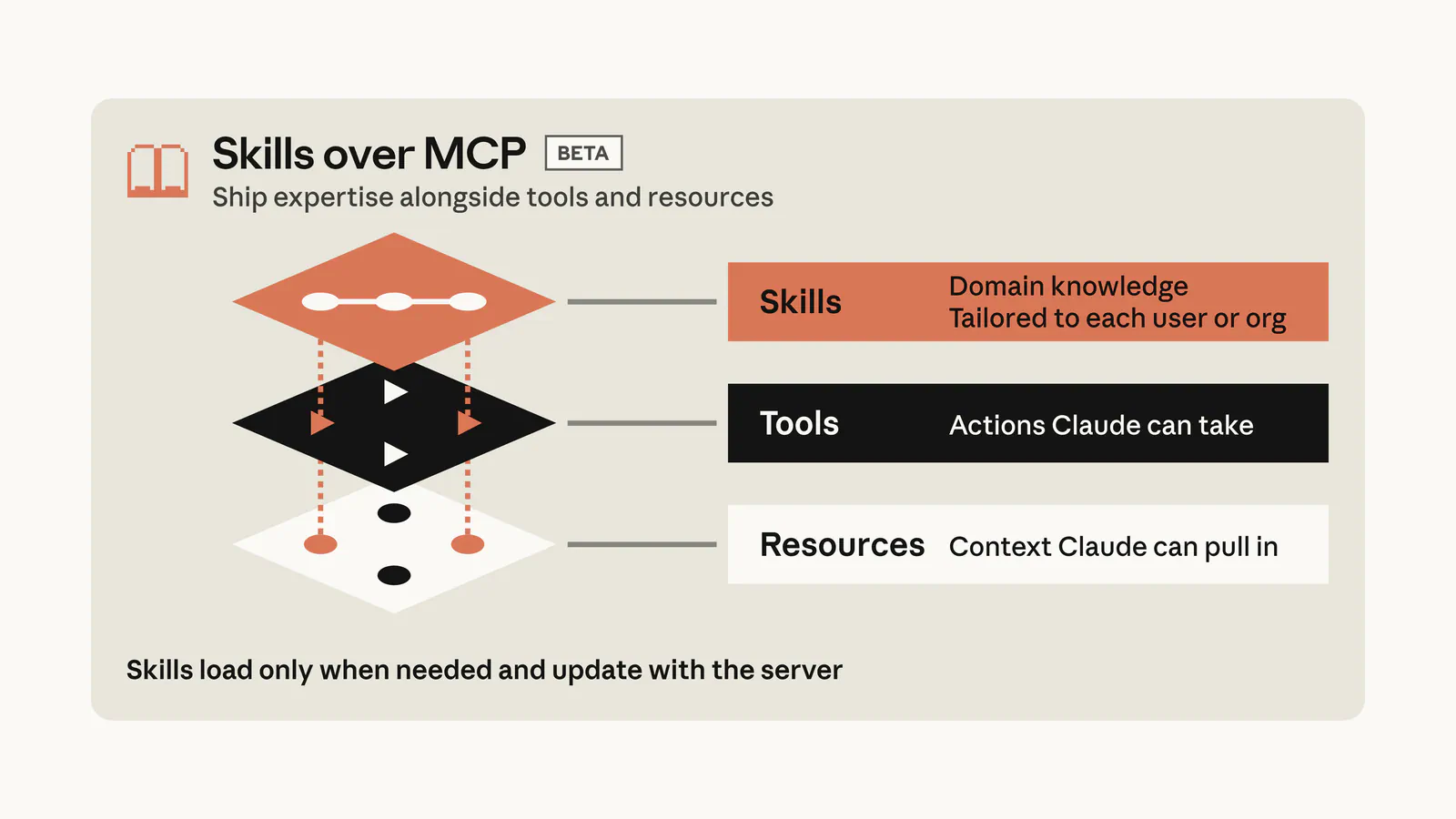
The practical change is that an MCP integration can carry more of a workflow. Tools describe available actions; skills explain how to combine those actions; Tasks and Elicitation support work that takes time or needs a decision.
Claude MCP Availability by Plan
Anthropic’s November 24 update makes Skills over MCP available as a public beta in Claude and Claude Code, while Tasks and Elicitation have reached general availability with an organization rollout still underway.
| Capability | Release status | Pro, Max and Ultra | Team | Enterprise |
|---|---|---|---|---|
| Skills over MCP | Public beta | On by default | Admin must enable | Coming soon |
| Tasks | Generally available | Available | Rolling out | Rolling out |
| Elicitation | Generally available | Available | Rolling out | Rolling out |
| File Uploads | Coming soon | Planned rollout | Eligible plans, coming soon | Eligible plans, coming soon |
These are Anthropic’s published availability conditions, covering both Claude and Claude Code. General availability for Tasks and Elicitation therefore does not mean every Team or Enterprise organization has access immediately.
For developers shipping integrations across multiple customers, the immediate deployment check has two parts: whether the customer’s plan has access and whether the client supports the capability. A feature appearing in the open MCP specification does not automatically make it usable in every MCP application.
How Skills Over MCP Works
The MCP Skills extension, identified as io.modelcontextprotocol/skills, defines how servers expose workflow instructions and supporting files. Its specification, SEP-2640, is Final; the official Skills documentation separately warns that SDK and host support is still being implemented.
That difference matters. Specification maturity describes the protocol contract. Claude’s public-beta label describes availability in Anthropic’s products. Neither guarantees support in another host application.
A skill is a directory containing a SKILL.md file and optional supporting files. It can explain a reusable workflow involving several tools, such as reviewing code against a checklist or processing a document with reference material.
Declare the Capability and Implement Discovery
Servers must declare both the resources capability and the Skills extension in server/discover. The following JSON is a capability fragment from the documented structure, with optional directory reading left disabled:
{
  "capabilities": {
    "resources": {},
    "extensions": {
      "io.modelcontextprotocol/skills": {}
    }
  }
}
The declaration advertises support; it does not supply the implementation. A supporting server must provide:
skills/listto expose available skills and their metadata, with pagination and caching support.skills/getto retrieve or refresh a skill entry by URI.resources/readto serve the actualSKILL.mdcontents and supporting files.
The documentation’s examples target MCP protocol revision 2026-07-28 or later. Full requests also require request metadata, so this declaration should not be treated as a complete runnable exchange.
Each listed skill contains its URI, frontmatter and a resource manifest, or an indication that the content is dynamic. A static manifest includes every file’s URI, SHA-256 digest and byte size. A complete list entry already contains the metadata, so clients do not need an extra skills/get call merely to discover more metadata about it.
Reading a Skill Is Not Activating It
MCP’s Skills extension requires the host application to handle skill loading separately from an ordinary resource read. Reading SKILL.md through resources/read does not itself activate the skill. The host routes the read through its skill-loading path, verifies the content and applies any required user approval before placing it in model context.
That is a consequential implementation boundary: fetching instructions and deciding to use them are separate steps.
The Skills specification also defines identity as the originating server’s identity plus the skill URI. Names are labels and need not be unique. Hosts must preserve that combined identity in registries, approvals and caches. Two servers publishing a skill called code-review should not accidentally share an approval or cache entry.
Why Server-Delivered Skills Reduce Setup and Context Load
Anthropic says Skills over MCP lets developers ship instructions with their tools, update both through the server and avoid a separate skill installation for users. Claude loads the skill when needed.
The discovery model explains how that can reduce context use: a client can inspect metadata before retrieving the full instructions and reference files. A service with several specialized workflows does not need to place every playbook into the model’s context at connection time.
The benefit is conditional on selective loading. A host that eagerly loads every skill would lose much of that advantage. Anthropic provides no Skills-specific token-saving measurement in this announcement.
Server delivery also reduces the risk of separately installed guidance drifting away from the service it describes. That is especially relevant to specialized workflows such as those discussed in Zeniteq’s Claude for Manufacturing coverage, where instructions and connected tools need to work together.
Tasks and Elicitation Change the Request Lifecycle
Anthropic’s Claude and Claude Code now support generally available MCP Tasks and Elicitation for Pro, Max and Ultra subscribers, with Team and Enterprise rollout underway. The capabilities address different interruptions: waiting for computation and waiting for a person.
Tasks Keep Long-Running Work Moving
MCP Tasks allow a server to continue a time-consuming operation while Claude works on other things, then return the result when ready. Anthropic says servers can run individual operations or full agent loops this way.
Anthropic names ZoomInfo as an example, saying Tasks enables deeper account and contact research that previously required several prompts. That is a vendor-described use case, not an independently measured performance result.
For implementation planning, the useful distinction is between the request that starts work and the later availability of its result. A long research job can become a delegated operation instead of occupying one blocking interaction.
Tasks concerns the lifecycle of work exchanged with an MCP server. Teams separately evaluating where agent infrastructure runs can consult Zeniteq’s coverage of the self-hosted Claude Managed Agents beta.
Elicitation Adds Structured User Input
MCP Elicitation lets a server request information during an operation. The defines two modes:
Frequently Asked Questions
3 questions
1Which Plans Support Skills Over MCP Now?
Skills over MCP is on by default for Pro, Max and Ultra subscribers in Claude and Claude Code. Team customers can use the public beta after an administrator enables it. Anthropic lists Enterprise support as coming soon, without a date, in its release announcement.


