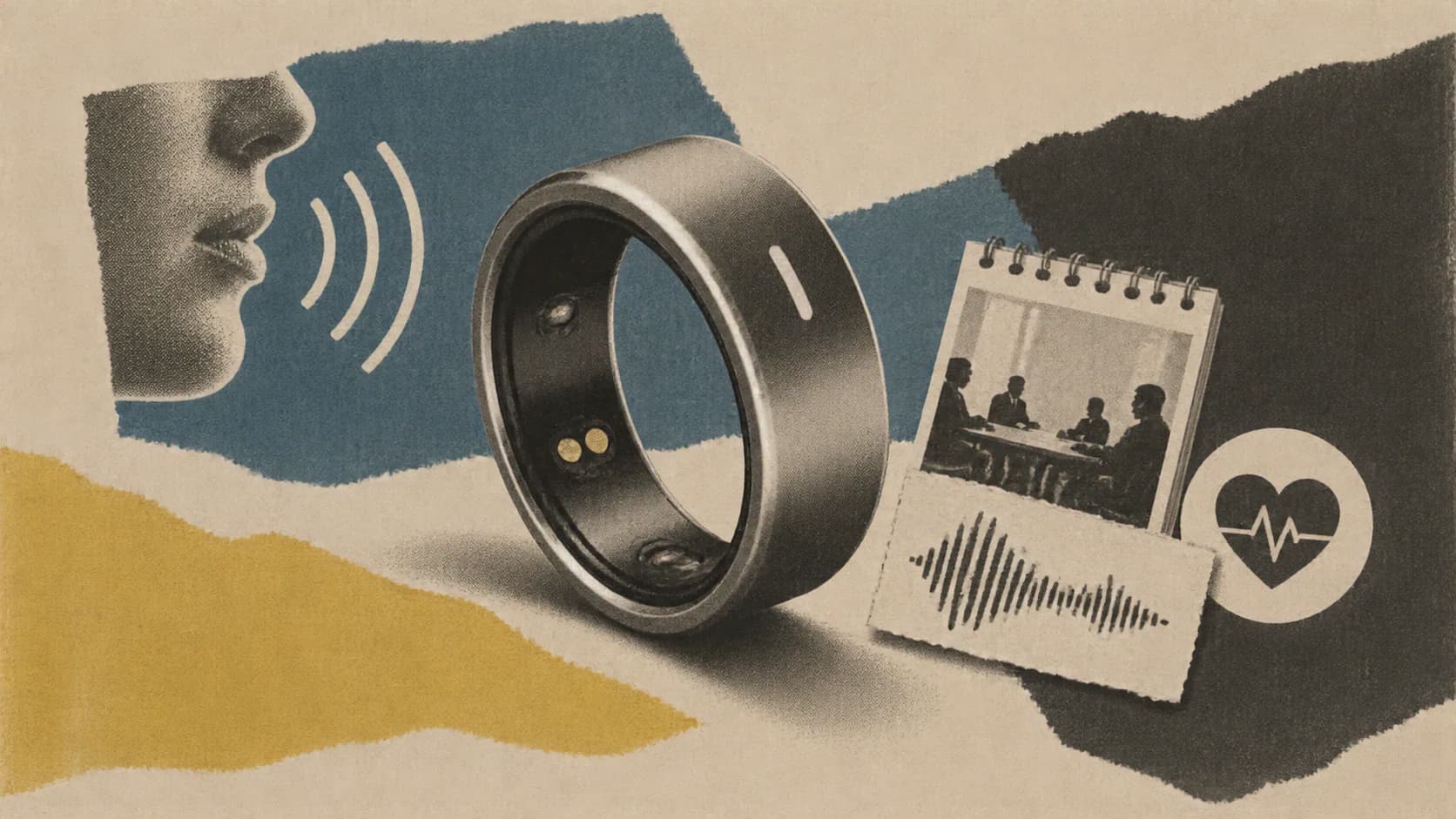
Natura is inviting people to join a waitlist for Interface, a smart ring designed to send spoken requests to AI agents, record conversations and capture notes. The official Interface page says final pricing, preorder timing and delivery details will be provided before ordering. It is not yet offering a finished product with confirmed purchasing terms.
TechCrunch’s October 8, 2026 report describes a $99 launch price, preorders the following month and shipping in December or January. Those are reported plans, not settled commitments on Natura’s product page.
Interface offers a concrete example of how AI products could move beyond opening a chatbot on a phone. Natura proposes a button-operated microphone on your finger, connected agents doing the work and its NatureOS software handling permissions, progress and results. Several capabilities that would determine whether this works comfortably in everyday life remain under validation.
The $99 Price Is a Reported Plan, Not an Order Offer
According to TechCrunch’s launch report, Natura expects Interface to launch at $99. The company also plans a $9 monthly subscription after an initial free period lasting three to six months, and reportedly intends to raise the hardware price later.
Preorders are expected in November 2026, TechCrunch says, with shipping slated for December or January. Given the report’s October publication date, that shipping window would span December 2026 and January 2027.
Natura’s official page offers first-access registration and says the final price, preorder timing and delivery window will be shown before checkout. Battery life will also be confirmed before ordering. The page does not confirm the subscription terms reported by TechCrunch.
These accounts need not contradict each other. A company can describe its intended launch economics in an interview while leaving its public sales commitments open. An expected price, however, is not one readers can actually order at, and a planned delivery window is not a confirmed shipment date.
For now, the official offer is a place on a waitlist. Anyone considering Interface should evaluate both the eventual hardware price and any recurring charges once Natura publishes its purchasing terms.
A Button Starts the Request; NatureOS Handles the Task
Interface’s proposed interaction is straightforward: press and hold its button, speak, then release. Natura says NatureOS sends the request to the chosen agent and asks the user to review actions that require approval.
Designed for the index finger, the ring has a button facing the thumb. Natura says recording starts only when the user operates that button. Under the described design, Interface is a deliberate voice-input device, not an always-listening assistant.
The workflow has several separate parts:
- Interface captures the spoken request.
- NatureOS lets the user choose an agent and the apps it may access.
- The connected agent performs the task.
- Progress and results return through NatureOS or another supported output.
TechCrunch reports intended launch connections to ChatGPT, Claude, Grok Bot and other agents and apps. This integration plan does not establish that every service will support every task or that the model providers have independently guaranteed compatibility.
Replies may arrive through connected headphones, an update on an iPhone lock screen or a fuller result in NatureOS, according to Natura. Its HumanPods earbuds are optional; they are not required to use Interface.
Capturing speech is only the first step in this larger system. Successful task completion still depends on the selected agent, its available tools and the permissions granted through NatureOS. A microphone on a finger does not, by itself, make an agent capable of booking, purchasing or controlling another application.
Meeting Capture Is Separate From Short Commands
Beyond issuing commands, Interface is intended to preserve conversations and thoughts.
For a longer recording, Natura describes double-clicking the button to start and double-clicking again to stop. Recorded conversations would then be available through NatureOS as notes, decisions and next steps. Short dictated thoughts could be saved as written notes or passed to agents for reorganization.

A short request asks software to do something; a meeting recording creates material that users and agents can return to later. The latter could be useful even when there is no immediate action to automate.
The page’s examples of meeting notes are product illustrations, not evidence of transcription accuracy or reliable identification of decisions and action items. Buyers will need to see how the system handles multiple speakers, overlapping speech and corrections before judging its usefulness for work.
Natura lists a recording-indicator light intended to make capture visible. The light can help with recording awareness, but it does not establish consent or permission to record a particular conversation. Users would still need to follow applicable rules and their workplace’s policies.
Health Tracking and Water Resistance Remain Unsettled
Interface is also designed to track health and activity. Natura explicitly says these features are being validated and that final capabilities will be confirmed before release.
The proposed measurements include heart rate, resting heart rate, heart-rate variability, sleep stages, steps, daily activity and skin-temperature changes. The listed sleep categories are awake, light, deep and REM.
These specifications describe intended capabilities without demonstrating measurement quality. A list of sleep stages does not establish how accurately the ring will classify them, and the presence of heart-rate tracking does not establish reliability across different activities or wearing conditions.
TechCrunch describes the ring as combining agent access with health tracking. Readers should treat the health component as part of the prerelease proposition, without assuming it already matches an established health-focused wearable.
Water resistance is also unresolved. Natura’s page uses “Waterproof” as a feature heading and describes a sealed design for everyday wear, but the accompanying text says the final water-resistance rating will be confirmed before release. Without that rating and usage guidance, readers should not infer that showering, swimming or other water exposure is supported merely because the page uses a broad waterproof label.
The Battery Figures Need Their Testing Context
Natura’s published battery specifications list six to 12 days per charge with typical daily use, varying with recording time and the frequency of health readings. The page also lists 13 hours of continuous recording.
The continuous-recording number comes with an important qualification: it is calculated from measured power draw, not a completed full battery-life test. It also excludes audio transfer. The figure is therefore a recording-only estimate, not proof that Interface can record, transfer audio and support the complete connected workflow for 13 hours.
Charging times are listed as 100 minutes to full and 75 minutes to 80%, while the case is expected to provide 10 full ring recharges. These remain prerelease specifications, not results from independent everyday testing.
Microphone performance is another unresolved part of the experience. The page depicts users speaking quietly or bringing the ring close to their mouth in noisy surroundings, but its specifications say whisper performance, noise handling and pickup distance are still in validation.
Those details could matter more than the headline battery range. If users must repeatedly reposition their hand, repeat a request or check whether speech was captured correctly, the convenience advantage over a phone becomes smaller. The relevant test is whether the ring reliably captures a request in the situations its design is meant to accommodate.
Putting the Phone Away Does Not Remove It From the System
Natura describes Interface’s premise as starting a request while the phone stays away. Its FAQ nevertheless says the ring pairs with a phone, and that details of what works without a connection will be confirmed before preorders.
The available information supports treating Interface as a proposed way to reduce direct phone interaction. It does not establish a standalone replacement or specify which tasks work when the paired phone is absent or disconnected.
NatureOS’s approval flow also needs more detail. Natura says users select the agent and the apps it may use, then review actions requiring approval. Those controls could preserve oversight as requests become easier to initiate, but the page does not explain which actions require review or how detailed those permissions will be.
A request to dictate a private note has different consequences from one that sends meeting notes to someone else. Before buying, readers should look for a clear explanation of when approval is required and what information the approval screen presents. For meeting capture, storage, retention, deletion and agent access also deserve scrutiny.
The most useful release demonstration would follow a complete task: capture the request, show the chosen agent and its permissions, obtain approval where necessary, then return a verifiable result. That would test what Interface can accomplish beyond its form factor.
Natura has described a plausible way to make agent access less phone-bound. It now needs to prove that the convenience survives the full workflow, with firm purchasing terms and validated hardware performance behind it.
Sources
- official Interface pagenatura.inc
- TechCrunch’s launch reporttechcrunch.com