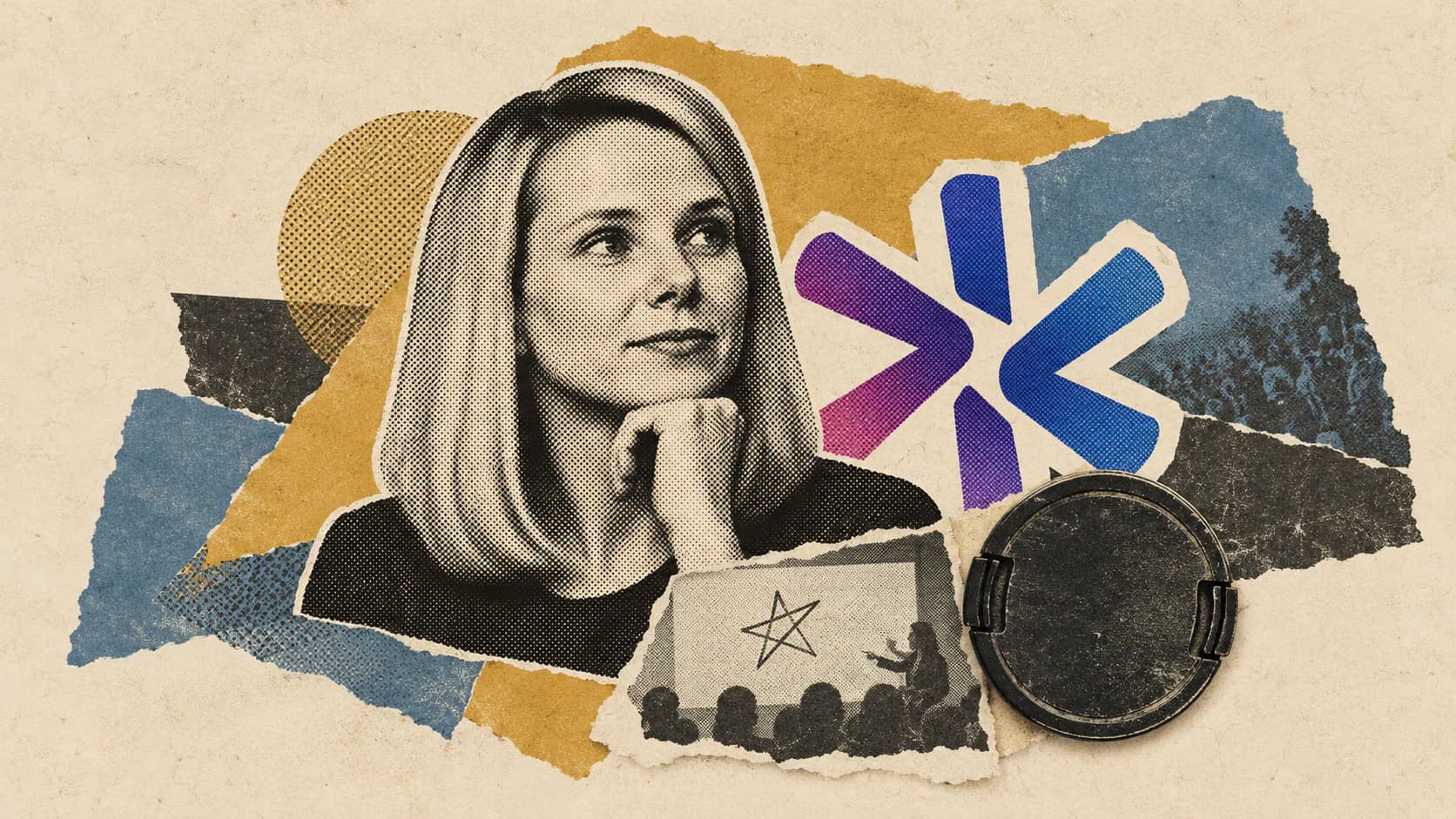
Marissa Mayer is defending a Dazzle AI demonstration after an anecdote about her daughter’s school birthday presentation drew widespread criticism. According to Fast Company’s October 26, 2026 report, the former Yahoo CEO described asking her assistant to generate three bullet points about what made her 10-year-old daughter special.
One critical X post attracted 1.9 million views and hundreds of comments, Fast Company reported. The objection was straightforward: describing your child seemed like a moment for personal reflection, and Mayer appeared to have delegated it to software.
Mayer subsequently told Fortune on October 27 that she was testing an early prototype’s ability to distinguish her identical twin daughters. She said the example was not a recommended use case.
The documented dispute concerns what Mayer intended, what Dazzle’s output demonstrated, and whether a technically interesting product test makes a convincing pitch for family AI.
The School Slide That Started the Dispute
The anecdote appeared in an October 25 New York Times profile about Mayer’s return to consumer technology with Dazzle. The accessible Times page provides only a preview, so the detailed account here relies on Fast Company, Fortune and TechCrunch’s subsequent reporting.
Dazzle is described as a personal AI assistant that learns from a user’s camera roll. Mayer’s example involved a school birthday presentation requiring three bullet points about her daughter. Fast Company reported that the assistant described her as:
“empathetic, creative, and an animal lover”
The emotional significance of the assignment made the example unusually sensitive. A school slide is a small deliverable, but the underlying request asks a parent to articulate what they notice and value about their child.
Critics interpreted the anecdote as outsourcing that reflection. Mayer’s explanation places the emphasis elsewhere: she wanted to see what an experimental product could recover and infer from photographs.
Those accounts can describe the same interaction while disagreeing about its purpose. Asking an assistant for material for a slide is an observable action in the reported story. Concluding that Mayer needed AI to understand her daughter is an interpretation, one she disputes.
What the 1.9 Million Views Actually Show
Fast Company identified political commentator Keith Edwards as the author of an X post criticizing the anecdote. His verdict was brief:
“This is so bleak”
The publication reported that the post had accumulated 1.9 million views and hundreds of comments. That is substantial documented circulation for criticism of a startup founder’s product example.
The number still needs its proper label. It is a reported view count on one post, not a count of people who agreed, a measure of unique readers, or a survey of Dazzle’s potential customers. The cited reactions show that a particular interpretation traveled widely; they cannot establish how most parents feel about family AI.
The strongest criticism also does not require a claim about Mayer’s parenting. A product demonstration can be poorly chosen even when its creator has a reasonable explanation for running it.
My view is that this is the more useful way to assess the episode. Whether an assistant can produce plausible adjectives is a product question. Whether those adjectives communicate a benefit that families want is a separate question, and the backlash exposed the gap between them.
Mayer’s Response: A Test of Distinguishing Her Twins
Fortune’s Emma Hinchliffe spoke with Mayer after the criticism spread. Mayer said she was testing whether Dazzle could distinguish between her identical twin girls in photographs and return an answer about the intended daughter.
She described the prompt as a difficult product test, not a conscious decision to outsource the task. She also explicitly separated the anecdote from Dazzle’s proposed applications:
“We have suggested use cases, and this wasn’t one of them.”
That response narrows what readers should take from the original story. Mayer was reporting her own experimental use of a prototype, not telling every parent to have AI describe their children.
TechCrunch’s October 28 commentary added details from Mayer’s public response. According to that account, Dazzle resurfaced forgotten kindergarten projects, including a device for removing snake venom and a playground for sandcats. Mayer presented those projects as evidence of her daughter’s creativity and interest in animals.
Those examples make the output more concrete than three standalone adjectives. They suggest the assistant was useful to Mayer as a way to retrieve older material and connect it with a present-day assignment.
They remain Mayer’s account of the prototype’s behavior. The supplied reporting contains no independent test of its accuracy or ability to distinguish the twins.
Retrieving a Memory and Judging a Person Are Different Tasks
Dazzle’s camera-roll approach is central to understanding both Mayer’s defense and the criticism.
A photo collection can contain useful material for a school presentation: pictures of projects, activities and moments a parent has forgotten. An assistant that helps locate those images could reduce the time spent scrolling through years of photographs.
Describing a child’s personality adds another layer. The system moves from locating records to interpreting what those records mean.
Mayer’s example therefore contains at least three distinct questions:
| Part of the task | What would count as useful evidence? | What it would leave unresolved |
|---|---|---|
| Identify the intended daughter | Photos consistently show the correct twin | Whether the system works reliably across a larger collection |
| Retrieve relevant memories | The surfaced projects belong to that child and fit the request | Whether important memories were missed |
| Suggest personal traits | Specific examples plausibly support each description | Whether those traits capture the child accurately or meaningfully |
This breakdown is an analysis of the reported interaction, not a description of Dazzle’s internal architecture.
The distinction explains why a successful identity test would be interesting without settling the broader question. Correctly selecting one twin’s projects would support Mayer’s technical point. It would not automatically validate every personality judgment attached to those projects.
A photo of an animal-themed project offers a plausible basis for suggesting an interest in animals. Broader qualities such as empathy depend on context that may be absent from the image. Photographs are also a selective record: they capture what someone chose to photograph, preserve and make available to the assistant.
The available reporting gives no technical specifications for Dazzle’s recognition system, model, photo-processing setup or storage controls. There is no basis here to infer a particular architecture or privacy guarantee.
For a family product, I would find a result that leads with the relevant memories more persuasive than one that leads with a polished character summary. Showing the evidence gives the parent something concrete to evaluate. A confident label can conceal how little information supports it.
Family Logistics and Emotional Judgment Overlap
Frequently Asked Questions
3 questions
1What Is Dazzle AI?
Dazzle is Marissa Mayer’s personal AI assistant, described in the reporting as learning from a user’s camera roll. Her disputed example involved using it to find material and suggest traits for her daughter’s school presentation.