
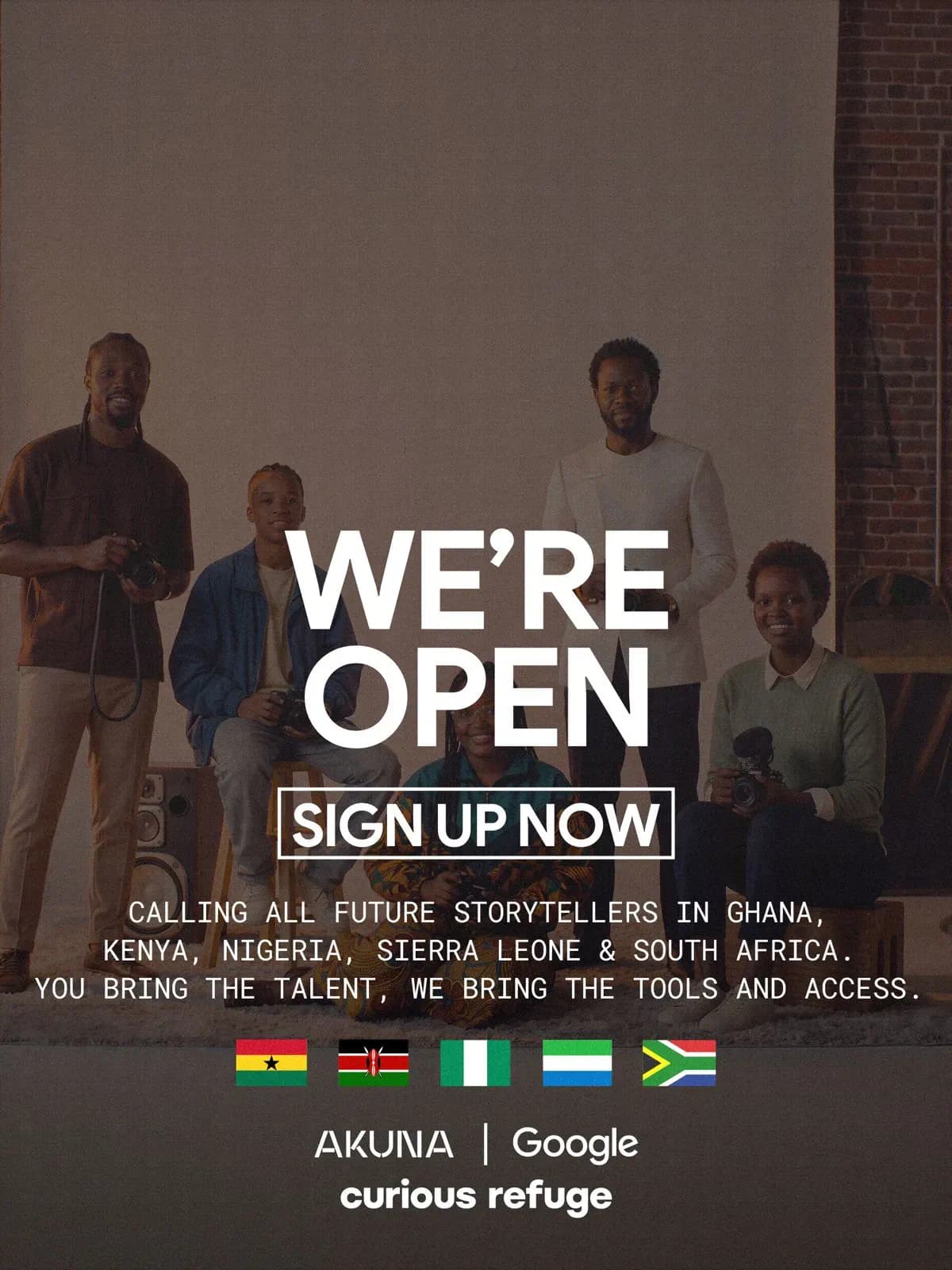
Google and Idris Elba’s Akuna Group have opened applications for From Script to Screen with AI, a filmmaking program supported by US$1 million from Google.org. The first cohort starts in February 2027, with a 12-week academy followed by mentoring, competitive pitching and production opportunities for selected teams.
Applications are open to creators physically living in Ghana, Kenya, Nigeria, Sierra Leone and South Africa. The deadline is November 15, 2026.
Google’s announcement, published October 28, 2026, outlines the funding and creative curriculum. Akuna’s earlier release, dated October 26, supplies the fuller eligibility rules and schedule.
The program is a training and production-funding initiative, not a new Google AI model or filmmaking app. For applicants, the consequential detail is the pathway: completing the academy creates an opportunity to progress toward a funded film, but it does not guarantee production funding.
Who Can Apply and What You Need
Akuna Learning, part of The Akuna Group chaired by Elba, is accepting applications online at AkunaLearning.com. According to the official application requirements, applicants must:
- Physically reside in Ghana, Kenya, Nigeria, Sierra Leone or South Africa.
- Be at least 18 on the date they apply.
- Have access to a laptop, reliable internet and consistent power throughout the program.
- Be able to commit fully to the February–April 2027 academy, plus later stages if they progress.
- Include existing creative work showing their talent and commitment.
The residency requirement deserves attention. The published rule concerns where applicants physically live; nationality alone is not the eligibility test described in the release.
Applicants do not need previous AI experience, a film-school qualification or a minimum number of years in the industry. Akuna welcomes aspiring and emerging filmmakers, screenwriters, animators, advertisers, digital creators, photographers, designers, editors and visual artists. Women are strongly encouraged to apply.
The portfolio requirement is broader than a completed film. Akuna asks for existing creative work, however modest, so a photographer or designer should not read the program’s title as excluding them. The release does not specify portfolio file formats or a required number of pieces.
Applying is free, and attendance is free for selected participants. That removes course fees, but applicants still need the equipment, connectivity and power listed above. The announcements do not specify whether paid AI subscriptions, generation credits or travel to meet-ups are covered.
I’d treat those access requirements as a practical readiness check before spending time on the application. Free tuition is valuable, but an online production course still depends on being able to participate consistently.
What the Academy Teaches
The program begins with a foundational AI filmmaking course, followed by specialization. Curious Refuge is developing the curriculum and delivering the 12-week online training, with weekly Akuna facilitation, in-person meet-ups in each participating country and certification at the end.
Google describes the training as spanning screenwriting, world-building, animation and digital production workflows. The five officially named creative pathways are:
| Pathway | Published focus |
|---|---|
| Fiction | Narrative filmmaking and scripted storytelling, from short films to series |
| Documentary | Real-world stories and factual filmmaking |
| Animation | Animated storytelling, motion design and visual world-building |
| Advertising | Branded storytelling, commercial content and creative campaigns |
| Screenwriting | Script development, dialogue, structure and moving from page to screen |
These are creative specializations, not five separate production departments. Writing, visual development, video creation and production workflows describe activities across the filmmaking process; Fiction, Documentary, Animation, Advertising and Screenwriting are the actual pathway names applicants should expect.
That distinction helps with choosing a direction. Someone interested in designing a fictional world might find relevant work in either Fiction or Animation, while a commercial director may see a clearer fit in Advertising. The published descriptions establish each pathway’s focus, but they do not provide a week-by-week syllabus or rules for switching tracks.
Google also lists regular mentor touchpoints and portfolio reviews involving industry mentors, creative technologists and Google teams. Those are useful parts of the offer, though the announcements do not specify the amount of individual feedback each participant will receive.
The 12-Week Course Is Part of a Longer Program
Akuna describes the full initiative as a 50-week pathway, running from applications through production and exhibition. The academy occupies only the first learning phase.
The five-stage schedule in Akuna’s release sets out how participants can move forward:
| Stage | Timing | What happens |
|---|---|---|
| Applications and selection | October 2026–January 2027 | Applications close November 15. Country-level review panels and a final cross-country panel assess applicants. |
| Learning and certification | February–April 2027 | Participants complete the 12-week online academy, with weekly facilitation and local meet-ups. |
| Mentoring | April–June 2027 | Graduates submit one-page ideas. Shortlisted idea owners form teams, which receive four weeks of mentoring. |
| Pitching | June–July 2027 | Mentor-endorsed teams pitch to panels drawn from Akuna, Google and the wider industry. Selected projects receive funding. |
| Production and showcases | July–October 2027 | Funded teams make their films with creative and technical support. Films are scheduled to be showcased in October. |
The progression contains several selection points. Admission gets a creator into the academy. Graduates then put forward ideas; shortlisted creators build teams; mentor-endorsed teams pitch; selected projects receive funding.
That structure changes how applicants should assess the commitment. Someone available for February through April may be able to complete the academy, but progressing toward production could require availability through October 2027. Akuna explicitly asks applicants to commit to later stages if they advance.
The October showcase is an announced target for selected funded films, not a promise that every participant will finish a financed project. These are the organizers’ published plans; the supplied evidence contains no participant outcomes or independent assessment of the program’s effectiveness.
What the $1 Million Funding Means
Frequently Asked Questions
3 questions
1Do I Need Previous AI or Film-School Experience?
No. Akuna says prior AI experience, a film-school qualification and a set number of industry years are not required. Applicants do need existing creative work demonstrating talent and commitment.