
All six language models in the Jais 3 release share a stated 512,000-token context window, from the 900-million-parameter entry model to the 375-billion-parameter flagship. IFM and Inception42 say the release also includes a separate Arabic speech model.
The October 15, 2026 announcement describes a fleet built for different deployment budgets, with support for Modern Standard Arabic and regional dialects. Multiple training checkpoints and deployment support through vLLM and SGLang give developers further options.
Performance leadership, however, comes from the vendors’ own evaluations. The exact license needs checking at the checkpoint level, and the promised Jais agentic platform is described as coming soon. It should not be counted among today’s shipped products.
Six Language Models, Plus a Separate Speech Model
According to IFM, Jais 3 builds on its K2 Horizon model fleet. The release combines six language models with Jais Speech; speech recognition is not presented as an established capability of every text checkpoint.
The lineup spans several deployment scales:
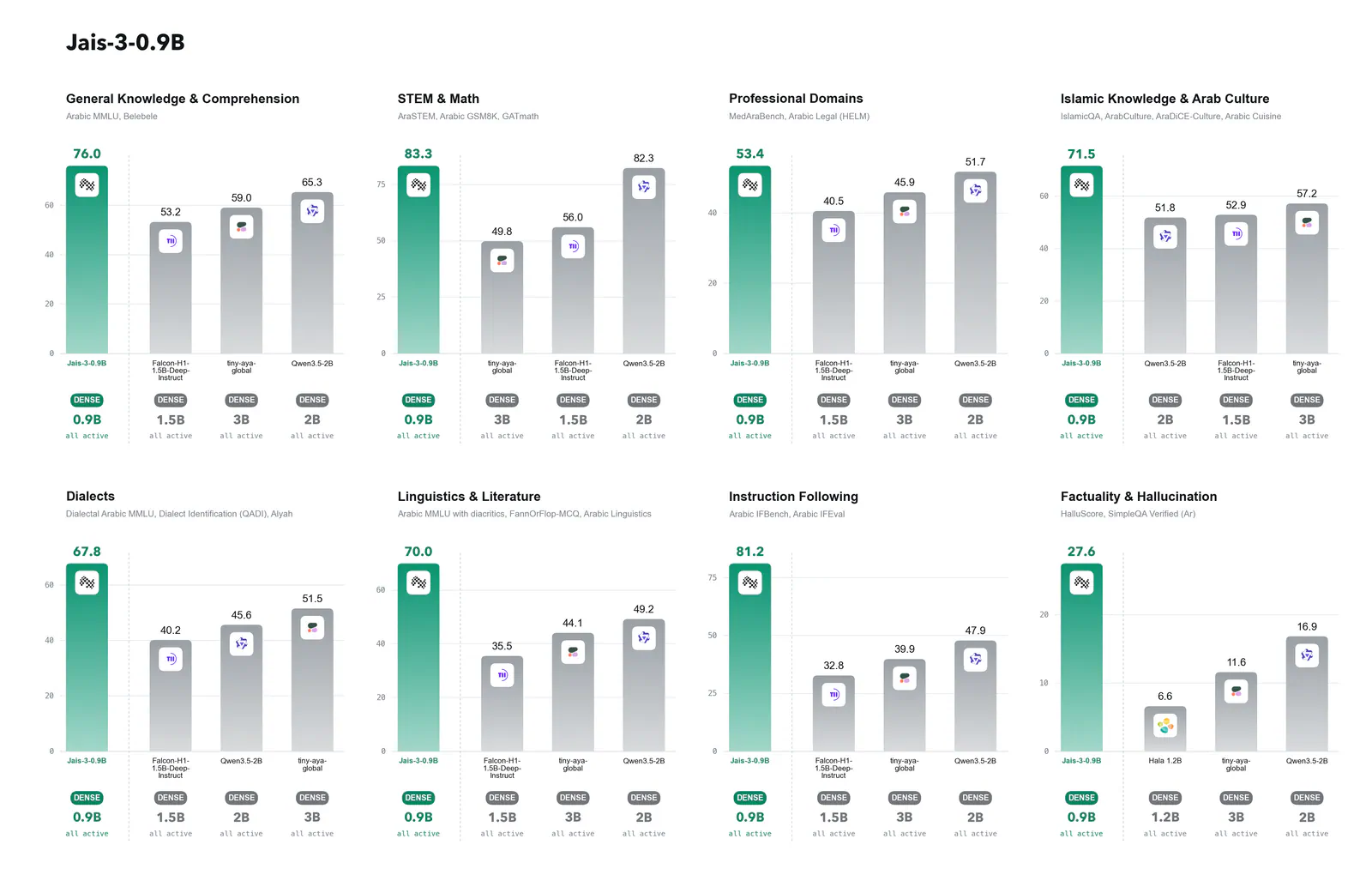
- 900 million parameters: The smallest model is listed as Jais 3 0.9B. It is the natural starting point for developers investigating resource-constrained or on-device applications.
- Four intermediate language models: These occupy the range between the entry model and flagship. Their exact checkpoint specifications need to be checked individually rather than inferred from the endpoints.
- 375 billion parameters: The largest model has a published Jais 3 375B-A23B repository. Its scale makes infrastructure planning a substantially different exercise from deploying the smallest model.
- Jais Speech: A separate speech model addresses Arabic transcription, dialect identification and related output controls.
The phone-to-server framing describes a deployment spectrum, not a hardware certification. A small parameter count makes a model a candidate for mobile deployment; it does not establish acceptable speed, memory consumption or battery use on a particular handset.
The flagship’s parameter count alone cannot tell a team how many accelerators it needs, either. Precision, model architecture, serving configuration and workload all affect the answer. Developers should compare exact checkpoints against their latency and quality requirements before choosing the largest model for production.
Arabic Coverage Includes Dialects and Mixed-Language Speech
IFM and Inception42 describe the language models as supporting both Modern Standard Arabic and regional dialects, a useful distinction for applications that process conversational language as well as formal documents.
Jais Speech extends that coverage to audio. According to the announcement, it is designed to transcribe dialects across 19 Arab countries, recognize Arabic-English and Arabic-French code-switching, identify dialects, and optionally add Arabic vowel marks.
A transcription system may need to preserve an English product name or a French phrase inside an otherwise Arabic conversation. Testing only monolingual, formal speech would not establish how reliably it handles those transitions.
Coverage across 19 countries is a vendor-stated scope, not proof of equal accuracy across every regional variety, speaker or recording condition. A developer building a call-center application should test the dialects and audio conditions its customers actually produce.
Optional vowel marks create another evaluation choice: a lightly normalized transcript, a diacritized transcript or output that follows another house style. These choices affect downstream processing and should remain consistent when comparing transcription results.
A Shared 512K Context Does Not Mean Shared Deployment Costs
The announced 512,000-token context window gives developers a common maximum context specification across the six language models, despite their large differences in size.
That could make the fleet useful for lengthy Arabic documents, document collections or extended conversations. Context capacity and effective long-document reasoning are separate properties, though. Accepting a large input does not, by itself, establish that a model can consistently retrieve a small fact, reconcile conflicting passages or follow instructions throughout it.
Long-context inference will not be equally affordable across the fleet. Holding and processing a large context introduces runtime costs beyond storing model weights. Teams should benchmark the context lengths they actually need instead of configuring every request around the advertised maximum.
IFM says Jais 3 and Jais Speech are available through Hugging Face, with vLLM and SGLang deployment support. This provides a route toward self-hosting, but does not establish that every artifact runs interchangeably through either engine under the same configuration.
Deployment planning calls for specific checks: which checkpoint is supported, which engine version it requires, what precision it expects, and how memory consumption changes with concurrency and context length.
A download is also distinct from a managed service. Self-hosting still requires capacity planning, monitoring, updates and application-level safeguards. The fleet offers more choices about where inference runs without removing that operational work.
Five Checkpoints Per Model Offer More Than a Final Download
The announcement says IFM is releasing five training checkpoints for each language model, alongside benchmarks and evaluation code.
Teams can use multiple checkpoints to study how model behavior changes during training or select a starting point for further adaptation. The documentation still needs to establish each checkpoint’s stage and intended use; the five should not automatically be treated as interchangeable production variants.
Benchmarks and evaluation code can help developers inspect the conditions behind the launch claims. For a practical comparison, a team should record the exact checkpoint, prompt format, generation settings and scoring method. Otherwise, a result attributed broadly to “Jais 3” may conceal differences between model sizes or evaluation configurations.
Releasing these materials makes scrutiny more feasible. Independent confirmation of the vendors’ conclusions remains a separate step.
Benchmark Leadership Remains a Vendor-Run Claim
IFM and Inception42 position Jais 3 and Jais Speech as leading Arabic models. Those statements should be attributed to the companies, not presented as independently established rankings.
The supporting results come from the vendors’ own benchmark suite and public-test-set evaluation. Even a suite described as audited is not equivalent to independent replication of the full comparison.
Language-model comparisons need to account for the competing versions tested, the comparability of prompting and inference settings, and the balance of formal Arabic, dialects and other tasks.
Sources
- Jais 3 0.9Bhuggingface.co
- Jais 3 375B-A23B repositoryhuggingface.co