Physical Intelligence’s Pi API beta, announced on October 13, 2026, combines data uploads, managed fine-tuning and a hosted gateway for inference. Robotics teams can apply to adapt the company’s models to their own robots without managing the training infrastructure themselves.
The company’s beta application says it is starting small and onboarding in batches. Access is limited to an early service; this is not a generally available production platform.
Teams still need robots, task data and a way to evaluate behavior on physical hardware. Pi proposes to handle the compute and infrastructure needed to adapt its models, then serve the resulting model through its API. That could remove a substantial engineering burden. Pricing, service guarantees and local-inference availability, however, remain unanswered deployment questions.
The API Manages the Model Adaptation Loop
Physical Intelligence describes three service components: upload robot data, launch fine-tuning on infrastructure it manages, and access the fine-tuned model through a hosted inference gateway.
Fine-tuning adapts an existing model to a particular application using additional training data. The company’s examples center on robot demonstrations: recordings of how a task should be performed. Developers would use those recordings to adapt Pi’s models without building the entire training pipeline themselves.
After the first training run, developers test the resulting policy, the model governing robot behavior, on their hardware. Evaluation results guide which demonstrations to collect next, and the process repeats.
Teams still have to understand why a robot fails. If a policy struggles with a misplaced manufacturing part or an ingredient that slips out of a scoop, the team needs to identify the failure and collect useful examples. Pi’s announcement uses those problems to explain why repeated data collection and evaluation remain central.
The company references π0 and π0.5 as examples of its general-purpose robotic foundation models. It says the latest model available through the API offers more data-efficient fine-tuning and improved capabilities for partners. The announcement provides no quantified comparison that would let applicants estimate their own data savings.
The offer is a managed adaptation process, with no promise that a fixed number of demonstrations will produce a reliable policy for any robot or task.
Partner Examples Show Possibilities, Not General Performance
The announcement presents two types of evidence: collaborations intended to demonstrate the models’ range, and early API access intended to show whether outside teams could iterate independently.
Among the broader collaborations, Physical Intelligence highlights Actor, which develops autonomous heavy machinery. The company describes footage of Actor’s wheel loader scooping material and loading a dump truck during a real commercial deployment, with no operator inside the machine.
An example of independent API iteration comes from Almond’s Axol dual-arm robot. According to Physical Intelligence’s partner showcase, Axol deburred spacers used in its own assembly with a model obtained after four days of iteration through the Pi API.
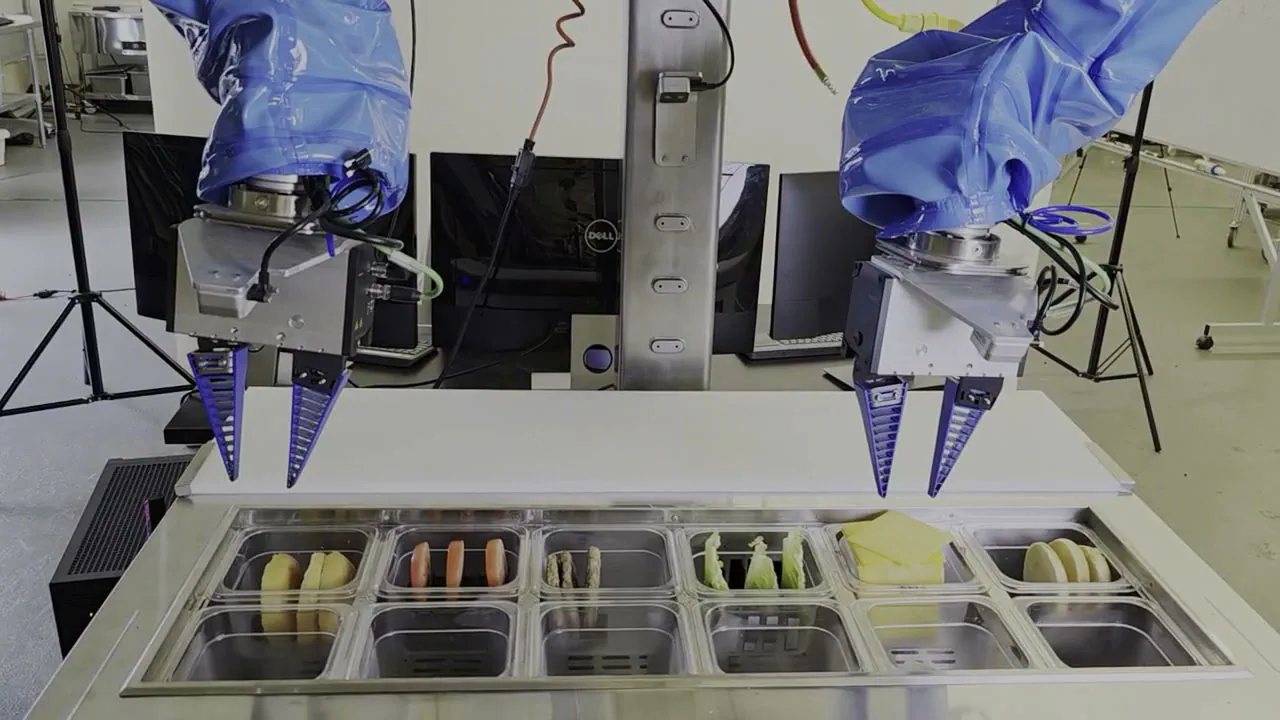
Those four days describe one team’s development cycle. They are not a general onboarding estimate, a training-time benchmark or evidence that another robot could reach comparable performance in the same period. The announcement does not establish those comparisons.
The heavy-machinery example has a separate limitation: it does not prove that a new API applicant can reproduce that deployment through a self-service workflow. Physical Intelligence distinguishes its close collaborations from the smaller group given early API access to test independent iteration.
These first-party examples, selected by the company, support the claim that Pi has worked with partners across different hardware and tasks, and that some early users have adapted policies through the API. Success rates across arbitrary robots, environments or operating conditions remain unestablished.
Hosted Inference Makes Connectivity a Deployment Question
Most of the applications showcased in the announcement used cloud-hosted inference, according to Physical Intelligence. Some early deployments encountered network-connectivity challenges.
Managed inference removes the need for a team to operate the model-serving infrastructure, but it introduces a dependency on the connection between the robot’s deployment environment and the hosted service.
The announcement does not report the duration or frequency of connectivity problems, their operational consequences, or the arrangements used to handle interruptions. Without those details, applicants cannot quantify the effect or make a meaningful reliability comparison with a locally hosted system.
Applicants have specific questions to resolve with Pi: what happens if the connection degrades, what behavior remains available locally, and how should the robot respond when hosted inference cannot be reached? The launch material does not establish those capabilities.
The application form asks whether teams need inference in the cloud, locally on their own hardware, both, or are unsure. Pi is gathering requirements through that question; it does not confirm that local inference is available through the beta. The announced workflow is explicitly built around a hosted inference gateway.
Applying Requires a Concrete Robot and Data Plan
The waitlist questionnaire asks applicants to describe their task, team, robot setup, available data and criteria for success, going considerably beyond a name and email address.
Questions cover who would train the policy and whether team members have previously integrated models into robot control stacks, prepared robot data, fine-tuned policies, compared policies through repeated physical evaluations or debugged their behavior. An option for teams that have not done those things yet means these questions should not be read as published eligibility requirements.
Pi also asks how many hours of teleoperation data applicants have collected and how much simulation data they plan to train on. Applicants must give the number of available robots and describe their embodiments, with additional detail encouraged for hardware that is not an off-the-shelf platform.
No minimum dataset size or guaranteed support for a particular robot is established by the form. Its question about simulation data also leaves open how each proposed dataset would be handled.
A useful application would make the project assessable: explain the task, describe the robot and demonstrations already available, specify where inference must run, and define what a successful evaluation would look like. Those details give Pi a more concrete starting point than a broad request for general autonomy.
Sources
- Pi API betapi.website
- beta applicationpi.website