
Apate says its AI agents have held 2.5 million conversations with scammers, consuming what the company describes as the equivalent of 17 years of scammers’ time. The agents try to obtain bank accounts, cryptocurrency wallets, malicious websites and other details that customers can use to investigate or disrupt scams while keeping fraudsters talking.
According to TechCrunch’s October 14 report, the Australian startup operates across phone calls, messages, email, phishing links and social groups. Customers include Commonwealth Bank of Australia and TPG Telecom.
Apate offers a concrete example of autonomous agents deployed in hostile, real-world channels. Assessing the results is harder: conversations handled, intelligence collected and losses prevented are different outcomes. The reported scale is Apate’s claim, and a prominent customer loss-reduction figure needs more context than the headline percentage provides.
The Agents Pretend to Be Victims to Extract Intelligence
Apate’s agents masquerade as potential victims, using different ages, genders, accents and languages to sustain conversations with scammers. When fraud becomes apparent, they attempt to keep the interaction going long enough to uncover operational details.
The targets include payment destinations, phone numbers, email addresses, malicious websites and the brands that scammers impersonate. These give defenders something more specific to investigate than a general description of a scam. Customers can assign particular missions, such as obtaining a bank account number or cryptocurrency-wallet address. A long conversation may help, but success depends on producing information relevant to the customer’s investigation.
Apate co-founder and chief commercial officer Brad Joffe told TechCrunch that the system uses both frontier models and the company’s own fine-tuned models. He said training draws on conversations with scammers and research conducted at Macquarie University, from which the business originated.
The report does not identify the models or provide detailed evaluation methodology. Readers therefore cannot compare the underlying system with another agent stack, assess its extraction accuracy or determine how reliably it maintains its fabricated identity. The disclosed evidence covers the deployment and its claimed activity; it does not provide a reproducible technical benchmark.
Telcos Divert Calls, While Text Agents Seek Conversations
Voice agents can receive calls diverted by a telecommunications provider. Text agents can seek out suspected scam activity in forums, investment groups and social platforms. Each channel has its own deployment arrangements.
On its product website, Apate says its voice service integrates through SIP/RTP VoIP configurations. It describes on-premises, private-cloud and hybrid deployment options, allowing organisations to choose where the service runs.
For a telecom operator, call routing is an important part of the system. Apate describes diverting detected scam calls to bots, so an evaluation needs to examine both the diversion decision and what happens after the agent answers. A capable conversational agent does not, by itself, establish that the right calls reach it.
Joffe told TechCrunch that TPG had diverted nearly 590,000 calls to Apate’s agents. This is a concrete customer deployment claim, though the figure comes through Apate’s executive in the report. It does not establish how many unique scammers were involved, how many calls yielded useful intelligence or how many attempted losses were prevented.
Customers do not necessarily need to operate a telecom network to use the voice service. The company also describes forwarding suspected scam calls from an organisation’s inbound call-centre operators to its agents.
For text deployments, Apate says it can operate bots on platforms including WhatsApp and Telegram without depending on a telecom provider. TechCrunch describes agents entering conversations under fabricated identities after identifying potential scam activity in online groups and forums.
These operating environments need separate assessment. Inbound call handling, outbound engagement and social-platform activity cannot be treated as interchangeable interfaces, and the aggregate conversation count does not show that every channel performs equally well.
Customers Buy Intelligence, Not Just Distraction
Customers receive access to an insights portal containing intelligence and analytics about scams targeting their users, employees, brands and products, according to TechCrunch. Apate’s site also describes dashboards and alerts. The commercial purpose extends beyond automated scam-baiting: conversations supply information that fraud or security teams can act on.
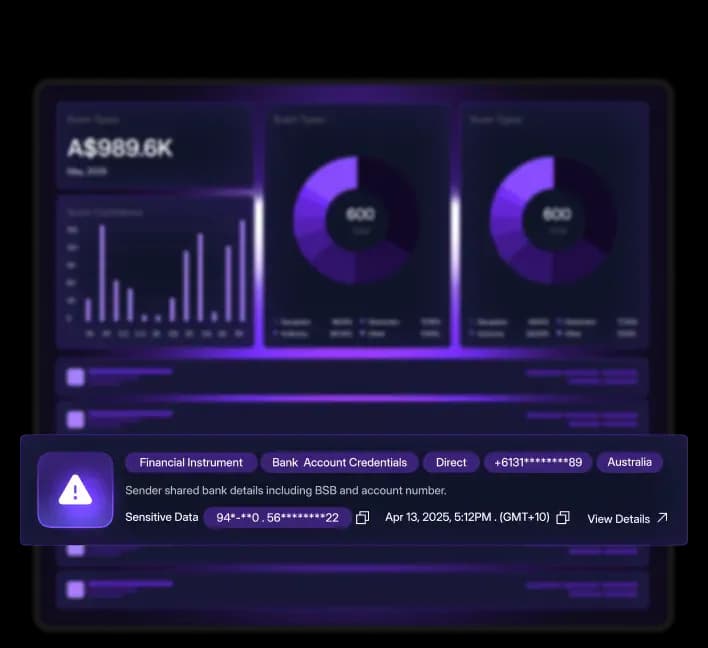
For a bank, a newly disclosed payment destination could become an investigative lead. Phone numbers and recurring impersonation tactics could inform a telecom provider’s investigation, while a brand-protection team might use a malicious website or impersonated identity to support a takedown request. These are possible uses of the reported outputs, not independently demonstrated results from each customer.
Collecting an indicator is not the same as validating it or acting on it. A bank account mentioned during a suspicious conversation still needs context. A website needs assessment. Each extracted detail should remain linked to the interaction that produced it so an analyst can judge what it means.
Teams evaluating AI products should examine how well the intelligence enters an existing workflow. A dashboard full of conversations has limited value if investigators cannot establish provenance, prioritise leads or record what action followed.
The 76% Loss Figure Does Not Isolate Apate’s Effect
The most consequential impact figure in TechCrunch’s report is a 76% decline in Commonwealth Bank’s publicly reported scam losses, cited by Joffe. It should not be read as an independently established estimate of losses prevented by Apate.
Commonwealth Bank’s own August 11, 2025 announcement reported a 76% reduction in customer scam losses from their peak, comparing periods labelled 2H25 and 1H23. The announcement presented the decline alongside a broader security programme, including investment in fraud, scams, financial crime and cyber protection.
Sources
- TechCrunch’s October 14 reporttechcrunch.com
- product websiteapate.ai
- August 11, 2025 announcementcommbank.com.au