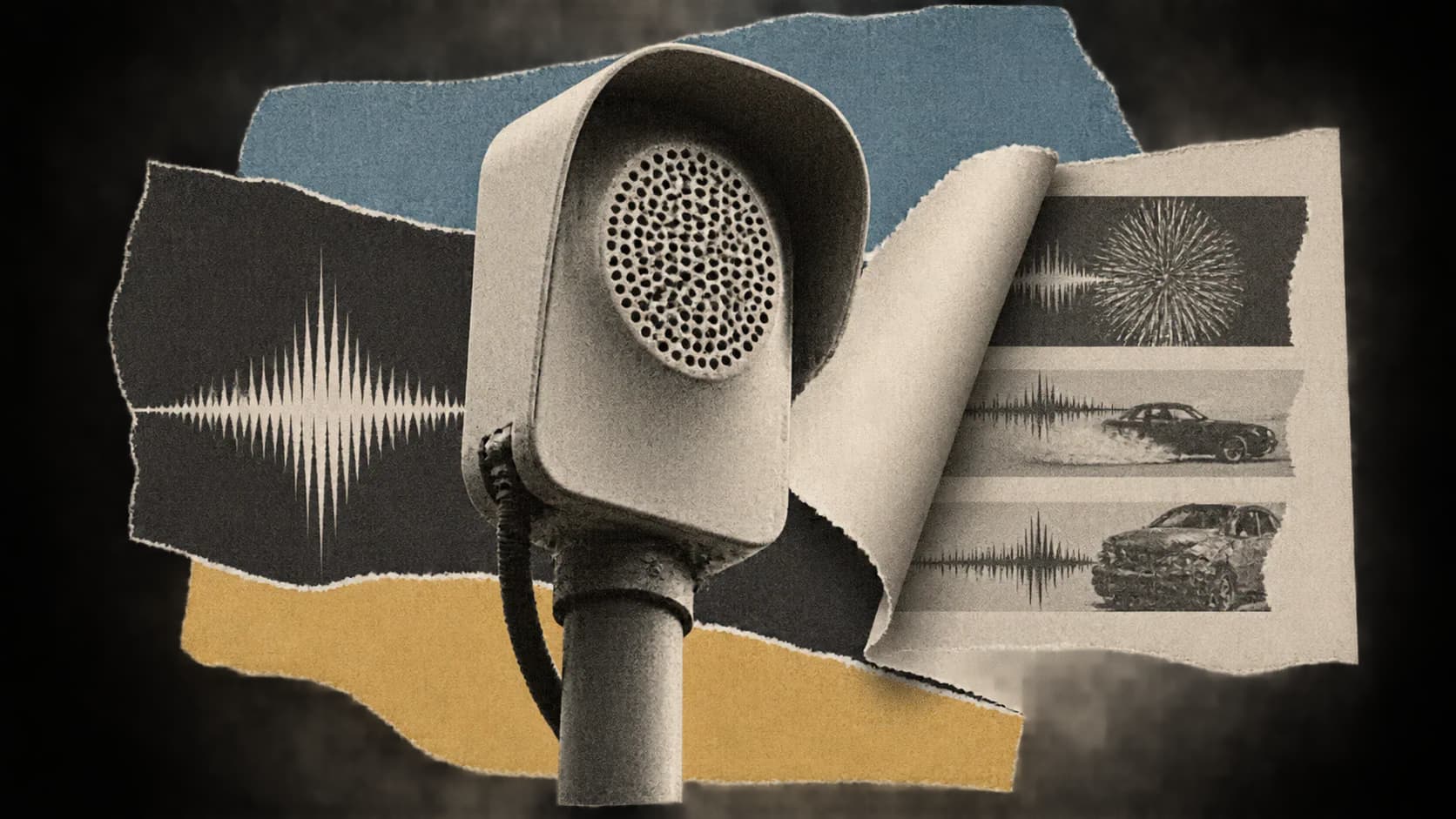
Flock Safety’s own product materials list gunshots, fireworks, sideshows and crashes as sounds its microphones can detect. Yet CEO Garrett Langley repeatedly described the system as detecting “just gunshots” during an appearance at TechCrunch Disrupt, according to TechCrunch’s October 14 report.
Asked about the discrepancy, a Flock spokesperson confirmed that the system’s capabilities extend beyond gunfire. The spokesperson said Langley intended to emphasize a different limit: the technology is not designed to monitor conversations or analyze speech.
An audio system can classify several kinds of environmental sounds without interpreting language. The evidence establishes a contradiction over the product’s stated detection categories; it does not prove that Flock operates a system for transcribing neighborhood conversations.
Municipalities buying the technology and residents living near its sensors need an accurate account of both what the system is designed to detect and what happens to the audio it processes.
Flock Advertises More Than Gunfire Detection
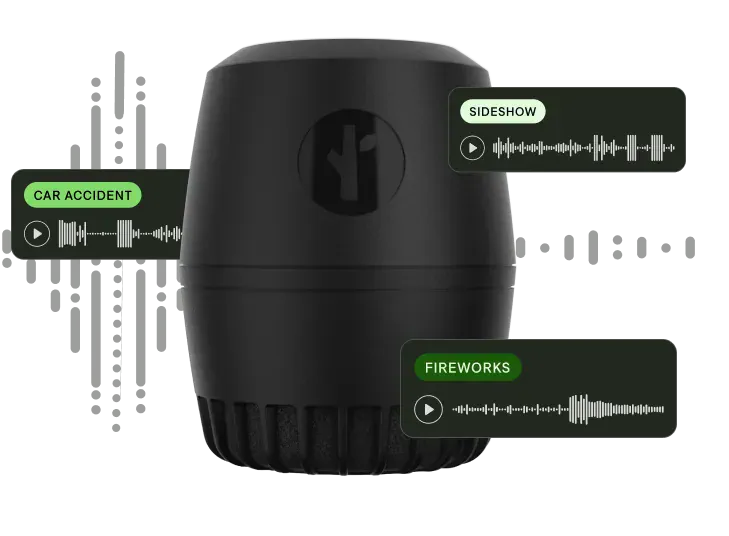
Flock’s audio-detection product page makes the mismatch explicit. Although the URL names gunshot detection, the page presents a broader audio product with four named capabilities:
- Gunshot detection: Identifying and locating gunfire.
- Sideshow detection: Detecting events the company describes as street takeovers.
- Crash detection: Identifying severe crashes.
- Fireworks detection: Distinguishing fireworks from gunfire to reduce false alerts.
The page also promotes alerts for crashes, fireworks and sideshows as a way to expand awareness beyond gunfire. Flock presents these sounds as detection features, not merely background interference.
According to TechCrunch, Langley discussed an earlier experiment with human-distress detection and said the company had decided the system would do only gunshots. When asked about marketing materials that described additional detection capabilities, he again answered that it was just gunshots.
Flock spokesperson Paris Lewbel subsequently told the publication that gunfire is the technology’s primary use, but that it can also detect fireworks, sideshows and potential car crashes. “Primarily” is materially different from “only.” Lewbel’s description aligns with the product page’s broader list and conflicts with Langley’s literal description of the system’s scope.
The crash claim also carries a qualification: while the website markets crash detection, the spokesperson described potential car crashes. Neither source provides independent evidence here that the system reliably identifies every advertised event. The categories describe intended capabilities, not measured accuracy.
TechCrunch also reported that Flock’s website described a detection library that could expand to address emerging threats relevant to customers. The list is a statement of scope, but not necessarily a permanent boundary.
Detecting Sounds Is Different From Analyzing Speech
Flock’s explanation of Langley’s remarks addresses a legitimate distinction, even though it does not resolve the wording problem. Recognizing an acoustic event, such as a gunshot or fireworks, is different from understanding spoken language. A sound classifier can assign an event label without transcribing words, identifying speakers or interpreting a conversation.
In its technical explanation of audio detection, Flock says the system cannot understand speech, analyze language or identify voices. It also says users cannot search for spoken words.
These are vendor claims about the system’s design and limits, not an independent technical assessment. Recognizing several non-speech sounds does not, by itself, contradict them.
The microphones’ processing and retention practices need closer attention. Flock says its sensors continuously analyze audio on the device in rolling windows of about three seconds. If the system finds no qualifying event, the company says the audio is discarded almost immediately without being stored or transmitted.
When it identifies a qualifying event, Flock says it saves an encrypted short audio clip, determines the event’s location and sends an alert to authorized users. The company also discloses an exception for limited, pre-scheduled diagnostic samples used to improve performance.
Under that account, the microphones analyze sound continuously and retain it selectively. They do not switch on only after a gunshot. Nor does “event-triggered” fully describe every circumstance in which the company says it retains audio.
Flock acknowledges that an event clip may incidentally contain a few spoken words if someone is talking nearby when a qualifying sound occurs. The company maintains that the system does not seek out conversations or analyze their contents. Saying the product can never capture speech would therefore be too broad. Treating that incidental-capture disclosure as evidence that it routinely records or transcribes conversations would be equally unsupported.
The company also says neither its customers nor Flock can open a live audio feed to listen to a location in real time. The cited materials do not provide independent technical verification of that restriction or the other processing and retention claims.
The Removed Distress Pilot Does Not Explain Every Category
The earlier human-distress feature helps explain the context of Langley’s remarks, but it does not reconcile them with the current product description.
According to TechCrunch, Flock initially promoted detection of screaming, faced criticism from privacy groups, changed its wording to human distress and later withdrew the capability from customers testing it.
Flock’s technical explainer likewise says it offered a limited pilot for sounds of human distress, including screaming. The company says the feature was available to a small number of customers, was never broadly released and has been removed.
That history supports the narrower statement that Flock says it no longer detects human screaming or distress. Fireworks, sideshows and potential crashes remain part of the company’s stated capabilities, so removing the distress category does not support the claim that the product now detects nothing except gunshots.
The former distress pilot should not automatically be equated with speech recognition, either. Detecting a scream concerns a type of sound; understanding what someone says concerns language. Both can raise privacy questions, but they require different factual descriptions and potentially different safeguards.
Cities Need a Deployment Policy, Not a Slogan
For a municipality considering Flock’s microphones, the immediate procurement question is which detection categories it is actually purchasing and enabling.
The cited materials establish what Flock advertises. They do not establish that every installation has every advertised category active. A city should distinguish the product’s available capabilities from the configuration approved for its own deployment.
Several operational questions follow directly from the company’s disclosures:
- Which events trigger retention and alerts? The approved list should identify the enabled categories rather than rely on the gunshot-detection label.
- What can change after deployment? If the detection library expands, the policy should state who authorizes additional categories.
- What audio is retained outside detected events? Diagnostic sampling deserves its own explanation, including its purpose and controls.
- Who can access retained clips? Access and retention rules should account for the possibility of incidental speech.
- What information accompanies an alert? Buyers should understand how audio events connect to other surveillance records.
Flock’s product page advertises linking sound alerts with nearby vehicles and video footage. Its technical explainer says a confirmed event can surface vehicles observed entering or leaving the area through nearby license plate reader cameras. Flock says a human reviews the information and decides what action, if any, to take.
An audio deployment’s practical scope includes the classifier’s event labels, the records an alert brings together and the decisions that follow. None of this establishes that Flock secretly monitors conversations. It does show why public descriptions need to be precise: a resident evaluating a gunfire-only deployment is being asked to accept a different stated scope from one that also generates alerts for other events.
Flock’s spokesperson supplied a more accurate description than the CEO’s repeated gunshot-only claim: the system primarily detects gunfire, also supports other environmental-sound categories, and, according to the company, does not analyze speech or monitor conversations. Municipal contracts and public privacy policies should use that fuller description, then specify which capabilities are enabled and how any expansion will be approved.
Sources
- TechCrunch’s October 14 reporttechcrunch.com
- audio-detection product pageflocksafety.com
- technical explanation of audio detectionflocksafety.com