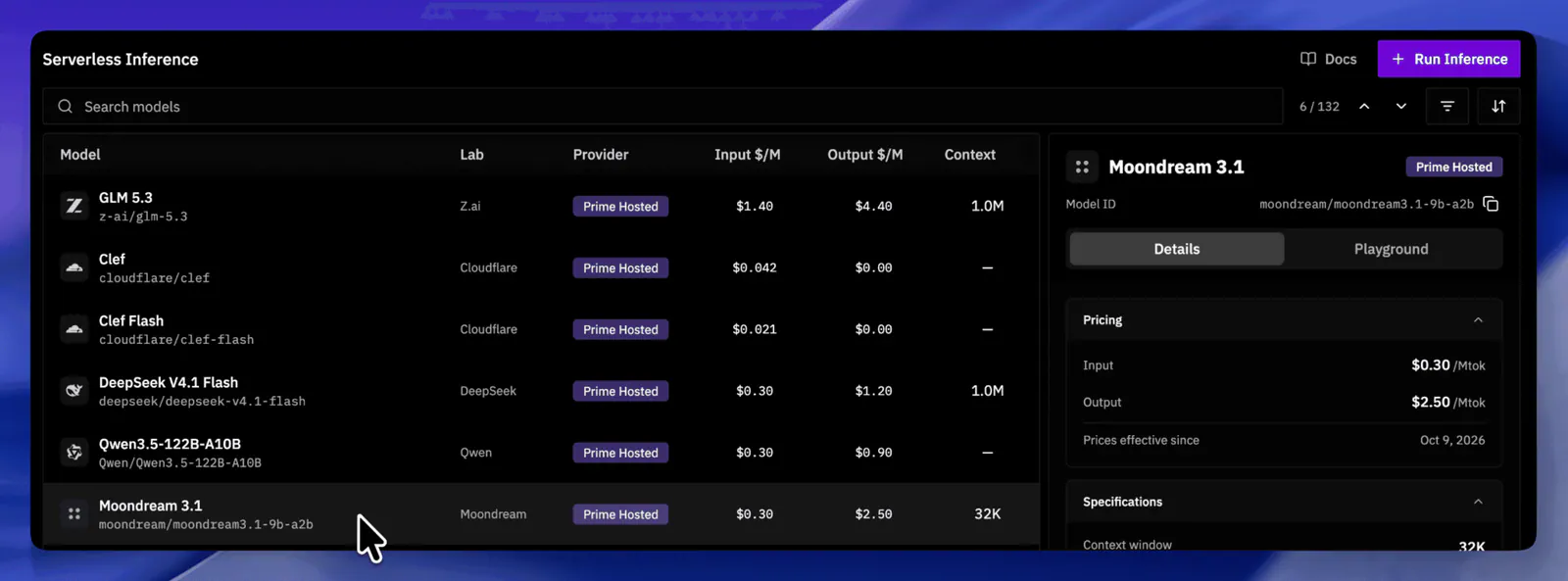
Moondream 3.1 is already available through Prime Inference, powered by Moondream’s Photon engine. Existing Moondream Cloud customers are also waiting for platform credits, which Prime Intellect says will arrive within days of the acquisition announcement.
These are the first customer-facing changes from Prime Intellect’s acquisition of Moondream, announced on October 13, 2026. Moondream founders Vik Korrapati and Jay Allen are joining Prime to lead and scale inference and accelerate its multimodal work, including vision and computer use. Financial terms were not disclosed.
The deal combines a compact open-weight model team, a specialized inference engine, and Prime’s training platform. Moondream will remain a brand, while Photon and its underlying GPU engineering become part of Prime’s stack. Some model access is already live, though the acquisition announcement leaves existing customers without a complete migration guide.
Moondream Keeps Its Name, Photon Joins the Infrastructure
Prime says Moondream will continue as its brand for small, efficient multimodal models. The model family keeps its identity; that does not guarantee a separately operated platform or unchanged commercial arrangements.
Photon is the engine that runs models. Prime says it is integrating Photon, Moondream’s custom GPU kernels, and the associated compiler work into its technology stack, with plans for Photon to power more than Moondream’s own models.
The relationship predates the acquisition. According to Prime, Moondream was one of its earliest customers. The transaction brings that customer’s model and serving expertise inside the company supplying its training stack.
Prime describes its stack as connecting evaluation, fine-tuning, reinforcement learning, and inference. Moondream adds a team working on both model behavior and the machinery that serves those models, creating an opportunity to optimize them together instead of addressing deployment performance separately after training.
The broader Photon integration is still ongoing, according to Prime. The available Moondream 3.1 endpoint does not mean every integration is finished.
Which Models Are Available Through Prime Inference?
The model availability details in Prime’s announcement identify three immediate access routes:
- Moondream 3.1: Available through Prime Inference and explicitly described as powered by Photon.
- Clef: Available through Prime Inference and OpenRouter.
- Clef Flash: Also available through Prime Inference and OpenRouter.
All three are announced as live offerings. Only Moondream 3.1 is specifically identified as Photon-powered, so the post does not establish that every listed model uses the same serving backend.
The announcement provides relative pricing comparisons for Clef and Clef Flash, without a complete standalone rate table. Developers should check the applicable endpoint’s current pricing before estimating production costs. The acquisition post is not a billing specification.
Nor does availability establish compatibility with an existing application. The announcement supplies no API base URLs, authentication instructions, request schemas, or compatibility guarantee for applications built against Moondream Cloud.
New users have an announced route to Moondream 3.1 through Prime Inference. Existing customers will need more than the same model name on another platform to move an application.
Moondream Cloud Customers Still Need Migration Details
Prime promises that every Moondream Cloud customer will receive credits on its platform “in the next few days,” relative to the October 13 announcement. Those credits will be usable for Moondream models and Prime’s broader training and inference offerings.
The credits are a concrete transition benefit, though they do not amount to a promise to transfer every aspect of an existing account. The post does not specify credit amounts, eligibility mechanics beyond being a Moondream Cloud customer, or whether credits correspond to customers’ existing balances.
There is also no Moondream Cloud shutdown date or required migration deadline in the post. The promised credit distribution should not be read as either.
Teams running production workloads should separate three checks:
- Account access: Confirm how their Moondream Cloud account connects to a Prime account and where the promised credits appear.
- Application compatibility: Verify authentication, request and response formats, model identifiers, and any application changes before switching traffic.
- Commercial continuity: Confirm credit value and expiry, applicable pricing, rate limits, and any overlap between the old and new services.
These are checks for developers, not migration procedures already documented in Prime’s acquisition post.
For automated workloads, a model can remain available under the same brand while account, billing, and API arrangements change. Keeping a working deployment in place until its replacement passes application-level checks is more defensible than assuming the acquisition guarantees a transparent handoff.
Photon Targets Real-Time Work, Not Just Large Queues
On its Photon product page, Moondream describes an engine that compiles each model into a single GPU program for its target chip. Prime’s announcement identifies the associated megakernel compiler and custom GPU kernels as part of the technology being integrated.
Model-specific and hardware-specific engineering are central to that design. Photon is more than another hosted endpoint.
Moondream positions Photon around small batches, low latency, and consistent tail latency. It contrasts those priorities with engines such as vLLM and SGLang, which it describes as optimized for throughput over large request queues. This is the vendor’s characterization, not an independent finding that Photon is universally faster.
An application responding to the next camera frame or spoken utterance has different requirements from a service processing a large backlog. High aggregate throughput alone does not establish that an individual request will finish quickly or predictably enough.
Photon’s product page lists support across vision-language and speech-recognition models, with model-and-chip combinations documented in a support matrix. It also describes supported local use as free on users’ own hardware.
The local offering is separate from Prime’s hosted-service credits. The acquisition announcement establishes no new licensing terms and does not guarantee that every future model and hardware combination will follow the same arrangement.
The Speed Claims Need Workload-Specific Evidence
Prime’s performance claims include more than 60 Moondream inferences per second on a single NVIDIA H100. The announcement’s references attribute that figure to unpublished internal measurements.
Sources
- Prime Intellect’s acquisition of Moondreamprimeintellect.ai
- Photon product pagemoondream.ai