HackerRank’s Chakra makes the work process part of a technical interview: candidates tackle a repository-based task with an AI assistant, while another AI observes their approach and asks them to explain decisions. The finished code is only part of what the employer receives.
According to TechCrunch’s launch report, Chakra became generally available to HackerRank customers on October 5, 2026, after roughly six months in beta. HackerRank says the system conducted more than 500,000 interviews during testing. TechCrunch names Snowflake, Snorkel, and Capgemini among the companies that tried it; the interview count remains a company-reported figure, not an independently audited result.
Chakra includes AI assistance in the workspace and aims to evaluate how candidates use it, changing its role from something solely to detect or prohibit. That creates a potentially useful hiring signal, alongside a harder question: how reliably can an automated interviewer measure engineering judgment?
The Interview Happens Inside a Code Repository
HackerRank describes Chakra as an agentic interviewer that creates a work canvas, observes candidates, and evaluates qualities including judgment, critical thinking, and AI fluency. In the workflow described by TechCrunch, candidates receive a task involving a real-world code repository and work in an environment that includes an AI assistant.
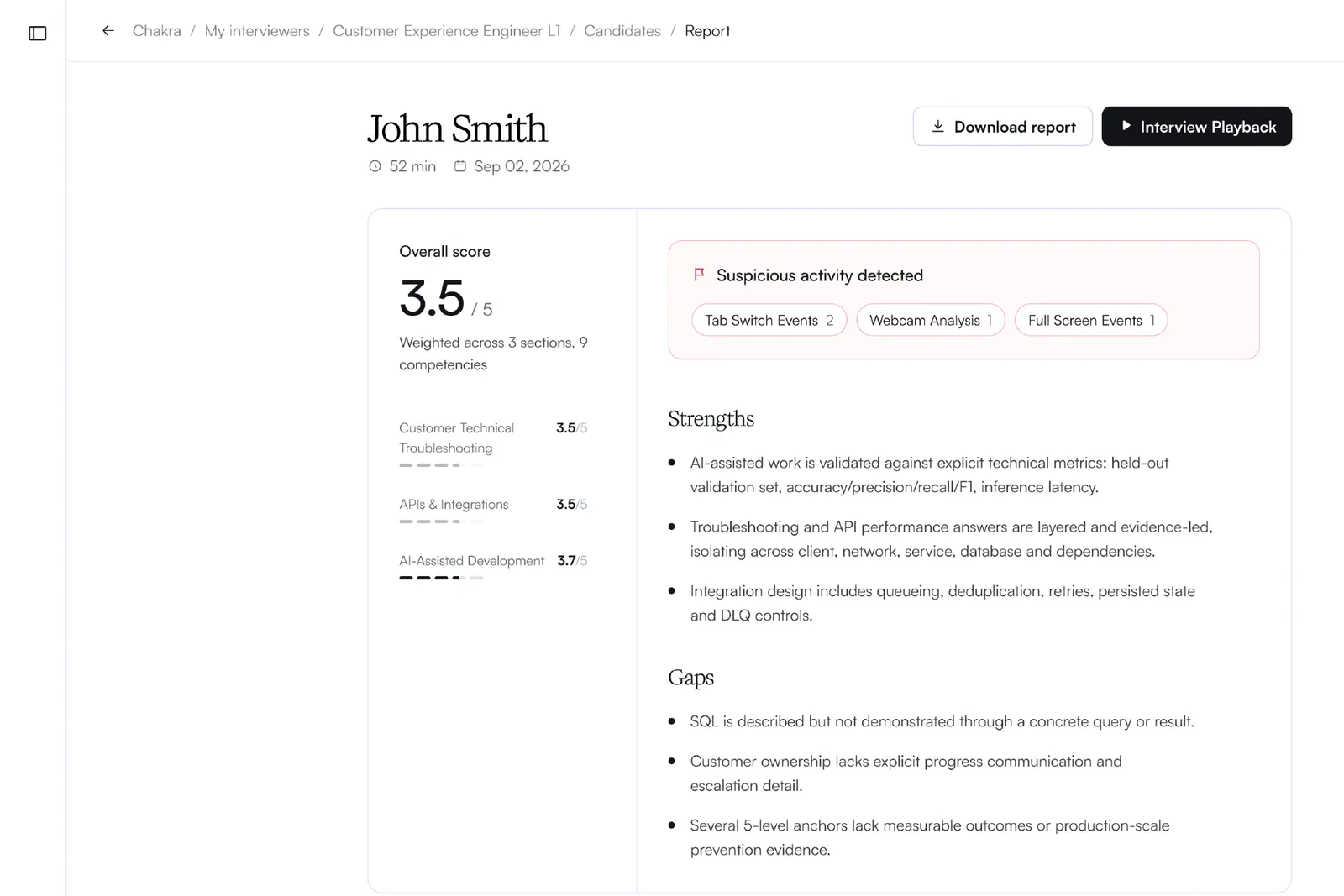
Chakra uses that context to ask follow-up questions. It might probe why a candidate chose one approach over another, or ask how the solution would change under a new constraint. Afterward, it produces an evaluation report for the hiring manager.
A correct submission establishes that a solution passed the assessment’s requirements. Questions about the path to that solution can provide additional evidence about whether the candidate understands it, recognizes its limitations, and can adapt it. That is a consequential difference from an answer-focused coding test.
Working in a repository also requires the candidate to navigate an existing code context instead of solving an isolated problem. The format offers an opportunity to assess how someone approaches unfamiliar software, although a job-like setting alone does not establish that the resulting score predicts workplace performance.
Candidates should be prepared to explain their reasoning and defend choices made with AI assistance; generating working code may not be enough. Employers, in turn, may receive a richer record of how a solution developed, beyond the final artifact.