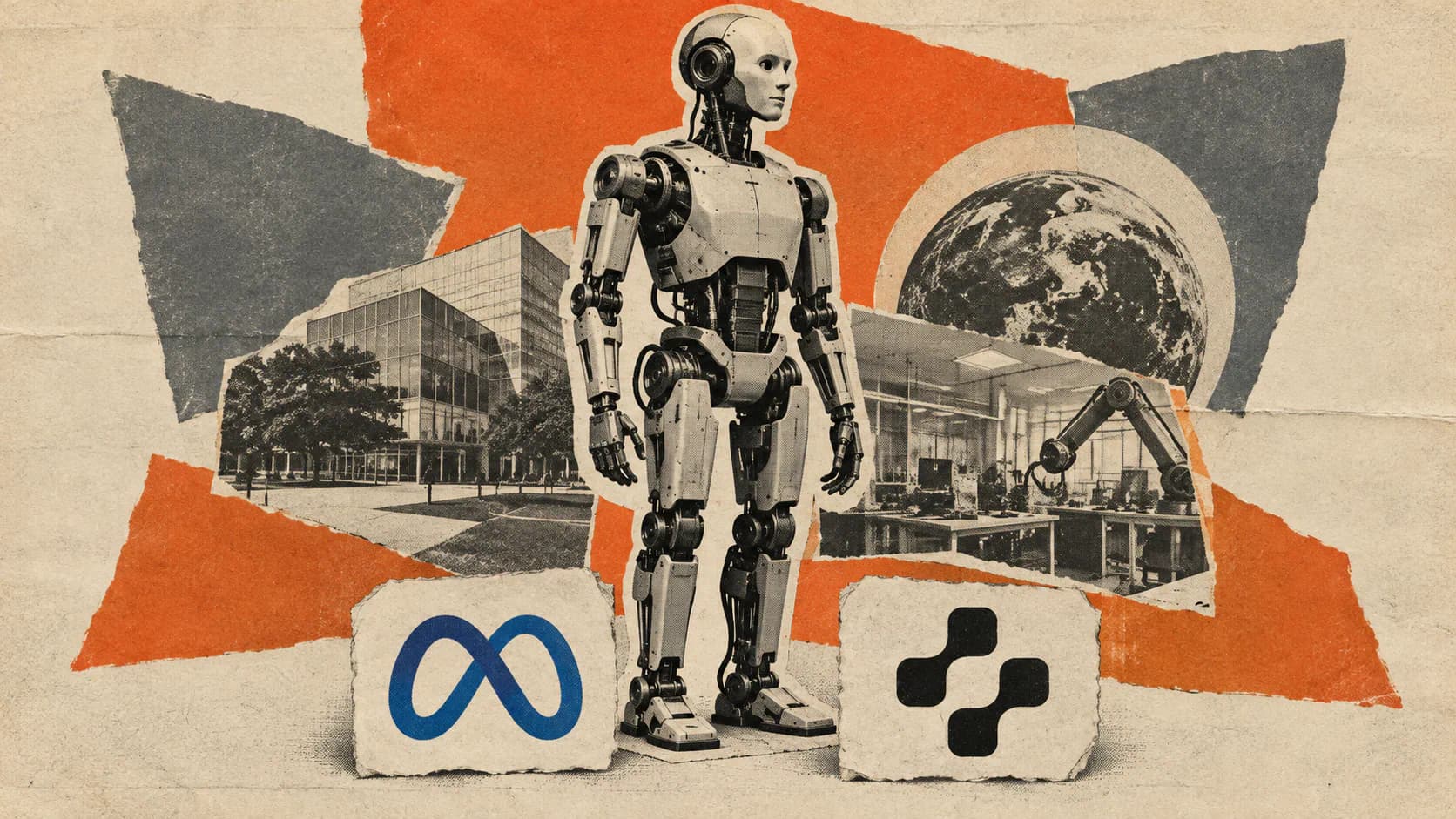
Meta has reportedly partnered with robotics company Fourier to develop a humanoid research prototype named Max, though the company claims it has no plans to sell the units as a consumer product. The project is intended to provide an internal platform for testing Meta’s AI software in physical environments.
According to reports, the 1.5-meter, 48-kilogram prototype utilizes an Nvidia Jetson Thor chip and features five-fingered hands. Development of a second version, Max 2, reportedly began in September, incorporating plans for improved hands and sensors for stair navigation.
Meta has built a humanoid robot prototype called Max with Chinese robotics company Fourier and is already working on a second version, according to The Information’s October 31, 2026 report. The account, by Jyoti Mann, cites people familiar with the initiative.
The most consequential detail is Meta’s stated purpose. According to The Next Web’s account of the reporting, Meta told The Information that the Fourier work is for internal research and experimentation, with no plans to sell the units. That makes Max a reported research platform, not an announced household appliance.
The evidence has limits. The Information’s account relies on unnamed sources, and TNW says it has not independently verified the report. The specifications and development schedule below should therefore be read as reported details, not publicly confirmed Meta product specifications.
Even with that qualification, the project would mark a meaningful step. Building a physical robot with a hardware partner gives Meta a way to investigate how its AI software behaves when perception, movement and interaction must work together.
What the Report Says About Max
Meta and Fourier reportedly built the first Max prototype in about three months. It weighs approximately 48 kilograms, or 106 pounds, stands about 1.5 meters tall and uses Nvidia’s Jetson Thor chip, according to TNW’s summary of The Information’s findings.
The reported configuration combines manipulation hardware with features intended for interacting with people:
Reported feature
What it tells us
Approximately 1.5-meter height and 48-kilogram weight
Max is a substantial physical machine, making movement and contact safety important research concerns.
Nvidia Jetson Thor chip
The report identifies a computing component, but leaves the full processing architecture unspecified.
Screen that mimics facial expressions
The prototype includes a visual interface for communicating with people.
Built-in speakers
Audio output is part of the reported design.
Five-fingered hands for picking up small objects
Object manipulation is an intended capability, though the account provides no measured grasping results.
The distinction between components and demonstrated performance matters. Five fingers describe a hand’s shape; they do not tell us how reliably it can handle a slippery cup, a flexible package or an unfamiliar object. Those tasks also depend on sensing, grip control and coordination.
The same caution applies to the chip. Naming Jetson Thor identifies part of the hardware stack, but it leaves open which tasks run locally, whether any processing depends on cloud services and how the system handles delays or connection failures.
My view is that the useful news is the integrated platform itself. The reported parts give researchers something concrete to connect and evaluate. They provide much less information about how capable the resulting robot is.
A Physical Testbed for Meta’s Software Ambitions
Meta reportedly sees humanoid robots as a physical form for Muse, its AI agent, with household tasks as a longer-term ambition. TNW also reports that Meta acquired San Diego-based Assured Robot Intelligence in May, bringing its robotics AI team into Meta Superintelligence Labs.
Taken together, those details fit a strategy centered on the software layer for consumer humanoids: an agent that can interpret requests, understand its surroundings and coordinate actions through a robot body. That is an analysis of the reported direction, not confirmation of a particular licensing model or commercial platform.
A physical prototype would help expose the gaps between those layers. Consider a simple illustrative request to put an object away. A robot would need to identify the right item, determine whether it can reach it, choose a grip, move without dropping it and recognize whether the task succeeded. A misunderstanding at any stage changes what the next stage should do.
That example is not a reported Max demonstration. It illustrates why an AI company might need integrated hardware experiments even if its main interest is software. A language agent can produce a plausible plan while the body encounters an obstacle, loses its grip or receives incomplete sensor information.
Fourier’s role gives this strategy a hardware partner. Nvidia supplies the reported computing component, while Meta’s Muse ambitions and robotics AI acquisition point toward the intelligence side of the system. The exact division of engineering responsibility has not been disclosed in the cited account.
I’d read that combination as evidence of an effort to connect software research with physical constraints. It is too early to infer that Meta intends to manufacture a mass-market robot, or that it has settled on software other robot makers could adopt. The report provides no licensing terms, third-party compatibility details or supported hardware requirements.
Max 2’s Reported Changes Reveal the Research Priorities
Meta’s involvement reportedly extended to work at Fourier’s facilities. Li-Chen Miller, Meta’s vice president of product for robotics, spent almost two months at the company’s Shanghai factory, according to TNW. Meta then showed Max to some employees at an internal robotics summit in late August.
Work on Max 2 reportedly began in September. Planned changes include:
A new torso.
Improved hands.
A projector.
Additional sensors intended to help with stairs.
These changes are informative because they touch several different engineering problems. Better hands concern manipulation. A revised torso changes the physical platform. Extra sensors for stairs concern the robot’s ability to perceive an environment that is harder to navigate than a flat floor.
The projector’s intended use is unclear from the account, so assigning it a specific role would be speculation. It could be tempting to treat every listed component as a finished feature, but the reporting describes development plans.
The stair-related sensors are especially revealing. Adding sensing to help with stairs identifies a problem the team wants to address. It supplies no evidence that the robot can already climb stairs reliably. Perceiving a step and moving a heavy, articulated body over it are connected but separate challenges.
The reported progression from Max to Max 2 suggests that Meta and Fourier are still changing the platform itself. I’d treat that as a sign of active experimentation: the team appears to be adjusting the body and its inputs while exploring what the software needs.
Why Internal Hardware Still Matters
Meta’s reported statement that it has no plans to sell these units places a clear boundary around the story. The account also says Meta has not set a launch date for a humanoid product.
Internal research hardware can still be strategically valuable. A company pursuing robot software needs ways to observe where instructions fail, where sensing is inadequate and where a physical design limits what the AI can accomplish. A jointly developed prototype can make those dependencies easier to investigate because the software and hardware teams can change the system together.
That is the strongest practical implication of Max. If the report is accurate, Meta has moved beyond studying robotics software in isolation toward a shared physical platform where design decisions can affect one another.
For readers following AI industry competition, this is a different milestone from a polished demonstration or a shipment announcement. A prototype answers whether a team has assembled a system to investigate. A commercial product must answer questions about repeatability, reliability, support and safe operation outside controlled conditions.
The published details do not provide task-completion rates, battery runtime, payload capacity or the amount of human assistance involved in operation. Those omissions prevent a useful performance comparison with competing humanoids. Height, weight and a processor name cannot substitute for comparable task results.
For a prospective household robot, I would look first for evidence about a narrow, repeatable task: what it completed, under which conditions, how often it failed and when a person had to intervene. That would say more about practical usefulness than a longer component list.
Max’s reported significance is therefore specific. It would give Meta a body on which to develop and examine its robotics software, with Fourier participating in the physical engineering. Whether that work eventually produces a Meta device, software for partners or research that informs another project remains open.
Frequently Asked Questions
3 questions
1
Is Meta planning to sell Max?
According to TNW’s account, Meta told The Information that the units are for internal research and experimentation, with no plans to sell them. No consumer launch date is reported.
2
Is Max the same robot as Fourier’s GR-3?
The report does not identify them as the same robot. TNW describes Fourier’s GR-3 as a 165-centimeter humanoid unveiled in August 2025, while Max is reportedly about 150 centimeters tall.
3
What would demonstrate useful progress beyond the prototype?
Published results showing repeatable task completion, operating conditions, failures and human intervention would be more informative than specifications alone. The cited reporting provides no such performance measurements.