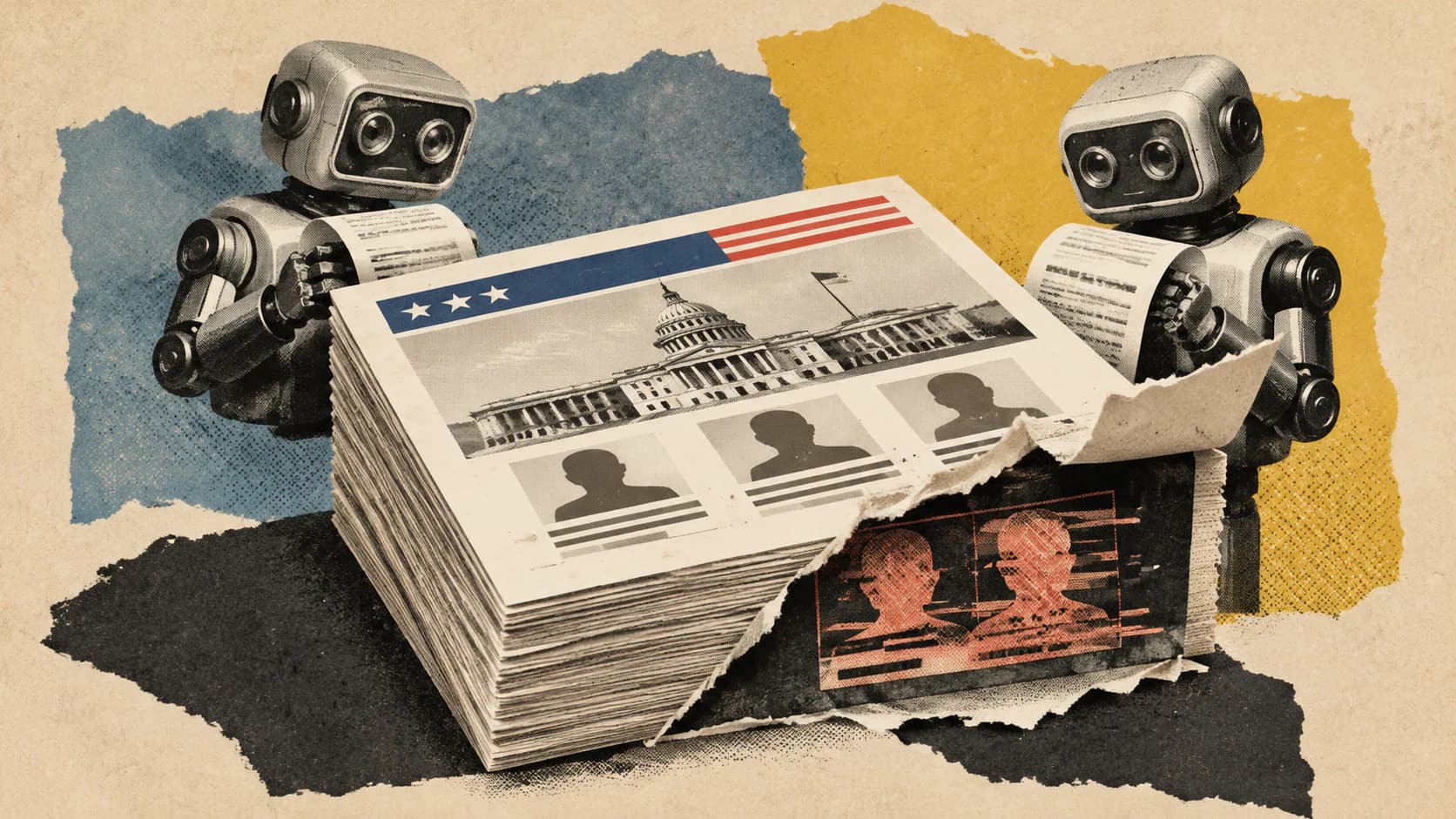
Microsoft Copilot cited the AI-built website Ballot Brief in 75% of tested election answers, while ChatGPT cited it in 22%, according to a Washington Post investigation published on October 30, 2026. The site contained errors involving candidate identities, committee roles and legislative support, some of which chatbots repeated. The Post’s report exposes a sourcing problem: an answer can include a citation and still inherit an upstream AI mistake.
Ballot Brief’s founder, Ben Torres Ezrick, used teams of AI agents to gather information across the web and build candidate dossiers. That approach offered a way to cover thousands of candidates. It also created a feedback loop in which AI-produced material became evidence for other AI systems answering voters’ questions.
The consequential finding is the combination of frequent citation and documented error propagation. Source selection is part of the product’s accuracy problem.
What the Citation Rates Actually Measure
The Post’s broader investigation asked six popular chatbots to produce voter guides for addresses in every U.S. county. Its companion report, dated October 28, described invented races and candidates incorrectly presented as appearing on the ballot.
The October 30 investigation focused on Ballot Brief’s role in that information pipeline:
| Chatbot | Share of tested election answers citing Ballot Brief |
|---|---|
| Microsoft Copilot | 75% |
| ChatGPT | 22% |
Copilot’s citation rate was 53 percentage points higher than ChatGPT’s. That is a comparison of sourcing behavior, not a comparison of accuracy. A response might cite Ballot Brief alongside other sources, and a citation alone does not show which individual claims came from it.
These figures apply to the Post’s test design and October 2026 testing period. They should not be treated as universal rates for every election question or later chatbot version. This article analyzes the published reporting; it adds no independent product testing.
AI Weekly’s summary of the investigation provides further details: the Post used a random address in each county and analyzed more than 3,000 guides. Across that set, chatbots omitted a congressional district 48% of the time. When they named a district, they named it incorrectly 22% of the time.
Those percentages have different denominators. The district-error figure applies only to answers that attempted to identify a district. It is also unrelated to ChatGPT’s coincidentally identical 22% Ballot Brief citation rate. Neither measure tells us what share of all chatbot errors originated on that website.
How an AI-Built Page Becomes Chatbot Evidence
Ballot Brief sits between underlying election information and the chatbot’s final answer. According to the Post’s account, Ezrick deployed AI agents to collect material and assemble candidate profiles. A chatbot could then encounter those profiles and cite them while constructing a voter guide.
The resulting chain has several opportunities for mistakes:
- Collection: Agents gather information about candidates, offices, districts and policy positions.
- Assembly: The website combines that material into profiles and voter-facing pages.
- Source selection: A chatbot selects those pages as supporting material.
- Answer generation: The chatbot incorporates claims into a personalized guide.
The reporting establishes frequent citation and examples of repeated errors. The internal ranking process remains unclear, so it would be speculative to blame a particular search-ranking signal, traffic threshold or commercial arrangement.
My view is that this is the most useful distinction in the investigation: retrieving a webpage and validating its contents are separate jobs. A chatbot can faithfully summarize a page that contains a false claim. Adding a link makes the answer easier to inspect, but the link’s presence supplies no independent check.
Ezrick said the site draws on official government sources and lets visitors provide an address for more complete candidate information, according to AI Weekly’s account of the Post’s reporting. Official inputs can still become inaccurate during collection, matching or summarization. The relevant question is whether the final claim remains traceable to the correct underlying record.
The Errors Affect Different Parts of a Voter Guide
The Post documented several kinds of Ballot Brief errors:
- Merged candidates: Information about different people was combined.
- Incorrect committee roles: Candidates were assigned inaccurate committee positions.
- Misattributed legislative support: Support for legislation was attached to the wrong person.
- Wrong ZIP-to-district mappings: Geographic matching placed voters in incorrect congressional districts.
The first three categories appear in the October 30 investigation. AI Weekly’s summary also describes incorrect ZIP-code mappings and reports that chatbots passed those mistakes along.
These failures have different practical consequences. Merging candidates corrupts identity. A committee error misstates someone’s institutional role. Misattributed support changes the policy record a voter sees.
A geographic error can undermine the entire guide before any candidate description is considered. If the system selects the wrong district, an otherwise accurate profile may describe a race the reader cannot vote in.
That makes address-to-district matching a particularly important validation step. ZIP codes describe postal delivery areas; they are not a dependable substitute for electoral boundaries. I’d prioritize checking the address and ballot assignment before assessing the prose quality of a generated guide. A polished summary cannot rescue the wrong race selection.
The evidence supports propagation of some errors, not a claim that every listed mistake appeared in every tested chatbot.
Vendor Responses Address Different Parts of the Problem
After the Post shared its findings, OpenAI reduced use of Ballot Brief, Microsoft said it would prioritize authoritative sources, and Anthropic described reliability improvements, according to the October 30 report.
Those responses describe different interventions.
Reducing use of a particular website targets an identified source of unreliable information. It can limit exposure to that source without resolving how the system will evaluate the next AI-built site it encounters.
Prioritizing authoritative sources addresses a broader selection problem. For election information, the useful standard depends on the claim: ballot eligibility and district assignment require a different evidentiary path from a summary of a candidate’s stated policy position.
Frequently Asked Questions
3 questions
1Does Copilot’s 75% Citation Rate Mean 75% Were Wrong?
No. It measures how often tested answers cited Ballot Brief. The Post separately documented errors and instances where chatbots repeated them.