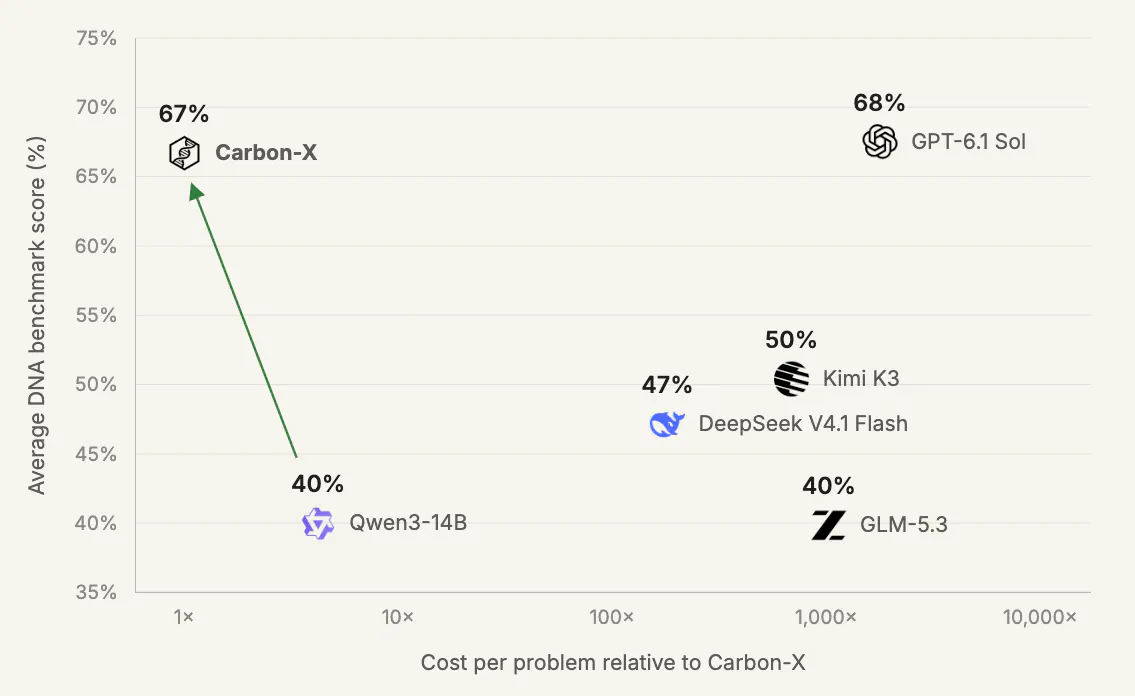
Researchers can download the Apache-2.0 weights for Carbon-X, Hugging Face’s new 14.8-billion-parameter DNA-and-text LLM, and analyze sequences on infrastructure they control. The documented serving configuration uses a single 80GB GPU. The model card also draws a boundary: exact counting, coordinates and sequence edits belong in code.
Released on October 22, 2026, Carbon-X accepts raw DNA alongside conversational questions and produces English explanations. Its practical appeal is local access to a sequence-aware research assistant. It is not a validated system for interpreting a patient’s genome.
DNA and Questions Enter the Same Decoder
Carbon-X derives from Qwen3-14B, with training that goes beyond prompting a general chatbot to discuss biology. According to the model card, Hugging Face mid-trained it on 302 billion tokens spanning DNA, biology text, English and instruction data.
Its hybrid tokenizer includes 5,515 DNA tokens. DNA and natural language share one token stream and one decoder, with no separate DNA encoder. A conversation can therefore contain sequence material, questions and responses mixing DNA with prose.
Where a conventional biology chatbot might explain published knowledge about a gene, Carbon-X is trained to process sequence content directly as part of the conversation. Hugging Face lists tasks including mutation classification, identifying regions that regulate gene activity, classifying sequences by organism group and predicting subsequent bases.
This training does not establish mechanistic understanding. An explanation remains generated text accompanying a prediction, not independent evidence that the prediction is biologically correct.
Local Serving Starts With Substantial GPU Memory
The downloadable repository and permissive license give researchers a concrete route to deployment. “Local,” however, should not be mistaken for “runs comfortably on an ordinary laptop.”
Although WIRED’s launch coverage describes laptop operation, the model card’s documented vLLM configuration uses a single 80GB GPU. That supports workstation or server deployment; it does not establish a minimum-memory configuration for consumer hardware.
The repository’s agent-tool example provides this serving command: