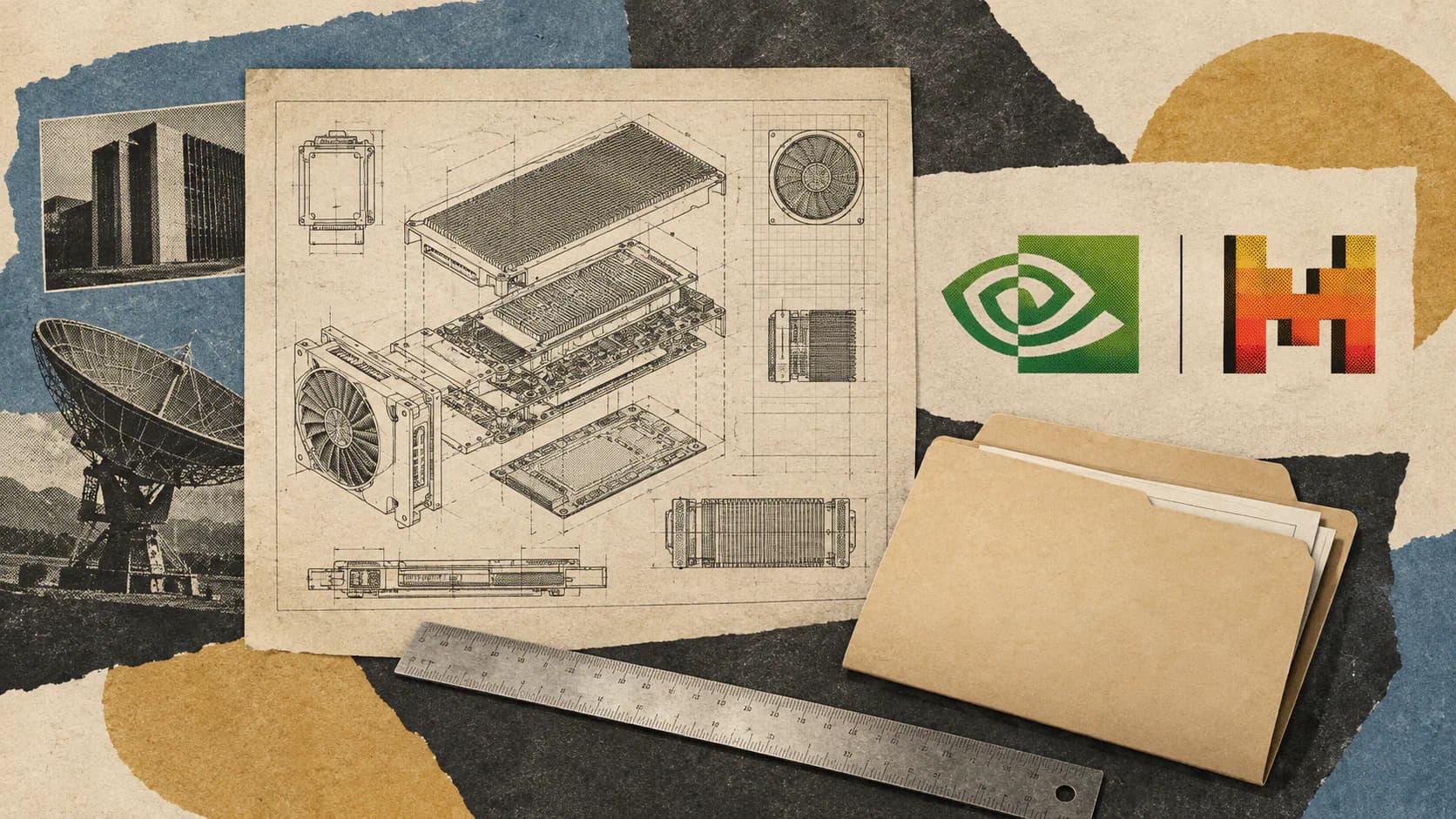
Mistral says its collaboration with Nvidia will produce public benchmarks and open datasets for AI-driven engineering. Those resources are intended to help teams compare physics models and evaluate automated workflows. They are not yet evidence that the proposed systems deliver faster or more reliable engineering results.
In its announcement dated October 21, 2026, Mistral describes plans to connect its models and physics-modeling pipelines with Nvidia’s accelerated computing tools. The work targets engineering applications in aerospace, automotive and semiconductors.
The consequential promise is a shared way to test these systems. The available announcement text provides no benchmark results or delivery timetable, leaving an important distinction between defining how engineering AI should be evaluated and demonstrating that it works.
Connecting Design, Simulation and Model Development
The proposed system combines Mistral Large 4 with Mistral’s data-generation and physics-modeling pipelines, accelerated by Nvidia CUDA-X libraries and Nvidia Warp. Mistral describes the objective as closed-loop workflows connecting simulation, AI model development and engineering design.
In practical terms, a closed loop would allow information from one stage to inform the next: simulation results could guide a design revision, which could then undergo another evaluation. That explains the intended workflow, not a capability independently demonstrated by this announcement.
The collaboration also covers planned integration with Nvidia Omniverse libraries for GPU-accelerated 3D scene generation and SimReady asset creation. Mistral presents this as work the companies will undertake, rather than an integration engineering teams can already deploy.
These are related but distinct tasks. Generating a scene or preparing an asset does not establish that an agent can correctly operate engineering software or interpret simulation results. Evidence for one component would therefore not validate the entire proposed loop.