Researchers can download the Apache-2.0 weights for Carbon-X, Hugging Face’s new 14.8-billion-parameter DNA-and-text LLM, and analyze sequences on infrastructure they control. The documented serving configuration uses a single 80GB GPU. The model card also draws a boundary: exact counting, coordinates and sequence edits belong in code.
Released on October 22, 2026, Carbon-X accepts raw DNA alongside conversational questions and produces English explanations. Its practical appeal is local access to a sequence-aware research assistant. It is not a validated system for interpreting a patient’s genome.
DNA and Questions Enter the Same Decoder
Carbon-X derives from Qwen3-14B, with training that goes beyond prompting a general chatbot to discuss biology. According to the model card, Hugging Face mid-trained it on 302 billion tokens spanning DNA, biology text, English and instruction data.
Its hybrid tokenizer includes 5,515 DNA tokens. DNA and natural language share one token stream and one decoder, with no separate DNA encoder. A conversation can therefore contain sequence material, questions and responses mixing DNA with prose.
Where a conventional biology chatbot might explain published knowledge about a gene, Carbon-X is trained to process sequence content directly as part of the conversation. Hugging Face lists tasks including mutation classification, identifying regions that regulate gene activity, classifying sequences by organism group and predicting subsequent bases.
This training does not establish mechanistic understanding. An explanation remains generated text accompanying a prediction, not independent evidence that the prediction is biologically correct.
Local Serving Starts With Substantial GPU Memory
The downloadable repository and permissive license give researchers a concrete route to deployment. “Local,” however, should not be mistaken for “runs comfortably on an ordinary laptop.”
Although WIRED’s launch coverage describes laptop operation, the model card’s documented vLLM configuration uses a single 80GB GPU. That supports workstation or server deployment; it does not establish a minimum-memory configuration for consumer hardware.
The repository’s agent-tool example provides this serving command:
vllm serve HuggingFaceBio/Carbon-X --trust-remote-code
Its client connects to an OpenAI-compatible endpoint at http://localhost:8000/v1, allowing researchers to integrate Carbon-X with software that already speaks that API format. The remote-code flag deserves review before deployment because it permits repository-provided code to run.
For direct Python integration, the repository declares Transformers support through AutoTokenizer and AutoModelForCausalLM. This offers an alternative to a persistent vLLM service. The documented single-GPU configuration should not be treated as a hardware guarantee for every context length or workload.
Hugging Face also provides an agent integration and a ready-made coding-agent skill. These make access easier, but introduce a privacy consideration: keeping Carbon-X local is insufficient if an external coordinating agent receives the same sequences. Researchers handling sensitive material need to examine the entire request path, including orchestration and logs.
Ask for Interpretation; Let Code Handle Exactness
The agent example supplies useful prompting guidance. It takes a question, optional context and named sequences, then encloses each sequence in <dna> and </dna> delimiters. Researchers should preserve that separation instead of mixing unlabeled sequence strings into prose.
A sensible workflow is to provide the biological question and relevant context explicitly, label each sequence and request a bounded interpretation. This is an editorial recommendation based on the interface, not a tested recipe for improving accuracy.
The model card’s limitations suggest a division of labor:
- Use Carbon-X for research predictions and explanations that will be checked against other evidence.
- Use deterministic code for sequence counts, coordinates and edits.
- Validate consequential biological conclusions independently rather than treating a fluent explanation as confirmation.
For example, code can establish precisely which bases differ between two sequences before the model discusses possible implications. This avoids asking generated prose to serve simultaneously as a sequence-processing engine and a biological interpretation layer.
Carbon-X can generate DNA tokens and continue sequences, though the card says it was not trained to design new DNA sequences. Generation capability does not establish that the model can reliably design functional genetic constructs.
Context Capacity Is Not Validated Sequence Accuracy
Carbon-X advertises a 40,960-token context window. The model card also says that this exceeds lengths used in training and that substantially longer inputs have not been evaluated.
A serving system accepting a long input does not demonstrate that predictions remain reliable across that input. Nor should a token limit be read as an equivalent number of DNA bases, particularly with a hybrid tokenizer. In practice, researchers should keep questions scoped to relevant sequence regions and validate performance at the lengths a project actually needs.
Hugging Face also warns that Carbon-X can hallucinate sequence identity or function and performs weakly on some splice-site and histone-mark tasks. These are substantive limitations for genomic interpretation. The model is not clinically validated, and its conversational interface does not change that status.
Close Benchmark Scores Do Not Establish Equivalent Utility
Hugging Face’s first-party evaluation reports a five-benchmark average of 66.7% for Carbon-X, compared with 67.5% for GPT-6.1 Sol at its best listed reasoning setting. The difference is 0.8 percentage points.
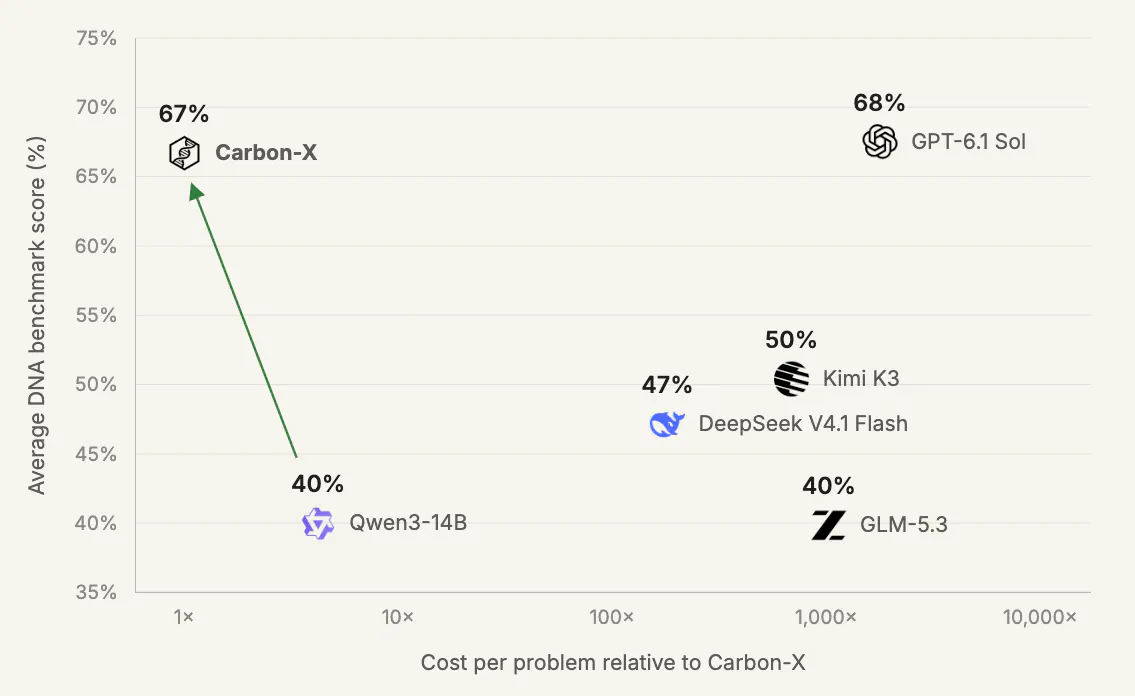
The comparison supports a narrow finding about the reported test suite. It does not demonstrate equivalent performance across genomics, establish clinical utility or resolve the task-specific weaknesses disclosed elsewhere in the card. An aggregate score can conceal differences that matter more than the average for a particular project.
The cost comparison also needs its assumptions attached. Hugging Face uses standard API pricing for comparison models and measured Carbon-X throughput on an H200 priced at $5 per GPU-hour. These are first-party calculations, not independent measurements of what every laboratory will pay. Actual local deployment costs depend on utilization and workload; a throughput-based comparison cannot by itself establish the economics of a lightly used GPU, long-context requests or a complete analysis pipeline.
Carbon-X’s clearest contribution is operational: researchers can obtain its weights, serve it locally and connect conversational sequence analysis to existing tools. Whether its predictions are useful for a particular biological task still requires validation. Local control does not establish that an interpretation is correct.