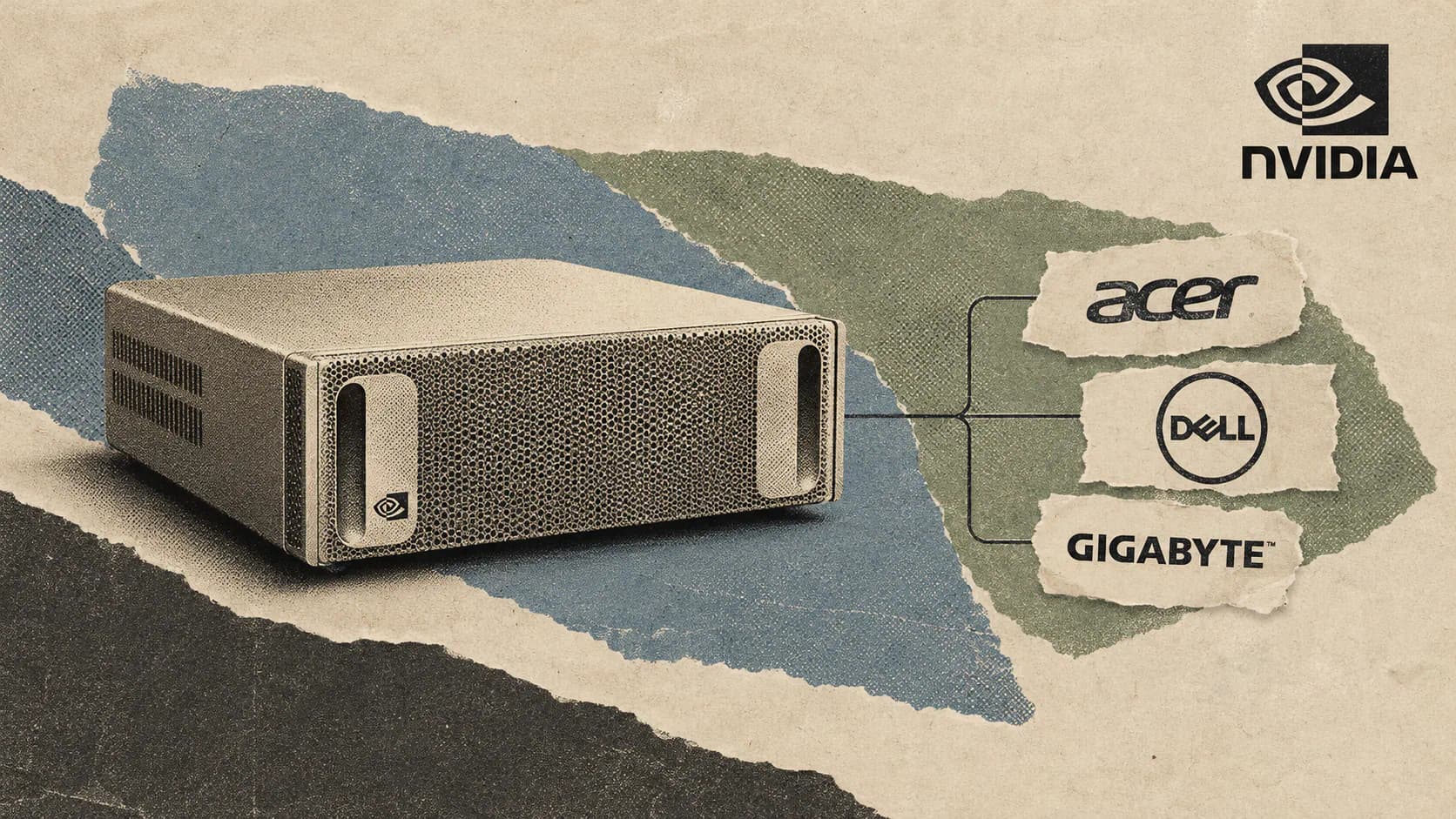
NVIDIA’s new 64GB DGX Spark retains the GB10 Grace Blackwell Superchip, DGX OS and NVIDIA AI software stack of the 128GB configuration. It targets developers who want a dedicated machine for local AI agents without starting with the platform’s larger memory option.
Buyers can expand later. NVIDIA says two 64GB systems can connect through NVIDIA Sync Cluster Assistant, combining their capacity into a 128GB memory pool for larger workloads. A networked cluster, however, is different from one machine containing twice the memory.
The October 2, 2026, forum announcement schedules availability for October 23 from Acer, Dell, Gigabyte, HP and MSI. It does not confirm that those systems are already broadly shipping.
For prospective buyers, the question goes beyond whether 64GB can run an AI model. That capacity needs to fit the model, context length and number of agents they intend to keep running.
A Smaller Memory Option Without a Different Software Platform
The 64GB configuration lowers the starting capacity while keeping the same development environment. According to NVIDIA, it uses the same GB10 chip, operating system and full AI software stack as the 128GB model.
The DGX Spark product page identifies both capacities as coherent unified system memory. Within each system, that memory serves the CPU and GPU. There is no conventional split between system memory and a separate graphics-card memory allocation.
For developers already building around NVIDIA software, continuity is the main attraction. The announcement lists support for NVIDIA Agent Toolkit, CUDA-X AI libraries, Nemotron models and frameworks including Ollama, vLLM and PyTorch with CUDA. Developers choosing the smaller configuration are intended to retain that environment without changing toolchains.
NVIDIA says a single 64GB unit supports models of up to 100 billion parameters. That vendor-stated capacity limit is no promise that every model below that size will run comfortably.
Model precision, runtime overhead, context length and concurrent requests all affect an agent’s memory requirements. A heavily compressed model that fits in memory may leave less room for long conversations or several agents than its parameter count suggests.
The right buyer is someone with a reasonably defined workload: a coding assistant, document-analysis agent or local application whose chosen model and operating requirements fit within 64GB. Developers who already know they need substantially more capacity should evaluate the larger configuration or a cluster from the outset.