
Treasury Secretary Scott Bessent has softened his stance on Jensen Huang returning as Nvidia’s CEO. He moved from calling for outside leadership to focusing on who bears responsibility for possible export-control failures.
Speaking on CBS’s Face the Nation on November 22, 2026, Bessent said officials needed to determine “where the buck stops” before judging a potential return. He did not endorse reinstating Huang, and he said the administration was still waiting for answers about Nvidia’s compliance practices. CBS News reported his comments.
President Donald Trump has publicly supported giving Huang another chance, while Nvidia board chair Harvey C. Jones said on November 17 that the board did not intend to reinstate him. Bessent’s answer changes the political pressure around that decision. It provides no evidence that Nvidia has changed its CEO search.
Bessent Shifts From an Outside Hire to a Responsibility Test
Bessent’s November 22 comments made his position on Nvidia’s leadership less categorical than his earlier demand for an external replacement.
In an earlier Fox News interview, Bessent said Nvidia’s directors should look “outside the company” and declared, “They need a dramatic shake-up.” Nvidia said it would consider both internal and external candidates, with chief financial officer Colette Kress serving as interim CEO, according to Business Insider’s account.
On CBS, Bessent instead emphasized the unresolved question of who knew about any noncompliance. He discussed possible responsibility at lower, middle and senior levels of the business, and expressed confidence that Nvidia’s committees would investigate.
Bessent also said administration officials had been in contact with Nvidia’s temporary management, lead directors and lawyers. The answers he had requested about compliance had not yet arrived, CBS reported.
My reading is that Bessent has moved from advocating a particular hiring outcome to describing an accountability test. An insistence on an outside CEO leaves little room for Huang. An inquiry into which executives knew what leaves more possibilities open.
That is a meaningful softening, but its limits matter: Bessent did not say what findings would make Huang’s return acceptable, promise to support him, or withdraw the demand for answers.
Nvidia’s Board Still Has the Clearest Public Position
Nvidia’s board said on November 17 that it “does not intend to reinstate” Huang, after the former CEO publicly expressed willingness to return.
Jones made that statement during an earnings call, according to ABC News. Huang had said a return would depend on the board deciding it served the interests of shareholders, employees, the company and the United States.
The public positions now look like this:
| Decision-maker | Reported position | What readers can conclude |
|---|---|---|
| Nvidia’s board | Said November 17 it did not intend to reinstate Huang | The board’s stated position remains against a return |
| Treasury Secretary Scott Bessent | Said November 22 that responsibility for possible noncompliance must be determined | His opposition has softened, without becoming an endorsement |
| President Donald Trump | Publicly supported giving Huang another chance | A return has presidential backing, but no announced board approval |
Kress remains the interim leader in the reporting reviewed here. The company’s previously stated search included internal and external candidates.
For readers following Zeniteq’s coverage of Huang’s resignation, the new development concerns the administration’s position. No opened report establishes a subsequent board reversal, an agreed return or a timetable for reinstatement.
That is the distinction I would keep at the center of this story. A senior official becoming less opposed can make a proposed appointment politically easier. It cannot tell investors or customers what directors will decide.
Why Compliance Responsibility Matters to a Huang Return
Bessent’s November 22 explanation separates two issues surrounding Nvidia: Huang’s personal conduct and the company’s handling of export restrictions.
CBS reported that Bessent questioned whether attention to Huang’s alleged relationship with a suspected Chinese intelligence asset was distracting from the compliance inquiry. His central concern was whether Nvidia had a broader pattern of failing to follow export rules, and where responsibility for any failures belonged.
The alleged chip diversions, intelligence connection and responsibility of individual executives remain unresolved in the opened reporting. China’s Foreign Ministry denied that the woman involved was a Chinese intelligence asset, according to ABC.
Bessent’s distinction creates a consequential change in how a possible return is being discussed. If the inquiry focuses on organizational responsibility, the relevant evidence becomes reporting lines, transaction records, escalation procedures and executive knowledge. Personal conduct and corporate compliance may overlap in an investigation, but they are different questions.
The reasoning behind the political shift is therefore straightforward:
- An outside-hire demand points toward replacing the existing leadership.
- A responsibility-based assessment makes the outcome depend on what investigators and directors find.
- A finding about lower-level conduct, if one emerges, would still leave the board to assess leadership oversight and suitability.
The third point is important. Even a finding that particular transactions originated below the CEO level would not automatically settle whether the chief executive exercised adequate oversight. That is an analytical implication of Bessent’s framing, not a conclusion reached by investigators.
Trump’s Support Has Not Produced an H200 Policy Change
President Trump reiterated his support for Huang on November 20, while Bessent separately indicated that U.S. policy on Nvidia’s H200 AI chips remained unchanged.
“I would love to see Jensen be given a second chance,” Trump said, according to CNBC. His remarks added clear presidential support to a return that Nvidia’s board had publicly rejected days earlier.
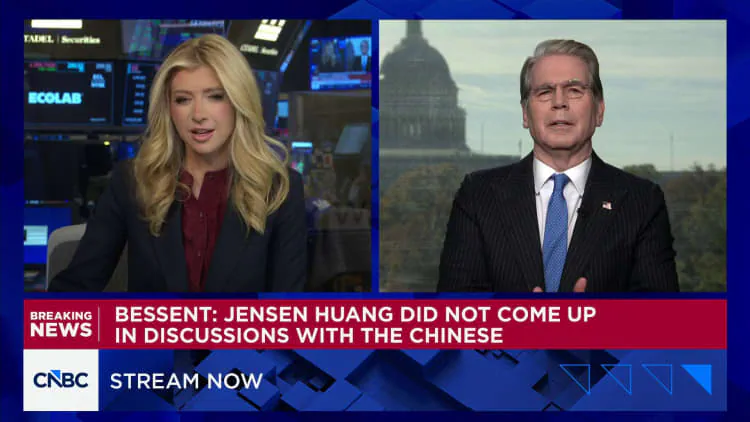
In his own CNBC interview that day, Bessent said the existing policy allowing H200 sales to China continued. “I wouldn’t anticipate any change in the policy,” he said when the interviewer noted that Nvidia had stopped selling those chips to China.
Permission to sell and actual sales are separate facts. Bessent’s statement concerned the government’s policy position; it did not announce resumed Nvidia shipments, new orders or a commercial agreement.
Frequently Asked Questions
3 questions
1Has Bessent Endorsed Jensen Huang’s Return?
No. Bessent’s November 22 answer focused on determining responsibility for possible compliance failures before judging a return. That softened his earlier call for outside leadership, but he did not explicitly endorse reinstating Huang. He also said the administration was still awaiting answers from Nvidia, according to CBS News.


