
The Federal Communications Commission authorized SpaceX Starmind on November 25, 2026: a constellation of up to 1,000,000 satellites that would run AI computing in low Earth orbit and send the results to the ground through Starlink. The FCC's Space Bureau order, DA 26-1273, is the first US license for a data center constellation in space.
The headline number hides a narrower grant. The FCC licenses radio spectrum, so what it actually authorized is backup radio links for telemetry and command, plus orbital slots and a deployment schedule that runs to 2040. It deferred SpaceX's plan to dispose of higher satellites outside Earth's atmosphere, and it declined to weigh whether orbital data centers make engineering or economic sense.
This article walks through what the order grants and requires, how SpaceX says a Starmind satellite works, the objections the FCC rejected, the arithmetic behind a million-satellite compute network, and the dates to watch.
Key takeaways
- It's a conditional license, not a launch. The FCC granted SpaceX's application "in part" and deferred the rest. No Starmind satellite is in orbit, and SpaceX's founder Elon Musk has said the first launch could come in the third quarter of 2027.
- The radio grant is backup only. Starmind satellites are meant to talk over optical laser links. The FCC licensed Ka-band radio (18.8 to 19.3 GHz down, 28.6 to 29.1 GHz up) only for emergency telemetry, tracking, and command, on an unprotected, non-interference basis.
- Hard deadlines void the license if missed. SpaceX must operate one satellite by November 25, 2033, 100,000 by November 25, 2035, 500,000 by November 25, 2038, and the full constellation by November 25, 2040.
- The disposal question was deferred. SpaceX wants to send satellites above 600 km into "heliocentric" or graveyard orbits instead of burning them up in the atmosphere. The FCC said SpaceX hadn't shown enough to judge that, and it must file again before deploying any satellite it won't deorbit.
- Petitions from Amazon Leo, Viasat, and the American Astronomical Society were denied. The FCC ruled that environmental review, optical astronomy, infrared "waste heat," and business viability fall outside its radio mandate.
What did the FCC actually approve for SpaceX Starmind?
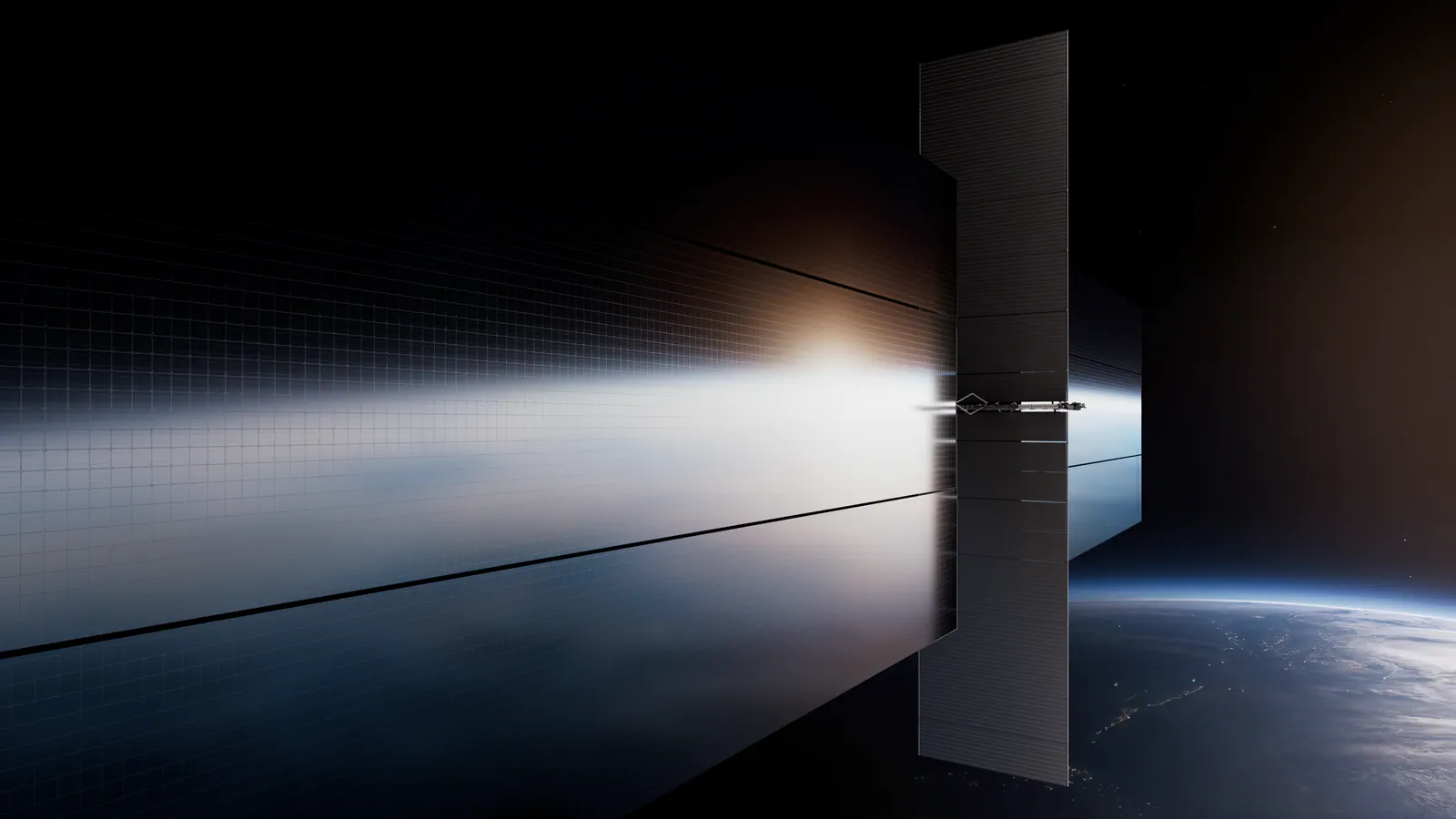
The FCC approved radio spectrum and orbital parameters for a constellation of up to one million non-geostationary satellites operating as orbital data centers. The order calls the system the "SpaceX Orbital Data Center System (Starmind)," licensed to Space Exploration Holdings LLC under call sign S00798.
That framing matters. The FCC's authority comes from the Communications Act, which covers radio transmissions, so the order's "scope of grant" is narrow: authority "for radiofrequency communications for backup and emergency telemetry, tracking, & command (TT&C)." Telemetry, tracking, and command is the low-bandwidth control channel operators use to check a satellite's health and send it instructions.
Everything else in the headline, from the AI chips to the laser links, rides on that license because a US operator can't legally fly the satellites without it.
What the grant covers and what it doesn't
The order's conditions sort into four buckets. The table below summarizes them from the text of DA 26-1273, adopted and released November 25, 2026, signed by Space Bureau chief Courtney Reinhard.
| Item | What the order says | Status |
|---|---|---|
| Constellation size | Up to 1,000,000 satellites in 50 km shells between 500 and 1,002 km | Granted |
| Radio spectrum | Ka-band backup TT&C only, unprotected and non-interference | Granted with conditions |
| Processing round, surety bond, Schedule S rules | Waived | Granted |
| Deployment milestones | New 2026 milestone schedule applied instead of a full waiver | Granted with conditions |
| Disposal above 600 km into heliocentric or graveyard orbits | Not enough information to decide | Deferred |
| Environmental review under NEPA | Not required | Dismissed |
| Optical and infrared astronomy | Covered by SpaceX's commitment to coordinate with the National Science Foundation | No extra conditions |
The license term is 15 years, and it starts only when SpaceX certifies that its first Starmind satellite is in orbit and working. SpaceX also has 30 days from release to decline the grant as conditioned; silence counts as acceptance.
The FCC's own press release announcing the grant describes the system as "1,000,000 orbital compute modules" and says the agency is "continuing to review additional orbital data center proposals." Chairman Brendan Carr framed it in industrial terms:
"By moving compute capacity beyond Earth, SpaceX and the many competitors working on their own orbital data centers are meeting the moment."
The same release goes further than the order, saying the system "promises to bring the human race closer to a Kardashev II civilization." That's a policy statement, not a finding in the order.
How is a Starmind satellite supposed to work?
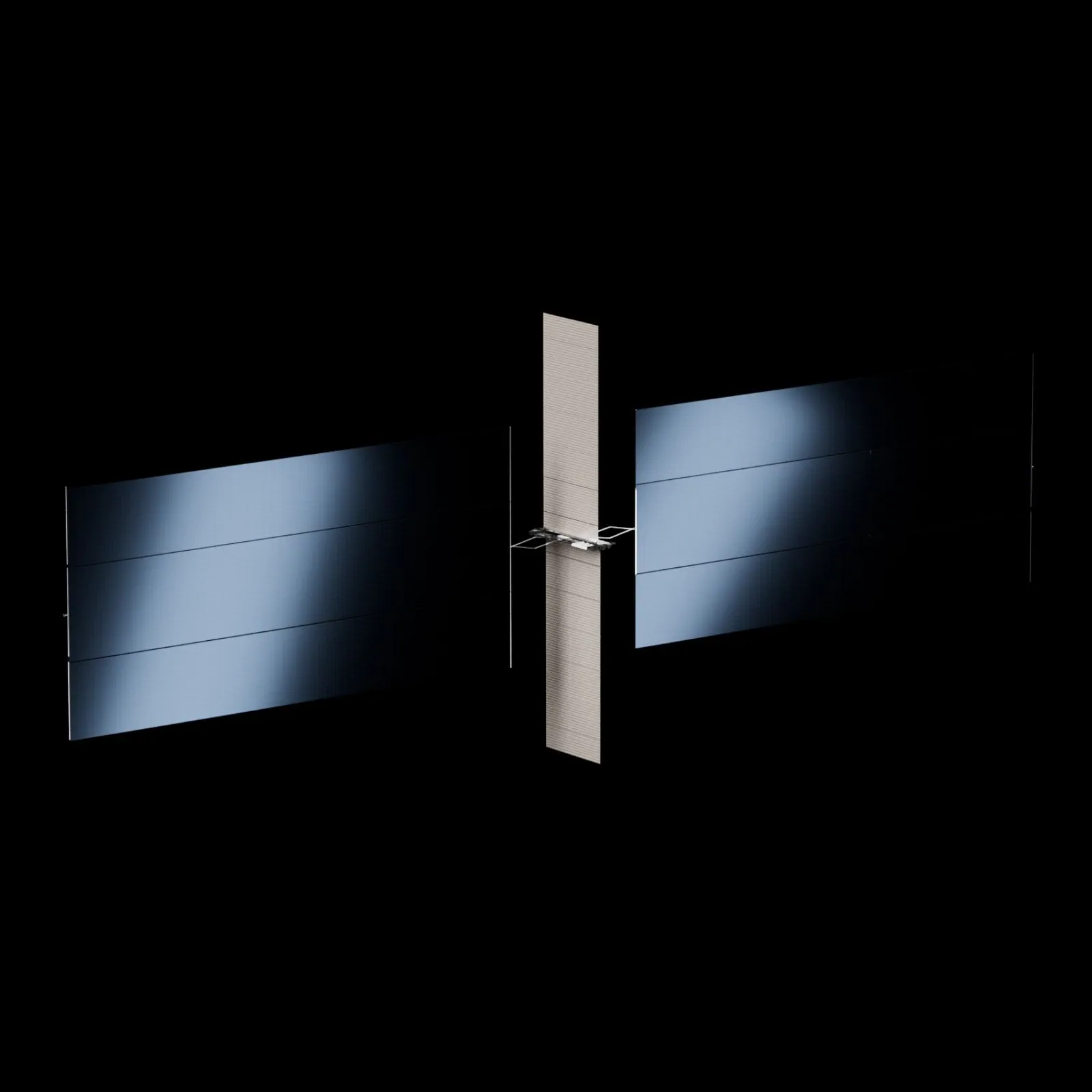
A Starmind satellite is a rack of AI computers with its own power plant and cooling: solar wings collect sunlight, the compute payload turns that electricity into AI work, a radiator dumps the heat into space, and laser links carry the results to Starlink. SpaceX calls the satellite design AI1.
The specifications below come from SpaceX's Starmind product page, which the company describes as "AI chip vendor agnostic." Spaceflight Now reports that SpaceX is building the spacecraft in partnership with Nvidia.
| AI1 specification | SpaceX figure |
|---|---|
| Deployed height | 30 m (98 ft) |
| Wingspan | 75 m (246 ft) |
| Compute payload | Up to 250 kW peak, 175 kW average |
| Vehicle efficiency | 75 kW per ton |
| Orbits | Sun-synchronous and 30-degree inclinations |
| Primary communications | Optical laser links to other satellites and Starlink |
Sources don't fully agree on the size. New Atlas gives a wingspan of 70 to 75 m, while SpaceX's current product page lists 75 m.
Power: why sun-synchronous orbit
A sun-synchronous orbit is a near-polar orbit that keeps a satellite over the same local solar time, so it can ride the boundary between day and night and stay in sunlight almost continuously. SpaceX's page sums up the pitch as "It's always sunny in space."
That's the core economic claim. On the ground, AI data centers are constrained by grid connections, land, and permits. In orbit, the power source is free once the panels are up.
Cooling: radiating heat instead of chilling it
In orbit there's no air, so a satellite can't use fans or cooling towers. It has to radiate heat away as infrared light. SpaceX's page says this lets its satellites "reduce cooling power overhead by an order of magnitude" compared with chillers on Earth.
New Atlas describes the satellite hardware in its November 25, 2026 report as a central rack of radiation-hardened compute modules, flanked by a larger solar array and a smaller array of about 110 square meters that pumps liquid through double-sided radiators angled edge-on to the Sun.
Links: optical first, radio as a backup
Each satellite would send its output by laser to other Starmind satellites and into Starlink. At the International Astronautical Congress in October 2026, SpaceX's senior vice president of Starlink and AI, Michael Nicholls, described the cluster design, as quoted by Spaceflight Now's report on the approval published November 26, 2026:
"Every one of these satellites might be something like a 250 kilowatt satellite, or roughly a rack of compute in space, something like a NVL 72... But the cluster of satellites will be 10-ish satellites that's interconnected with 10 terabits or so of bandwidth between them."
An NVL72 is Nvidia's rack-scale system of 72 GPUs. So the unit of compute isn't one satellite; it's a formation of roughly ten flying close together.
What deadlines does the Starmind license set?
The Starmind license sets four deployment deadlines, and missing any of them makes the authorization "null and void." SpaceX first asked for a full waiver of milestones, then withdrew that and asked the FCC to apply the new schedule it adopted in its July 2026 Space Modernization order.
| Deadline | Required in orbit and operating | Implied pace from previous step |
|---|---|---|
| November 25, 2033 | 1 satellite | n/a |
| November 25, 2035 | 100,000 (10%) | at least 100,000 within two years |
| November 25, 2038 | 500,000 (50%) | about 133,000 a year, or 365 a day |
| November 25, 2040 | 1,000,000 (100%) | 250,000 a year, or about 685 a day |
The pace column is our arithmetic from the order's dates, not an FCC figure.
For scale, the whole world has about 17,000 satellites in orbit, according to Reuters' report on the decision, carried by NBC News, and Starlink itself is just over 11,000. Meeting the 2040 milestone would mean adding roughly 90 times today's global satellite count.
Reuters also notes that operators often ask for more satellites than they plan to fly. SpaceX sought approval for 42,000 Starlink satellites before it began that deployment.
Musk's own timeline is earlier than the FCC's floor. Speaking at an event hosted by Baron Capital, he said, "We'll start off slow, but then it will ramp to significant volume probably in '28 and then very large volume in '29."
Why did the FCC reject Amazon, Viasat, and the astronomers?
The FCC rejected the petitions because it found SpaceX's commitments adequate on the issues inside its authority, and ruled the rest outside its authority. Three parties filed formal petitions to deny on March 6, 2026: Kuiper Systems LLC (Amazon Leo), Viasat Inc., and the American Astronomical Society (AAS). The order says the application also drew a substantial number of public comments.
Here's how the order answered the main objections:
- Radio interference. Viasat and the wireless group WISPA worried about aggregate interference from a million satellites. The FCC found it unlikely that optical links would fail at enough scale to put all satellites on Ka-band at once, and it added a reporting condition on Ka-band use.
- Too many waivers. Secure World Foundation and Dark Sky International argued that waiving processing rounds, bonds, and milestones together removed every guardrail. The FCC said its rules set no limit on waivers and pointed to earlier grants for Reflect Orbital, Impulse Space, Momentus, and Muon Space.
- Orbital debris and congestion. Amazon and Viasat raised collision and disposal risks. The FCC said the plan complies for satellites below 600 km and declined to "invent a de facto rule" capping satellite numbers.
- Casualty risk on reentry. SpaceX committed that each satellite "fully demises" on reentry and that it will steer reentries over the ocean.
- Astronomy. The AAS argued Starmind's waste heat would raise the infrared sky background. The FCC called that a non-spectrum impact outside the scope of the license.
The AAS responded that it was "disheartened and dismayed," according to Spaceflight Now, and said it remained concerned by "the lack of formal coordination requirements" in the license.
Why the FCC wouldn't judge whether orbital data centers make sense
Many commenters doubted the technology itself: thermal management, efficiency against ground data centers, and economics. The order lists them by name and declines to engage. In the order's words:
"In many cases, the comments seek to substitute the government's judgment regarding the viability of business endeavors for that of the applicant and private enterprise. We decline to do so."
That's a consistent legal position for a spectrum regulator. It also means no federal agency has formally tested the engineering case for orbital AI compute as part of this license.
What did the FCC defer or leave out of its review?
The FCC deferred one major piece and excluded several others. The deferred piece is end-of-life disposal for satellites above 600 km.
FCC rules require satellites ending their mission below 2,000 km to reenter the atmosphere within five years. SpaceX asked for "flexibility to dispose satellites operating above 600 km altitude into Earth disposal orbits or heliocentric orbits," meaning orbits around the Sun. The order's answer is direct:
"Because SpaceX has not provided sufficient information for the Commission to determine whether its alternative disposal methods are compliant with the Commission's requirements, SpaceX's waiver request is deferred."
The practical effect: until SpaceX files a modification with a final debris plan, it can only use the lowest shells. Under the order, satellites bound for altitudes above 600 km can't be deployed without that new filing.
The six operating shells
The order lists six nominal shells from a SpaceX letter filed May 29, 2026. Only the first two sit at or near the 600 km line, so the deferral covers most of the planned altitude range.
| Altitude band | Inclination |
|---|---|
| 550 to 568 km | 26 to 32° |
| 565 to 585 km | 97.7° (sun-synchronous) |
| 686 to 718 km | 30° |
| 707 to 744 km | 97.2° (sun-synchronous) |
| 946 to 978 km | 30° |
| 967 to 1,002 km | 99.4° (sun-synchronous) |
Environmental review was ruled out entirely
The FCC said it will not do an environmental review under the National Environmental Policy Act. It relied on its October 2026 NEPA order, which concluded that licensed space operations are "extraterritorial activities" and not a "major Federal action." It added that launch emissions are the Federal Aviation Administration's responsibility and called concerns about reentry effects on the atmosphere "speculative."
Does the math work for orbital AI compute?
The math is enormous but not obviously impossible, and the radiator numbers are tight. All figures in this section are our estimates from SpaceX's published specs, with assumptions stated.
Total compute power. One million satellites at 175 kW average is 175 gigawatts of continuous compute power. That's a figure on the scale of national electricity systems, and it explains why SpaceX pitches Starmind as a way around the grid.
Mass to orbit. At SpaceX's stated 75 kW per ton, a satellite would weigh roughly 2.3 metric tons if the rating refers to average power, or 3.3 tons if it refers to peak. A full constellation would then be about 2.3 to 3.3 million tons. If a single Starship flight lifted 100 tons (an assumption for illustration, not a SpaceX figure), that would mean 23,000 to 33,000 launches.
Cooling. Using New Atlas' description of a roughly 110 square meter, double-sided radiator gives about 220 square meters of radiating surface. Shedding 175 kW from that area means about 800 watts per square meter. Under the Stefan-Boltzmann law, with an assumed emissivity of 0.9 and ignoring sunlight and Earth's own infrared, the radiator would need to run near 80°C; at 250 kW peak, closer to 110°C.
That's a rough model. It leaves out heat absorbed from Earth and the Sun, and the real radiator layout may differ from the published description. Still, it shows why many commenters flagged thermal management: chips have to run hotter than the radiator that cools them.
How the pitch compares with a ground data center
SpaceX's argument and the critics' doubts line up neatly against each other:
- Power: near-continuous sunlight with no grid connection, versus launch and replacement costs that ground facilities never pay.
- Cooling: no chillers or water, versus radiators that must be large and run hot.
- Permitting: no local zoning fights, versus a 15-year license with milestone deadlines and an unresolved debris plan.
- Maintenance: none possible in orbit, so a failed chip stays failed until the satellite is replaced.
- Latency and bandwidth: results travel over lasers and Starlink, which suits batch AI work better than tasks that need constant, heavy data exchange with the ground.
Who does the Starmind decision affect?
The Starmind decision affects AI companies looking for compute, rival satellite operators, astronomers, and every other orbital data center applicant.
- AI labs and cloud buyers. If Starmind works, it adds a compute supplier whose capacity isn't tied to local grids. Nothing in the order says who will buy that compute or at what price.
- Rival operators. Amazon Leo and Viasat lost their petitions. SpaceX gets no processing-round priority in the Ka-band and must protect operators licensed in earlier and future rounds.
- Other orbital data center applicants. The FCC says it is reviewing "additional orbital data center proposals." This grant is the first such decision, so it is likely to shape how those are handled.
- Astronomers. The FCC added no new astronomy conditions beyond SpaceX's commitment to coordinate with the National Science Foundation.
- Federal spectrum users. SpaceX must coordinate with federal and national security systems before using 18.8 to 19.3 GHz, and must stop any transmission that causes documented harmful interference.
What is still unproven about SpaceX Starmind?
Almost everything about Starmind's performance is unproven, because no satellite has flown. The license confirms the right to try, not the result.
The open questions fall into a few groups:
- Thermal design. SpaceX hasn't published a full thermal analysis. Our estimate above suggests the radiators must run hot, but that rests on a secondhand description of their size.
- Chip reliability in radiation. New Atlas describes radiation-hardened compute modules, but SpaceX hasn't published failure rates for modern AI accelerators in these orbits.
- Formation flying. Nicholls said SpaceX still needs "to figure out proximity ops, how to operate these satellites together in close formation."
- Disposal above 600 km. The FCC explicitly deferred this, and SpaceX hasn't yet filed the modification it needs.
- Launch economics. Reuters notes the plan bets heavily on lower Starship costs, and Amazon has argued the constellation could take centuries to deploy.
- Customers. No buyer, contract, or price for Starmind compute appears in the FCC record or on SpaceX's page.
There's also a small discrepancy in the record itself. The order's grant page and background say SpaceX filed on January 30, 2026, while one footnote cites January 20. Spaceflight Now uses January 30.
What to watch next for Starmind
These are the dated, checkable events that will show whether Starmind moves from license to hardware:
- December 25, 2026: the 30-day window for SpaceX to decline the conditioned grant ends. Silence means acceptance.
- January 1, 2027: the first date in the order's twice-yearly reporting cycle, which covers conjunction events, satellites removed, reentries, and Ka-band use.
- Third quarter of 2027: Musk's stated target for the first Starmind launch.
- Late 2027: SpaceX's target for its Gigasat Factory in Bastrop, Texas, to start producing AI satellites.
- Any time before high-altitude deployment: a SpaceX modification application with a final disposal plan for satellites above 600 km.
- Pending FCC decisions on other orbital data center applications, which the agency says it will issue "expeditiously."
- November 25, 2033: the hard deadline for the first operating satellite.
Frequently Asked Questions
5 questions
1What is SpaceX Starmind?
SpaceX Starmind is a planned constellation of up to one million satellites that would run AI computing in low Earth orbit. Each AI1 satellite carries a rack of compute powered by solar arrays, sheds heat through radiators, and sends results to Earth by laser through Starlink. SpaceX lists up to 250 kW of peak compute power per satellite. The FCC authorized the constellation on November 25, 2026, but none has been launched yet.
2Did the FCC approve one million SpaceX satellites?
Yes. The FCC's Space Bureau authorized up to 1,000,000 Starmind satellites in order DA 26-1273 on November 25, 2026. The grant is conditional: it licenses only backup Ka-band radio links, requires deployment milestones through November 25, 2040, and deferred SpaceX's request to dispose of satellites above 600 km outside the atmosphere. SpaceX must file again before deploying any satellite it won't deorbit.
3When will the first Starmind satellite launch?
Elon Musk has said the first Starmind satellite could launch in the third quarter of 2027. The FCC's legal deadline is later: SpaceX must have one satellite operating by November 25, 2033, or the license becomes void. SpaceX also says its Bastrop, Texas, factory could start producing AI satellites as soon as late 2027. None of these dates is confirmed by an actual launch.
4Why did astronomers oppose the Starmind license?
Astronomers opposed Starmind because a million satellites could brighten the night sky and add infrared heat that interferes with observations. The American Astronomical Society filed a petition to deny, arguing the satellites' waste heat would raise the infrared sky background. The FCC denied the petition, saying those impacts fall outside its radio mandate, and added no conditions beyond SpaceX's commitment to coordinate with the National Science Foundation.
5Does the FCC license mean orbital data centers will work?
No. The FCC licenses radio spectrum and orbital operations, and its order explicitly declined to judge whether orbital data centers are technically or economically viable. Questions about heat rejection, chip reliability in radiation, formation flying, launch costs, and customers remain open. The license gives SpaceX the right to try, with deadlines, not evidence that the system will perform as advertised.
Sources (6)
- 01docs.fcc.govFCC's Space Bureau order, DA 26-1273 (opens in a new tab)
- 02spacex.comspacexsi / starmind (opens in a new tab)
- 03docs.fcc.govpress release announcing the grant (opens in a new tab)
- 04newatlas.comdescribes the satellite hardware in its November 25, 2026 report (opens in a new tab)
- 05spaceflightnow.comSpaceflight Now's report on the approval (opens in a new tab)
- 06nbcnews.comReuters' report on the decision, carried by NBC News (opens in a new tab)


