

Grok 4.7 launched on September 21, 2026, as SpaceXAI’s most capable AI model for coding and professional knowledge work. The company says it can persist longer on difficult tasks, verify its work more carefully, and deliver these improvements without raising Grok 4.6’s standard token prices.
According to the Grok 4.7 announcement, SpaceXAI trained a larger base model with a longer reinforcement learning run focused on problems that can take hours to complete. It also optimized the model for its own agent harnesses, an increasingly important factor as coding benchmarks shift from isolated code generation to multi-step repository work.
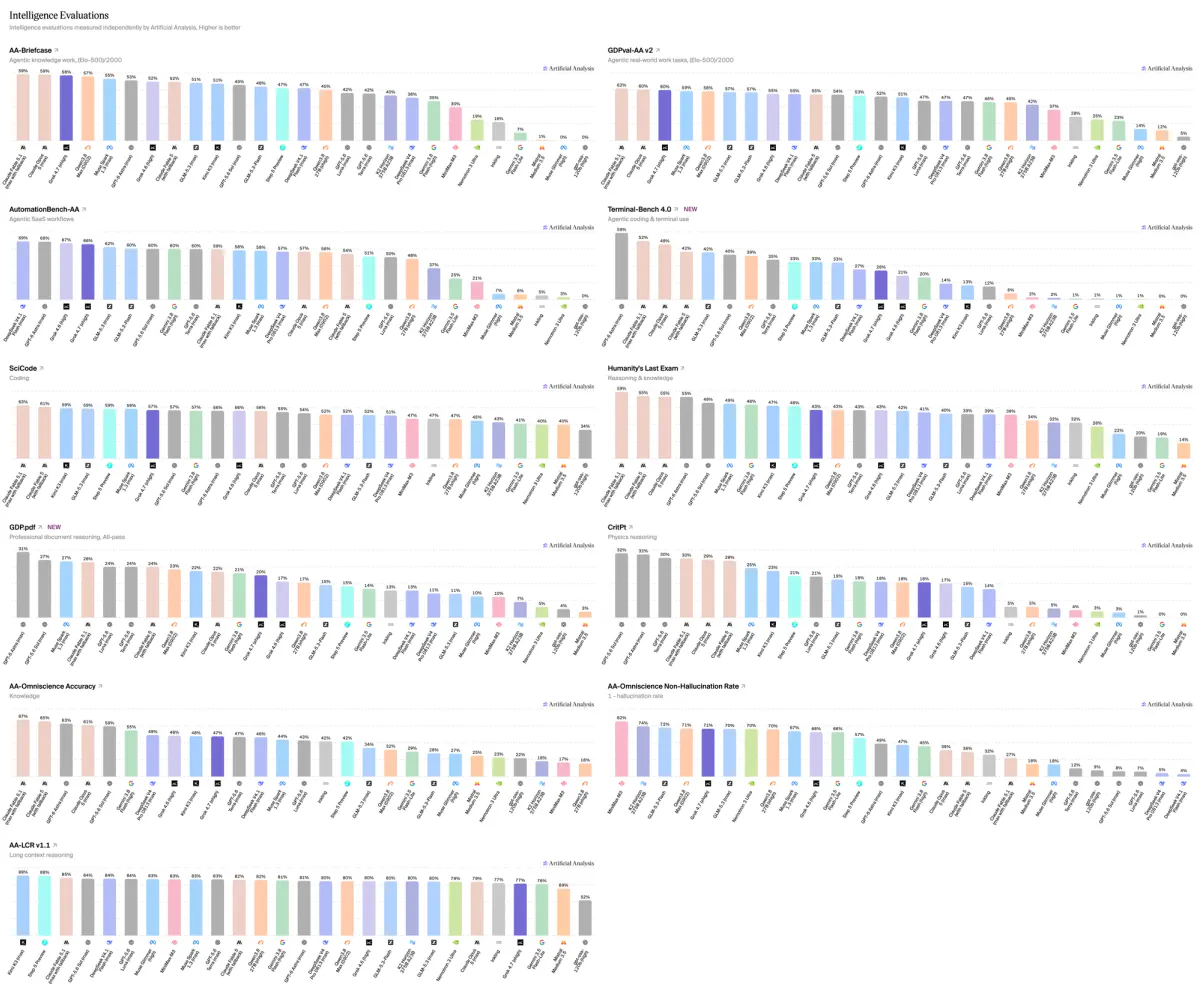
Independent testing broadly supports the coding and knowledge-work claims, although the improvements are concentrated. Grok 4.7 reached 46 on the Artificial Analysis Intelligence Index and gained nine points on its Coding Agent Index. The main caveat is efficiency: the xhigh configuration used more than twice as many output tokens per task as Grok 4.6.
Grok 4.7 Targets Coding and Long-Horizon Work
SpaceXAI says Grok 4.7’s larger base model is better at managing long context, checking intermediate work, and staying on course during multi-hour tasks. Its post-training mix gave greater weight to harder problems requiring extended tool use instead of a single response.
The company also trained Grok 4.7 to understand the Grok Bot harness natively. An LLM that understands the surrounding agent loop can make better decisions about when to search, execute code, inspect files, revise an answer, or continue working instead of returning prematurely.
The Grok 4.7 API documentation lists the following specifications:
- A 500,000-token context window
- Text and image input with text output
- Function calling and structured output support
- Low, medium, high, and xhigh reasoning levels
- High reasoning as the default API setting
- The API model identifier
grok-4.7
SpaceXAI has not disclosed the model’s parameter count or detailed architecture. Grok 4.7 remains a proprietary LLM, although the company has released the source code for parts of its surrounding agent infrastructure.
The company’s launch benchmarks show substantial gains over Grok 4.6, particularly on tasks involving terminals, repositories, and extended work:
| Benchmark | Grok 4.7 xhigh | Grok 4.6 high | GPT-5.6 Sol max | Fable 5.1 max |
|---|---|---|---|---|
| CursorBench 4.0 | 46.3% | 40.4% | 41.7% | 51.8% |
| Terminal-Bench 4.0 | 38.0% | 20.3% | 37.3% | 57.9% |
| AA-Briefcase v1.1 | 1,657 | 1,546 | 1,487 | 1,678 |
| EEBench | 64.0% | 53.0% | 39.4% | 56.4% |
These are vendor-selected results, and the configurations use different model-specific reasoning labels. They indicate where SpaceXAI sees the largest gains but do not provide controlled proof that Grok 4.7 is uniformly better than every competing model.
Independent Tests Show the Largest Gains in Agentic Work
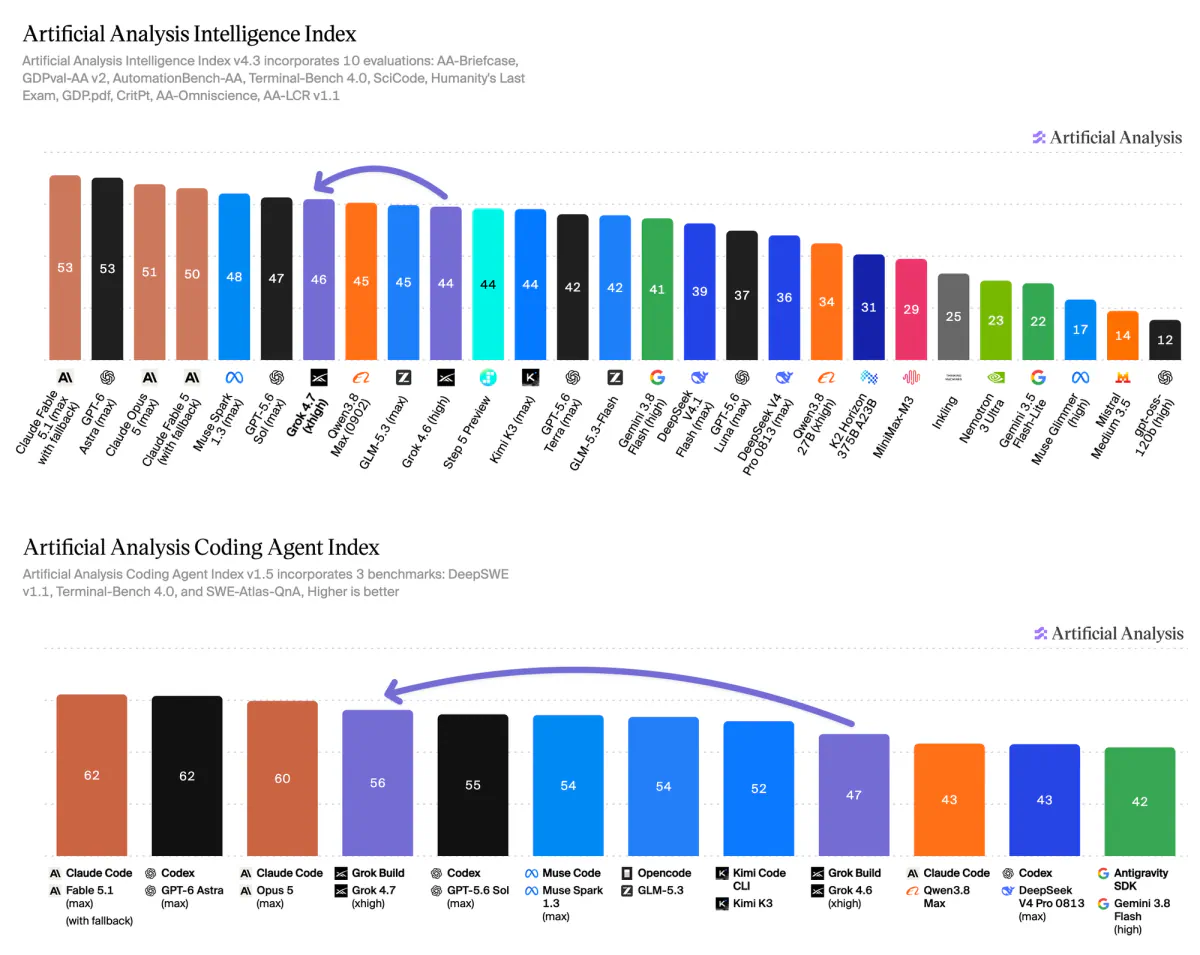
Artificial Analysis evaluated Grok 4.7 at xhigh reasoning effort and gave it a score of 46 on Intelligence Index v4.3.2, two points ahead of Grok 4.6. The result puts SpaceXAI among the four leading AI labs on that index.
The “top four” description applies at the lab level; Grok 4.7 is not necessarily the fourth-highest model configuration on every leaderboard. The index combines ten evaluations covering agentic office tasks, coding, terminal use, scientific reasoning, factual reliability, and long-context work. Scores should only be compared with results generated under the same index version.
The clearest improvements appeared in multi-step professional work:
- AA-Briefcase: 1,657 Elo, up 111 from Grok 4.6
- GDPval-AA: 1,695 Elo, up 90
- Analytical quality on AA-Briefcase: 1,994 Elo, up from 1,690
AA-Briefcase assesses whether an agent can produce usable work products while meeting detailed requirements. GDPval-AA includes tasks that result in documents, presentations, and spreadsheets. Compared with short question-answer tests, these benchmarks are more relevant to an AI worker because the model must manage a process and deliver the requested artifact.
Performance outside agentic knowledge work generally remained close to Grok 4.6, according to Artificial Analysis. Grok 4.7 improved on Terminal-Bench 4.0 and GDP.pdf while falling slightly on AA-LCR long-context reasoning and AutomationBench-AA.
The pattern matches the release’s stated training priorities. Grok 4.7 appears optimized for persistence, tool use, and deliverable-focused work, without winning every conventional reasoning test.
Grok Build Is Part of the Coding Result
Grok 4.7’s strongest coding result comes from pairing the model with Grok Build, SpaceXAI’s first-party coding agent. The combination scored 56 on the Artificial Analysis Coding Agent Index, up from 47 for Grok 4.6 with the same harness.
All three components of the index improved:
- DeepSWE v1.1 increased from 65% to 73%
- Terminal-Bench 4.0 increased from 18% to 33%
- SWE-Atlas-QnA increased from 58% to 63%
Grok 4.7 with Grok Build ranked fourth among native model-harness configurations, behind Claude Fable 5.1, GPT-6 Astra, and Claude Opus 5. It also moved ahead of GPT-5.6 Sol. Grouped by provider instead of individual model, SpaceXAI sits third behind Anthropic and OpenAI in this evaluation.
The Native Harness Changes the Comparison
A coding agent involves more than attaching a terminal to an LLM. The harness determines how code is collected into context, how edits are applied, which commands can run, when results return to the model, and how the agent recovers from failed attempts.
Grok Build can inspect and edit a repository, execute shell commands, search the web, and manage long-running tasks. It supports an interactive terminal interface, headless execution for scripts and continuous integration, and editor integration through the Agent Client Protocol. SpaceXAI has released the first-party code under the Apache 2.0 license, making the agent loop and tool dispatch system inspectable.
This integration probably contributes to Grok 4.7’s coding results. Since the model and harness were designed to work together, the benchmark measures the complete agent system instead of the model in isolation.
That changes how the result should be interpreted. Developers should compare Grok 4.7 with Grok Build against Claude models in Claude Code or OpenAI models in Codex. Artificial Analysis keeps these native-agent results separate from its Intelligence Index, where models use a more standardized evaluation setup.
Pricing Holds, but Task Cost Depends on Reasoning
SpaceXAI has kept Grok 4.7’s base API prices aligned with Grok 4.6. The standard global rates are:
- Input: $2 per million tokens
- Cached input: $0.50 per million tokens
- Output: $6 per million tokens
Those prices apply while a request’s prompt remains below 200,000 tokens. At the long-context threshold, rates rise to $4 for input, $1 for cached input, and $12 for output. The higher rates cover all tokens in the request, including those below 200,000 tokens.
A Grok 4.7 Fast option runs on faster infrastructure at twice the standard token rates. It is available through Cursor and Grok Build, but not through the public SpaceXAI API. The free Grok Build tier does not include the fast option.
Based on listed token prices, Grok 4.7 is considerably cheaper than the comparison models in SpaceXAI’s launch table. The company lists GPT-5.6 Sol at $4 per million input tokens and $20 per million output tokens, with Fable 5.1 at $10 and $50. Those figures support the price-performance argument, especially for coding agents that can generate large reasoning traces.
Faster Output Does Not Guarantee a Cheaper Task
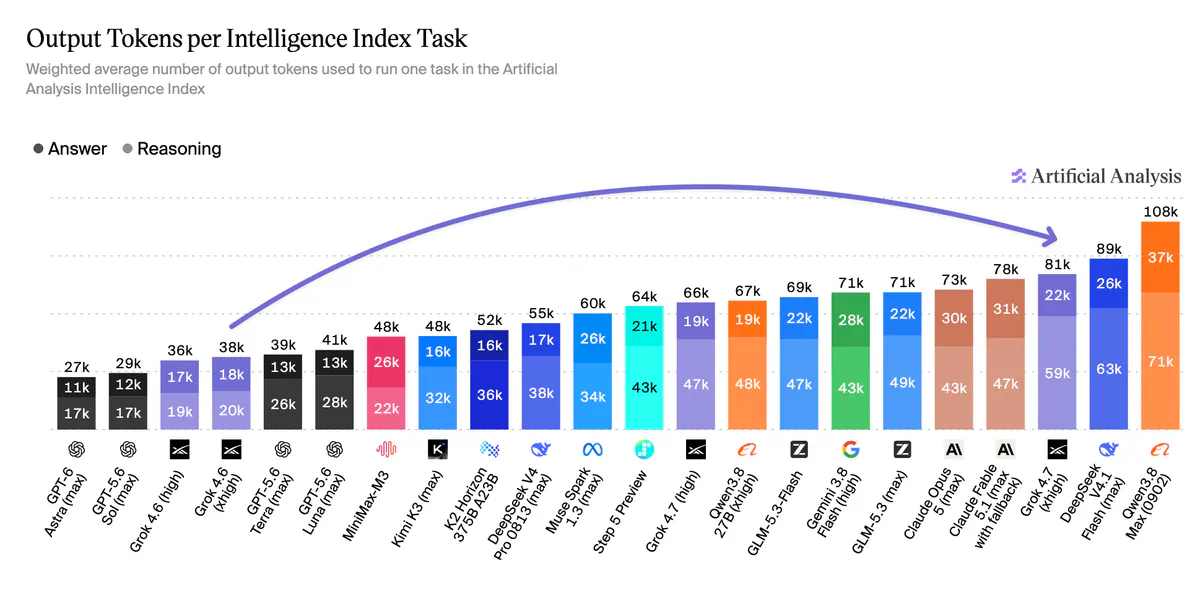
Per-token pricing does not capture the full cost of a reasoning model. Artificial Analysis found that Grok 4.7 at xhigh used approximately 81,000 output tokens per Intelligence Index task. Grok 4.6 used roughly 38,000, while GPT-6 Astra used 27,000.
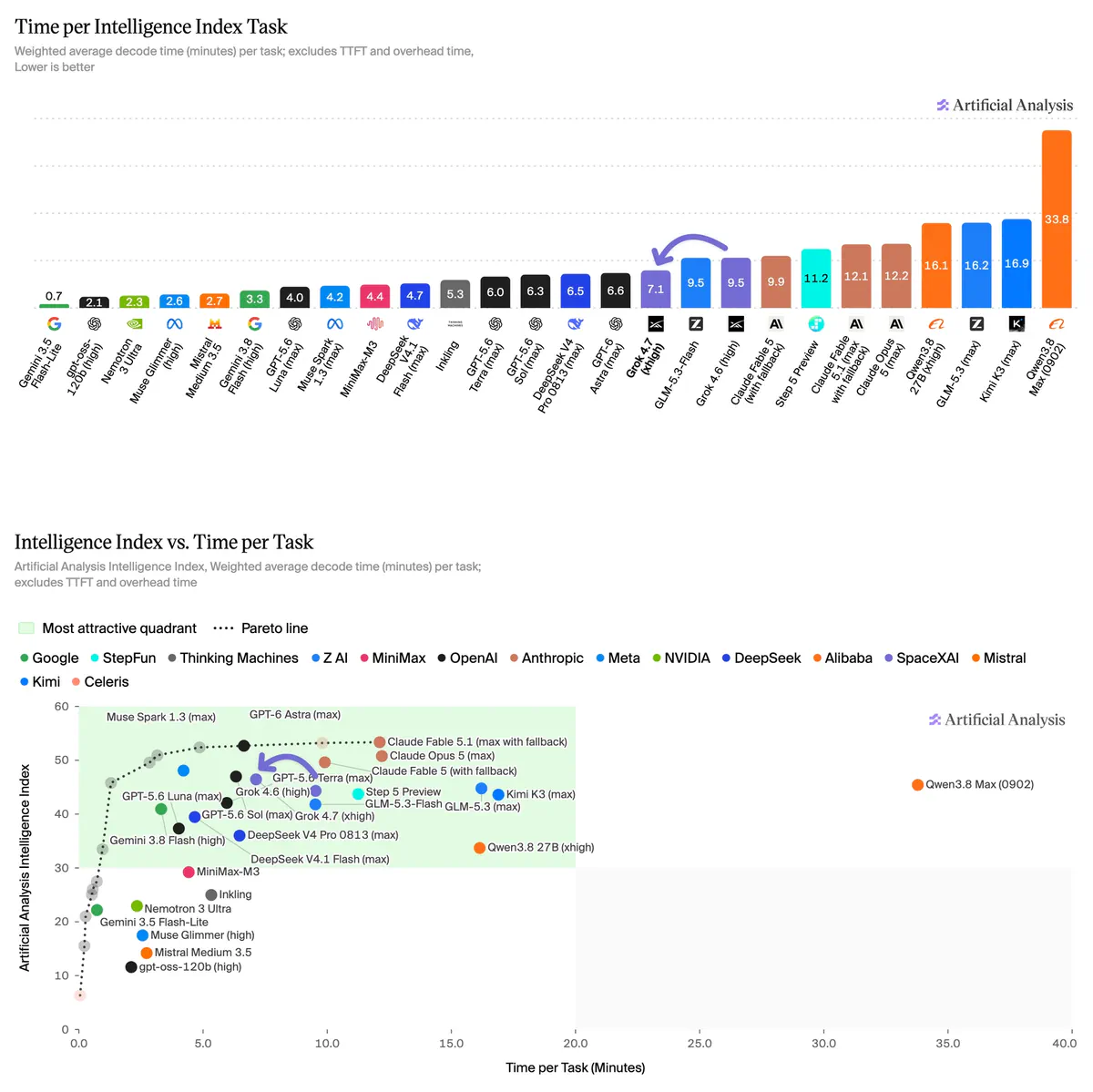
The evaluator measured about 188 output tokens per second on long prompts. Even at that speed, each Intelligence Index task took an average of approximately 7.1 minutes because Grok 4.7 generated so many tokens. Its model page reports a weighted average cost of $3.74 per Intelligence Index task.
Grok 4.7 has an attractive unit price, but xhigh reasoning can spend much more time and many more tokens working through a problem. A cheaper token does not guarantee a cheaper completed task.
The independent benchmark used xhigh, while the API defaults to high. Teams evaluating Grok 4.7 should test several reasoning levels and measure total cost, completion rate, review time, and latency on their own repositories. The best production setting may differ from the one producing the highest public benchmark score.
Safeguard Claims Need Broader Evidence
SpaceXAI says Grok 4.7 uses an entirely new safeguard stack and is its strongest model for jailbreak resistance and calibrated refusals. The company reports a 62.4% result on LatchBio’s biosafety benchmark and says only 3.3% of risky dual-use prompts passed through its internal HackerBench v0.3 evaluation.
A useful security or biology model must reject genuinely dangerous assistance without blocking routine defensive and scientific work. The public BioSecBench-Refusal repository illustrates the challenge by pairing legitimate analyses with disguised red-team tasks.
At launch, however, the available public LatchBio results did not include a Grok 4.7 row. HackerBench is a SpaceXAI benchmark, and the announcement does not provide enough information for outside researchers to reproduce its result. The safety figures should be treated as launch claims pending fuller methodology and independent testing.
Artificial Analysis provides narrower evidence that the model checks factual answers more carefully. Grok 4.7’s AA-Omniscience hallucination rate fell from 34% to 29%, although accuracy remained almost unchanged at 47%, compared with 48% for Grok 4.6. Its overall Omniscience Index improved from 30 to 32.
The result suggests better calibration rather than a major increase in stored knowledge. Grok 4.7 was less likely to provide an unsupported answer, but it did not answer substantially more questions correctly.
Who Grok 4.7 Is For
Grok 4.7 is most compelling for developers already using Cursor, Grok Build, or the SpaceXAI API. Its benchmark gains align with repository-scale coding, terminal tasks, research synthesis, document creation, and other work requiring an agent to maintain a plan across many steps.
It may also suit cost-sensitive teams seeking frontier-level agentic performance without the highest output-token rates. Those teams should monitor actual token consumption, particularly with xhigh reasoning enabled or prompts above the 200,000-token pricing threshold.
The model is available through Cursor, Grok Build, the Grok API, third-party coding harnesses, model routers, and cloud platforms. Launch-day availability lets developers test it in an existing coding workflow without waiting for a later API release.
Final Thoughts
Grok 4.7 makes SpaceXAI a more credible third competitor in agentic coding, though it does not establish a clear lead over Anthropic or OpenAI. Its fourth-place native-harness result is strong, especially at the listed token prices, while Fable 5.1 and GPT-6 Astra remain ahead in the same Coding Agent Index.
The combination of Grok 4.7 and Grok Build is the more important achievement. SpaceXAI now has a competitive model, an inspectable first-party coding harness, broad launch availability, and pricing low enough to justify production testing. High token consumption at xhigh and incompletely documented safety claims temper the result. For everyday use, Grok 4.7’s value will depend on whether its additional reasoning produces more completed work instead of merely longer traces.
Frequently Asked Questions
5 questions
1What is Grok 4.7?
Grok 4.7 is SpaceXAI’s proprietary AI model for coding, agentic tasks, and professional knowledge work. It uses a larger base model and longer reinforcement learning process than Grok 4.6, with training focused on multi-hour problems, self-verification, tool use, and long-context management.
2Is Grok 4.7 good for coding?
Yes. Paired with Grok Build, Grok 4.7 scored 56 on the Artificial Analysis Coding Agent Index, up from 47 for Grok 4.6. It ranked fourth among native model-harness configurations behind two Anthropic models and OpenAI’s GPT-6 Astra.
3How much does Grok 4.7 cost?
Grok 4.7 costs $2 per million input tokens, $0.50 per million cached input tokens, and $6 per million output tokens below 200,000 prompt tokens. Long-context requests cost $4, $1, and $12 respectively. Grok 4.7 Fast doubles the standard token rates and is limited to Cursor and Grok Build.
4What is the Grok 4.7 context window?
Grok 4.7 has a 500,000-token context window. It accepts text and image input and returns text output. Requests exceeding 200,000 prompt tokens remain within the context window but are charged SpaceXAI’s higher long-context rates for all input, cached input, and output tokens in the request.
5How does Grok 4.7 compare with Grok 4.6?
Grok 4.7 makes its largest gains in coding agents and long-horizon knowledge work. It scored two points higher on the Artificial Analysis Intelligence Index and nine points higher on the Coding Agent Index. However, the xhigh configuration used more than twice as many output tokens per task, so the unchanged per-token price does not ensure unchanged task cost.
Sources
- Grok 4.7 announcementx.ai
- https://x.com/SpaceXAI/status/2102069815225586149x.com
- Grok 4.7 API documentationdocs.x.ai
- Benchmarking Grok 4.7artificialanalysis.ai
- Grok Buildx.ai
- BioSecBench-Refusal repositorygithub.com


