
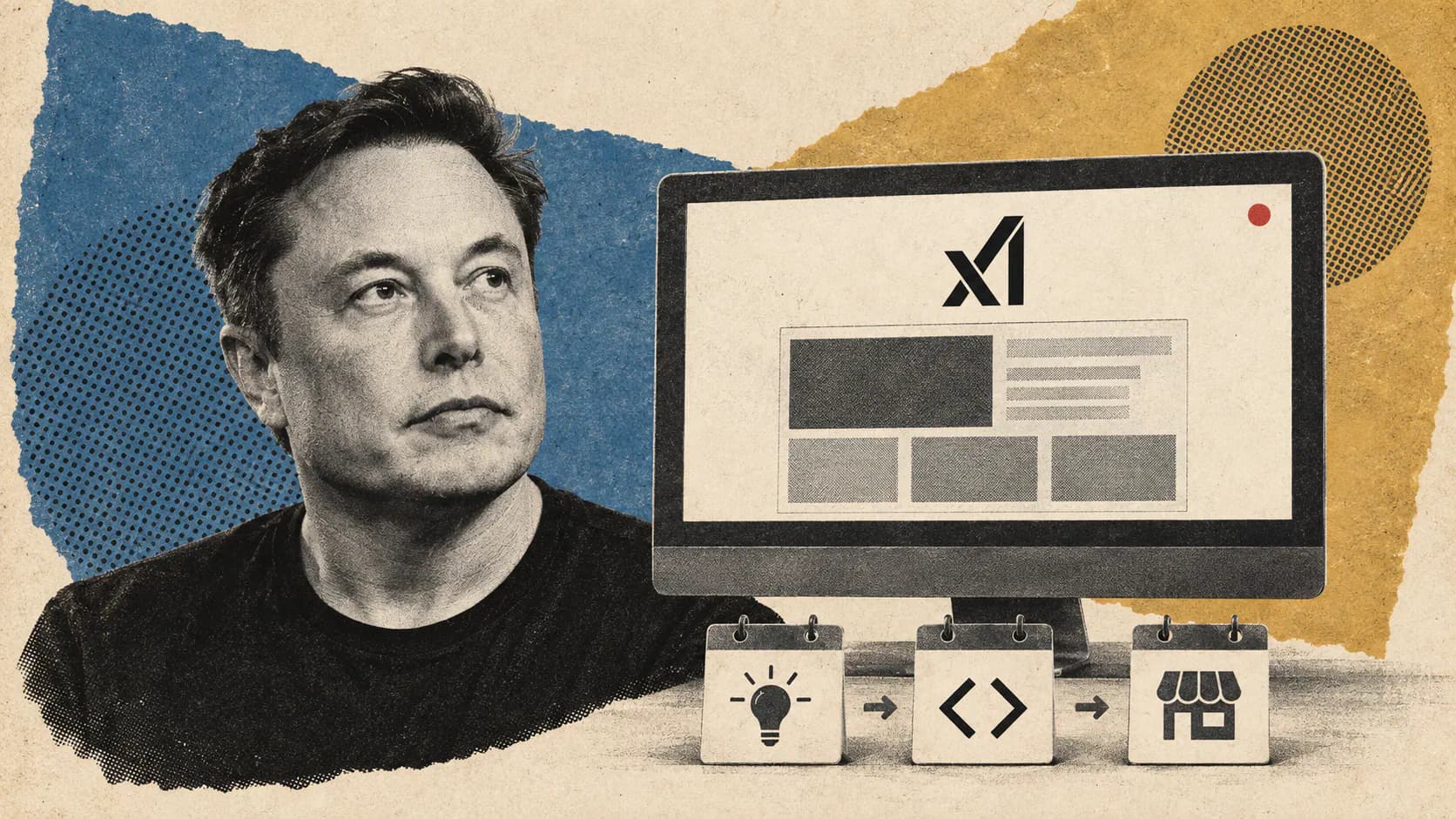
SpaceXAI is giving Grok Bot a launch demonstration that could go visibly wrong. From September 15 through September 17, 2026, xAI employees Matt Palmer, Lauren Tan, and Malte Ubl plan to brainstorm an idea, make product decisions, build the software, and present what they created during a series of public livestreams.
The official Grok Bot Galaxy event page frames the challenge as building a company in three days. Its more detailed description focuses on building a product from scratch, which is a more realistic way to interpret the experiment. Three days may be enough to produce and deploy an early product. It isn’t enough to prove that the result has customers, a defensible business model, or any long-term viability.
There is another important qualification. As of September 12, 2026, the experiment hasn’t happened. The announced schedule also covers 51 hours from the opening session to the final demo, rather than a literal 72-hour build. What SpaceXAI has announced is still interesting, but the results will matter more than the premise.
Grok Bot Galaxy Turns the Launch Into a Public Stress Test
The official livestream listing describes a three-person team starting with a blank slate and using Grok Bot throughout ideation, planning, product work, and engineering. The team will share updates at four scheduled points:
| Date | Session | UTC-7 | Eastern Time |
|---|---|---|---|
| September 15 | Kickoff and Grok Bot walkthrough | 12:00 p.m. | 3:00 p.m. |
| September 16 | Progress update | 10:00 a.m. | 1:00 p.m. |
| September 17 | Final-day update | 10:00 a.m. | 1:00 p.m. |
| September 17 | Product demo and wrap-up | 3:00 p.m. | 6:00 p.m. |
Viewers can watch through the Galaxy page or X, and xAI says replays will be available. Registration isn’t required, although the Luma page offers event reminders. The published schedule advertises milestone broadcasts rather than an uninterrupted stream of the entire build.
The SpaceXAI branding comes from SpaceX’s acquisition of xAI, announced on April 17, 2026. The company described the combined organization as SpaceXAI, while the Galaxy listing still identifies Palmer, Tan, and Ubl as xAI employees. This is best understood as an xAI product demonstration within the broader SpaceXAI organization, not a SpaceX aerospace engineering project.
The “Company in Three Days” Claim Needs Qualification
A product and a company aren’t interchangeable.
The team could plausibly leave the event with a deployed application, a landing page, initial documentation, and perhaps a way for people to try or buy what it built. That would represent a serious amount of work for three people over a short period, particularly if Grok Bot handles meaningful parts of the process.
A functioning company requires much more. It needs a defined customer, evidence that the customer’s problem is worth solving, a business model, distribution, support, legal administration, security practices, and some indication that people will continue using the product. Those questions cannot be settled during a three-calendar-day demonstration.
The fairer test is whether three people can use an AI agent to compress the earliest startup work. Can they move from an unstructured idea to a clear product specification? Can Grok Bot research options, create plans, implement features, test its own work, and keep track of decisions? Can the humans delegate substantial tasks without spending more time repairing the agent’s output than they save?
A usable product at the end would support the claim that AI agents can accelerate a startup sprint. It would not prove that Grok Bot independently created a viable business.
Grok Bot Is More Than a Chat Window
Grok Bot is designed as an agentic work platform rather than a conventional chatbot. According to xAI, each bot receives a persistent cloud computer with a browser, desktop applications, files, and a workspace that remains available between sessions. The system can operate software visually, continue longer tasks in the background, and run multiple workstreams in parallel.
Those features map closely to the Galaxy challenge. A startup project involves far more than generating source code. Someone has to research the market, compare technical options, maintain project files, test the application, revise specifications, handle repetitive browser work, and coordinate dependencies between tasks.
Grok Bot also has persistent memory and configurable routines. Memory can preserve relevant context across conversations, while routines allow recurring or scheduled work to run without a new prompt each time. Those capabilities could help the team maintain continuity as decisions, code, and requirements accumulate across the three days.
There is an important wrinkle when judging the result. xAI’s model documentation says Grok Bot can use xAI models as well as external models from OpenAI, Anthropic, and Google. Unless the livestream identifies which models handle each task, Galaxy will test Grok Bot’s overall orchestration system more clearly than it tests the standalone capability of a particular Grok model.
That distinction doesn’t make the event less valuable. Products are judged by what the complete system accomplishes. It does mean that “Grok built a startup” would be an oversimplified description if the bot routes some of the work through outside models.
This Is a Demo, Not a Controlled AI Benchmark
Grok Bot Galaxy doesn’t have the structure of a scientific benchmark. There is no announced control team building the same product without an agent, no standardized task, and no numerical definition of success.
The participants are also product insiders. They may understand Grok Bot’s strengths, preferred workflows, and failure modes better than an ordinary customer. That makes them sensible choices for a launch event, but it limits what the result can tell us about how easily a new user could reproduce the process.
Several other variables remain unclear before the kickoff:
- Whether the team has prepared prompts, assets, or possible ideas in advance
- How much implementation the humans will do directly
- Which AI models Grok Bot will use during the project
- What counts as a finished or working product
- Whether the final application will be publicly accessible
- How failures and abandoned approaches will appear in the updates
None of these issues invalidate the event. They simply determine whether viewers are watching a transparent build log or a polished marketing demonstration.
The public format still raises the stakes compared with a prerecorded product video. A multi-day project can reveal context loss, contradictory plans, broken integrations, slow task execution, and the cumulative effect of small mistakes. Those problems are easy to remove from a two-minute demo. They are harder to hide when viewers receive updates across several days.
The Most Revealing Moments May Be the Failures
The final product will attract the headlines, but the handoffs between humans and Grok Bot may provide better evidence of the system’s maturity.
One useful signal will be how the team divides the work. If the employees define every implementation detail and use the bot primarily to generate code, the experiment will resemble an accelerated software sprint with AI assistance. If Grok Bot can turn broad goals into sensible tasks, identify dependencies, execute across applications, and revise its plan after errors, that would demonstrate a more capable agent workflow.
Recovery matters as much as first-attempt performance. Real product development includes failed builds, incorrect assumptions, incompatible packages, changing requirements, and tests that uncover deeper design problems. An effective agent needs to diagnose those failures without repeatedly discarding context or asking the human to reconstruct the entire problem.
Tool access will deserve attention too. Grok Bot can log into websites through its cloud computer, but xAI’s app approval system requires authorization before a bot uses new applications or sites. The company also says actions needing human confirmation should pause for approval. Watching where those safeguards appear will help show whether Grok Bot can balance autonomy with meaningful human control.
The most credible presentation would disclose the major prompts, human corrections, model choices, failed attempts, and manual interventions. Human assistance isn’t evidence that the experiment failed. Grok Bot is explicitly positioned as a collaborator. The relevant question is whether that collaboration expands what three people can accomplish within the available time.
Final Thoughts
Grok Bot Galaxy should not be treated as proof that an AI agent can create a company in three days. The scheduled build is too short to validate a business, the participants are insiders, and the event has no control group or predefined success metric.
It could still become a useful demonstration of agentic software development. A persistent AI worker that can retain project context, operate applications, coordinate parallel tasks, and recover from mistakes would be materially different from a chatbot that produces isolated blocks of code.
Transparency will decide how much weight the result deserves. If SpaceXAI shows the messy parts of the process and ends with a usable product, Galaxy will offer a valuable look at how AI agents change early product development. If viewers see only scheduled recaps followed by a polished demo, the event will tell us more about Grok Bot’s launch strategy than its ability to help build a startup.
Frequently Asked Questions
5 questions
1When is the Grok Bot Galaxy livestream?
Grok Bot Galaxy runs from September 15 through September 17, 2026. The kickoff begins at noon UTC-7 on September 15, followed by updates at 10:00 a.m. UTC-7 on September 16 and 17. The final product demonstration is scheduled for 3:00 p.m. UTC-7 on September 17.


