
A personal AI agent might be allowed to check a traveler’s reservation without being allowed to change it. For a business receiving that request, the distinction matters more than whether it arrives by phone, chat or a direct agent connection.
That problem sits at the center of Decagon’s Dialogues launch on October 1, 2026. The company introduced four AI products: Voice 3 for customer calls, Personal Agent Gateway for interactions with customers’ AI agents, Agent Modules for industry workflows, and Duet Apprentice for learning from an organization’s internal knowledge.
Together, they mark a shift in Decagon’s pitch from resolving support requests to operating a governed customer-facing concierge. The products are at different stages of maturity. Voice 3 has a described speech stack and company-reported tests. The gateway introduces a new channel and controls, while PACT, the protocol intended to help outside agents use that channel, is still being refined.
Voice 3 Separates the Call From the Work
Voice 3 combines Decagon’s Chord speech model with what the company calls a duplex architecture. It aims to avoid a familiar voice-bot failure: the agent goes silent while checking an account, then interrupts the caller when they offer a brief acknowledgment.
According to Decagon, a low-latency conversational model handles listening, speaking and progress updates while a separate model handles reasoning, tool calls and guardrail enforcement. The two run in parallel. The company says the agent can keep processing incoming audio as it speaks, distinguish a genuine interruption from an “mhm,” and answer a follow-up while a longer task continues.
A caller changing a booking may need to clarify a date while the system checks availability. If the agent can manage that conversation during the lookup, it has a better chance of completing the task without forcing the caller through a rigid sequence. Whether Voice 3 does so reliably in messy, high-stakes calls still requires evidence beyond the launch description.
Decagon also says Voice 3 supports more than 70 languages, detects language changes during a call and offers locale-specific voices. Those are company-stated capabilities, not evidence that every language performs equally well across accents, noisy connections and complex requests.
Chord’s Test Results Need Careful Reading
Chord is Decagon’s speech model, post-trained for customer conversations rather than general narration. The company says it can vary pace and emphasis phrase by phrase, slowing for a confirmation code before returning to a conversational rhythm. Its technical account describes a tokenizer-free diffusion model and a training process designed to preserve pauses and other details of spoken conversation.
In a blind listening test using three voices, Decagon reports that 45.7% of listeners identified the real human recording as the AI recording. That is close to chance in the company’s forced-choice setup. The result concerns those audio samples; it does not show that customers cannot identify an AI agent during a full call.
The company also reports before-and-after increases in resolution rate after customers in telecom, financial services, and travel and hospitality switched to Chord voices: 6.1, 7.1 and 2.6 percentage points, respectively. Decagon says the voice was the only change in those programs. The published account lacks enough detail about call volumes or evaluation controls to treat the figures as independently established causal gains.
Decagon says Chord uses licensed data and consented voice talent, not customer-owned data, for training. That statement concerns the speech model. It should not be confused with the separate question of how Duet Apprentice uses an enterprise customer’s internal material.
The Gateway Gives Personal Agents a Different Entrance
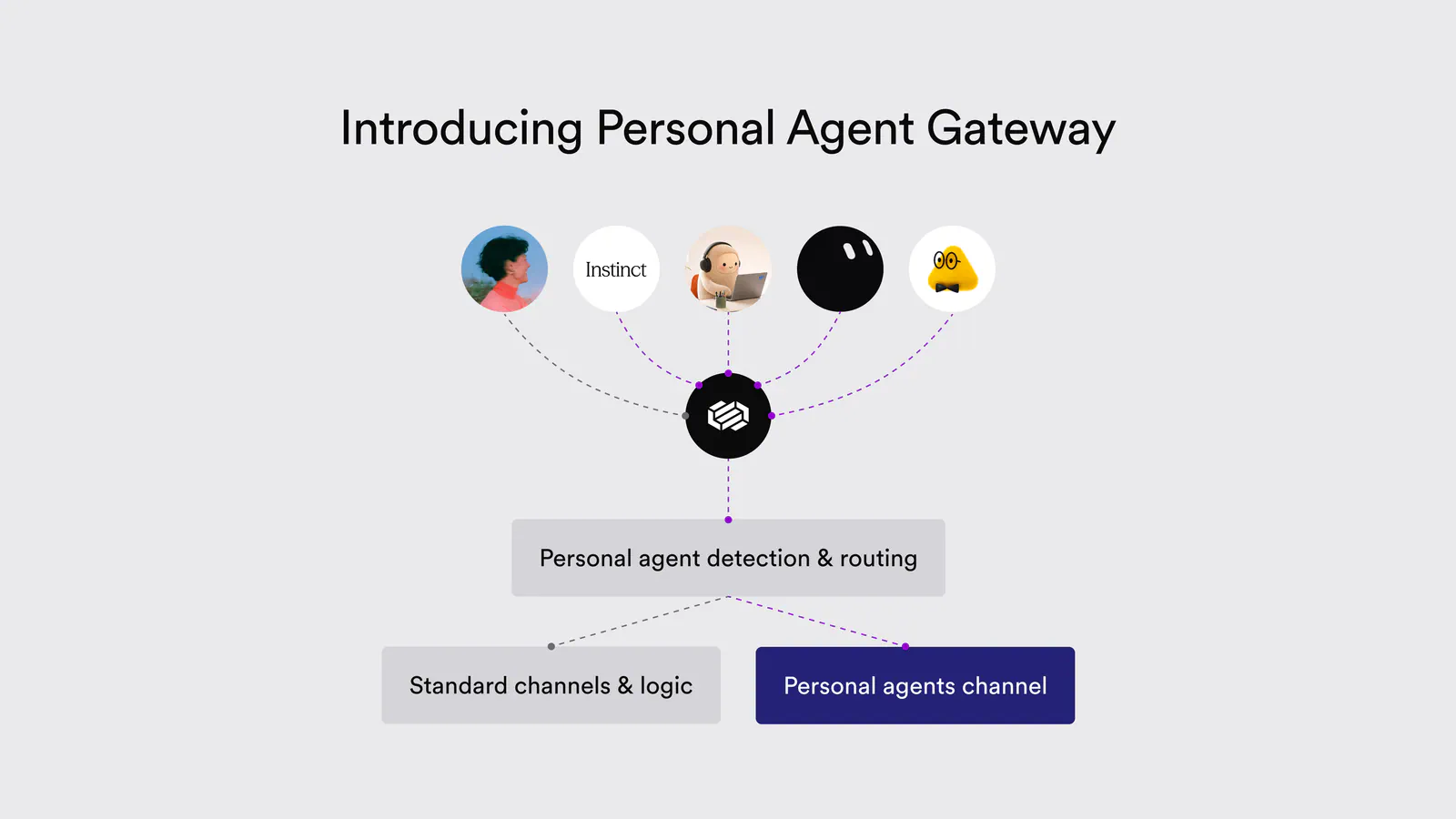
Personal Agent Gateway addresses an interaction that ordinary customer-service channels were not designed to govern: one AI agent contacting another on behalf of a person. Decagon describes two components. Detection flags likely personal agents arriving through existing voice and live-chat channels. A dedicated channel gives agents that identify themselves a direct way to communicate with a business’s Decagon agent.
Signals such as request cadence or conversational patterns may help a business suspect it is dealing with an automated caller. On their own, they cannot establish which customer the caller represents or what that customer approved. Decagon says each business decides how to handle agents it detects and what they may access.
For agents using the dedicated channel, Decagon proposes separate Agent Operating Procedures, or AOPs, from those used for human-facing interactions. A business can define permission scopes and require a particular scope before exposing the corresponding part of a workflow. Less sensitive requests can reuse existing procedures.
The airline example in Decagon’s announcement makes the boundary concrete. A traveler’s agent could be authorized to view earlier flights but not rebook one. The airline’s agent could return options, then require the traveler to approve an additional permission before making the change. That is a design example, not a reported deployment result.
The announcement leaves operational questions open: how reliably detection handles agents that do not identify themselves, how permissions are revoked, and what happens when an agent repeatedly seeks an exception to policy. Those details will matter as much as the convenience of a dedicated channel.
PACT Is an Authorization Proposal, Not an Adopted Standard
Decagon calls its proposed protocol PACT, short for Personal Agent Consent & Trust. According to the gateway announcement, it builds on Agent2Agent concepts for discovery and agent communication, then adds delegated authorization based on OAuth 2.0. The intended result is that a personal agent can establish whom it represents and present permissions granted by that person for actions the business defines.
Knowing that a request came from a particular agent does not prove that its owner authorized a refund, reservation change or account action. Decagon’s proposal puts the business in charge of defining available scopes and the customer in charge of granting them.
A specification is available, Decagon says, and the company is working with personal-agent providers and enterprise customers to refine it. That does not establish broad support among agent providers or interoperability across businesses. PACT’s practical value will depend on other systems implementing compatible discovery, consent and authorization flows, not merely on Decagon offering a gateway.
Modules and Apprentice Supply the Business Context
A direct channel is useful only if the business’s agent can carry out the work behind a request. Decagon’s Agent Modules are intended to package capabilities, analytics and campaign orchestration for journeys beyond support, including lead qualification, onboarding and collections. The company names financial services, travel and hospitality, healthcare, retail, and telecom as target industries.
Decagon says teams can define business logic while managing their portions of a shared agent through separate access controls. It also describes memory across conversations and channels, so a later onboarding interaction can draw on an earlier sales conversation. That combination could make an agent more useful across a customer relationship, provided the access controls get the right context to the right workflow without exposing information to an unauthorized requester.
Duet Apprentice addresses a different bottleneck. Decagon says it draws on internal resources and escalated conversations handled by experienced staff to help Duet draft AOPs, run simulations and analyze interactions. Through Slack and Microsoft Teams plugins, Duet can follow discussions about changing policies and suggest procedure updates when tagged, according to the company.
What Duet learns remains in the customer’s workspace and is not used to train models outside it, Decagon says. That is a vendor statement about data handling, not an independently verified privacy assessment. The company’s overview also does not establish uniform availability for every Apprentice capability; it directs prospective customers to its team rather than specifying general-availability terms for all four releases.
The Launch’s Hardest Test Is Governance
Decagon has presented a coherent plan: make calls less brittle, give personal agents a controlled route into a business, and equip the business’s agent with workflows and organizational knowledge. Those pieces address failures that a better-sounding support bot alone cannot fix.
The authorization layer faces the hardest test. Chord’s voice quality and Voice 3’s turn-taking can be assessed in calls. A gateway must also establish that the right person approved the right action, enforce the business’s policy, and work with agents outside Decagon’s own system. Decagon has introduced products and described its approach, but PACT’s adoption and performance across real providers remain unproven.
Frequently Asked Questions
4 questions
1What Did Decagon Announce at Dialogues 2026?
Decagon introduced four products on October 1, 2026: Voice 3 for customer calls, Personal Agent Gateway for handling customers’ AI agents, Agent Modules for industry-specific workflows, and Duet Apprentice for drawing on internal business knowledge. The company also introduced PACT, a developing authorization protocol associated with the gateway. It has not specified uniform general-availability terms for every capability.
2How Does Decagon Voice 3 Work?
Voice 3 combines Decagon’s Chord speech model with a duplex architecture. Decagon says one model manages the live conversation while another handles reasoning, tool calls and guardrails, allowing listening, speaking and task execution to overlap. The company also claims support for more than 70 languages. Its published performance results are company-run, not independent validations.
3What Does Personal Agent Gateway Allow Businesses to Control?
Personal Agent Gateway is designed to identify likely personal agents in existing channels and provide a dedicated channel for agents that identify themselves. Decagon says businesses can set different procedures and permission requirements for those interactions. Detecting an agent does not verify its customer’s consent; authorization must establish what the customer allowed the agent to do.
4Is PACT an Established Standard for Personal AI Agents?
No. PACT is Decagon’s proposed protocol for delegated authorization between personal agents and businesses. The company says it draws on Agent2Agent and OAuth 2.0 concepts and that a specification is available, but it is still refining that specification with providers and customers. Decagon has not established broad ecosystem adoption or demonstrated that agents across providers can use it consistently.
Sources
- Decagon’s Dialogues launchdecagon.ai
- Voice 3decagon.ai
- Chorddecagon.ai
- Personal Agent Gatewaydecagon.ai