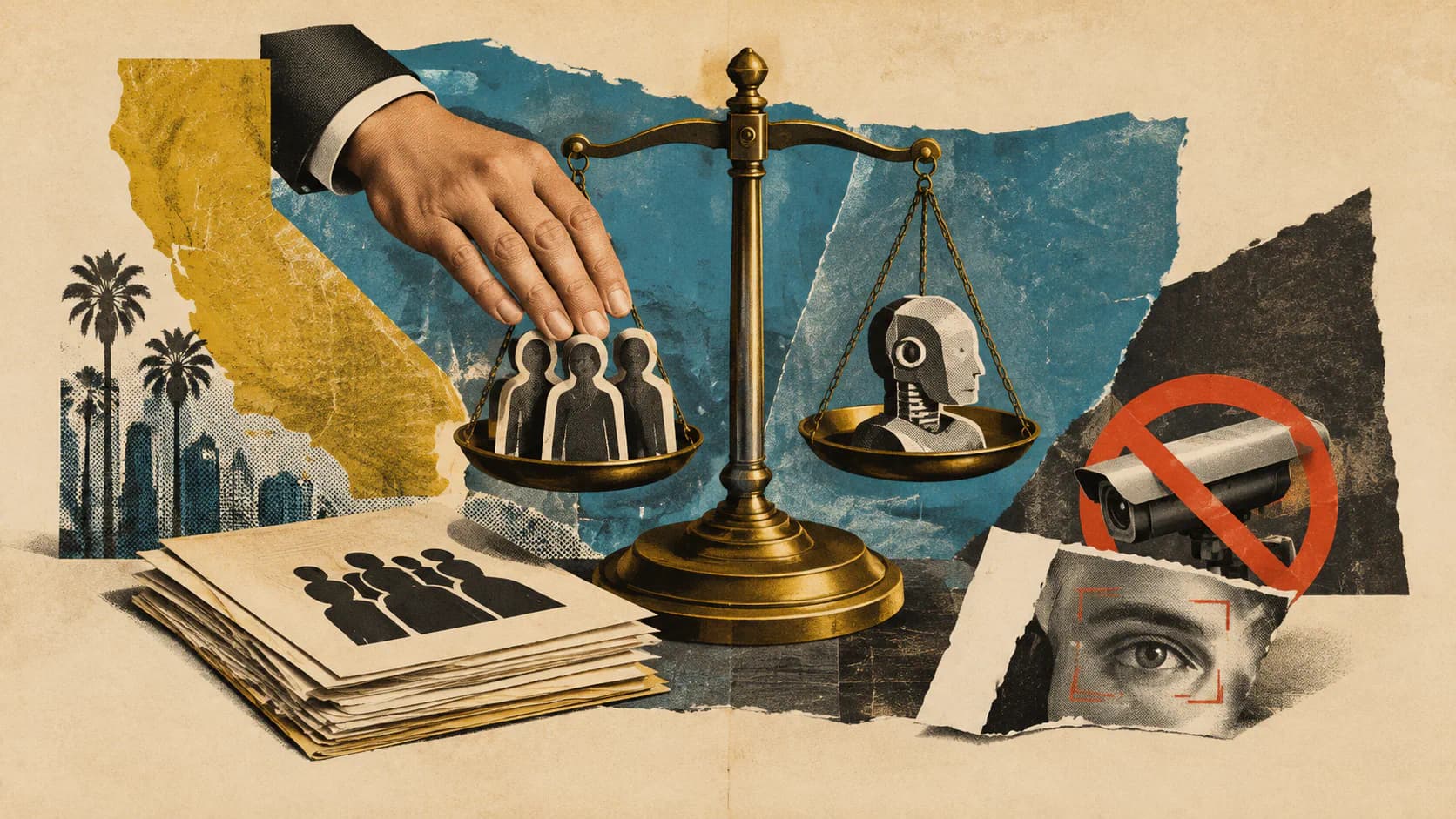
An AI system can still flag a California employee for discipline. Under a new law, it cannot be the sole basis for the employer’s decision to discipline or fire that person. If the employer primarily relies on the system’s output, a human must corroborate it. The employer cannot use an output the reviewer finds inaccurate, incomplete, or misleading.
That rule is part of a workplace-AI package signed on September 30, 2026. Other measures add disclosures to certain notices of AI-related workforce cuts and restrict biometric emotion analysis and workplace surveillance. California calls the worker protections first-in-the-nation. For employers, the immediate question is how their existing decisions, notices, and tools will satisfy each law.
The requirements address different situations: a manager checking an AI-generated disciplinary recommendation, an employer explaining a technology-driven mass layoff, or a company using cameras or biometric tools at work. They do not amount to a general ban on workplace AI.
Human Review Must Be More Than an Approval Click
SB 947 bars an employer from relying solely on an automated decision system, or ADS, to discipline or terminate an employee. The bill’s definition extends beyond products marketed as AI. It covers certain computational processes based on machine learning, statistical modeling, data analytics, or AI that produce a score, classification, or recommendation used in a decision with a material impact on a person. It expressly excludes tools such as calculators, databases, spam filters, and antivirus software.
The stronger test applies when an employer primarily relies on an ADS output for a disciplinary or termination decision. The employer must then direct a human to corroborate the decision using the information behind the output or other relevant evidence. The law gives examples including managerial evaluations, personnel files, work product, peer reviews, and witness interviews.
A reviewer cannot simply approve whatever the system recommends. If the output cannot be corroborated, or the reviewer concludes that it is inaccurate, incomplete, or misleading, the employer cannot use that output to make the decision. AI-assisted decisions remain possible, but the check must be able to change the result.
SB 947 also creates a disclosure duty after certain decisions. When an employer primarily relies on an ADS to discipline or terminate someone, it must give the employee a separate, plain-language written notice when it communicates the decision. The employee can request a meaningful, objective description of their own data used by the system; the employer must protect other people’s personal information when providing it. The bill also prohibits specified retaliation against employees who assert their rights under it.