This is the kind of result that scientists spend entire careers hoping to see. On August 19, 2026, Merck and Moderna announced that their personalized mRNA-based cancer vaccine, combined with Keytruda, met the primary and a key secondary endpoint in a pivotal Phase 3 trial for patients with surgically removed high-risk melanoma, marking the first positive Phase 3 result for an individualized neoantigen therapy and for any mRNA-based cancer treatment.
The therapy is called intismeran autogene (also known as V940 or mRNA-4157). Decades before mRNA vaccines became a household name, scientists were already exploring the technology as a way to treat cancer. Merck and Moderna have been working on this melanoma vaccine for about a decade. That long road just paid off in a very big way.
As someone who covers AI's role in medicine closely, I can say this result lands differently than most announcements. This isn't AI writing a better marketing email. It's AI helping design a treatment that keeps people alive longer after one of the deadliest forms of skin cancer. That's a different category of impact entirely.
What Is Intismeran Autogene?
Before getting into the numbers, it's worth understanding what makes this therapy so different from a standard cancer drug.
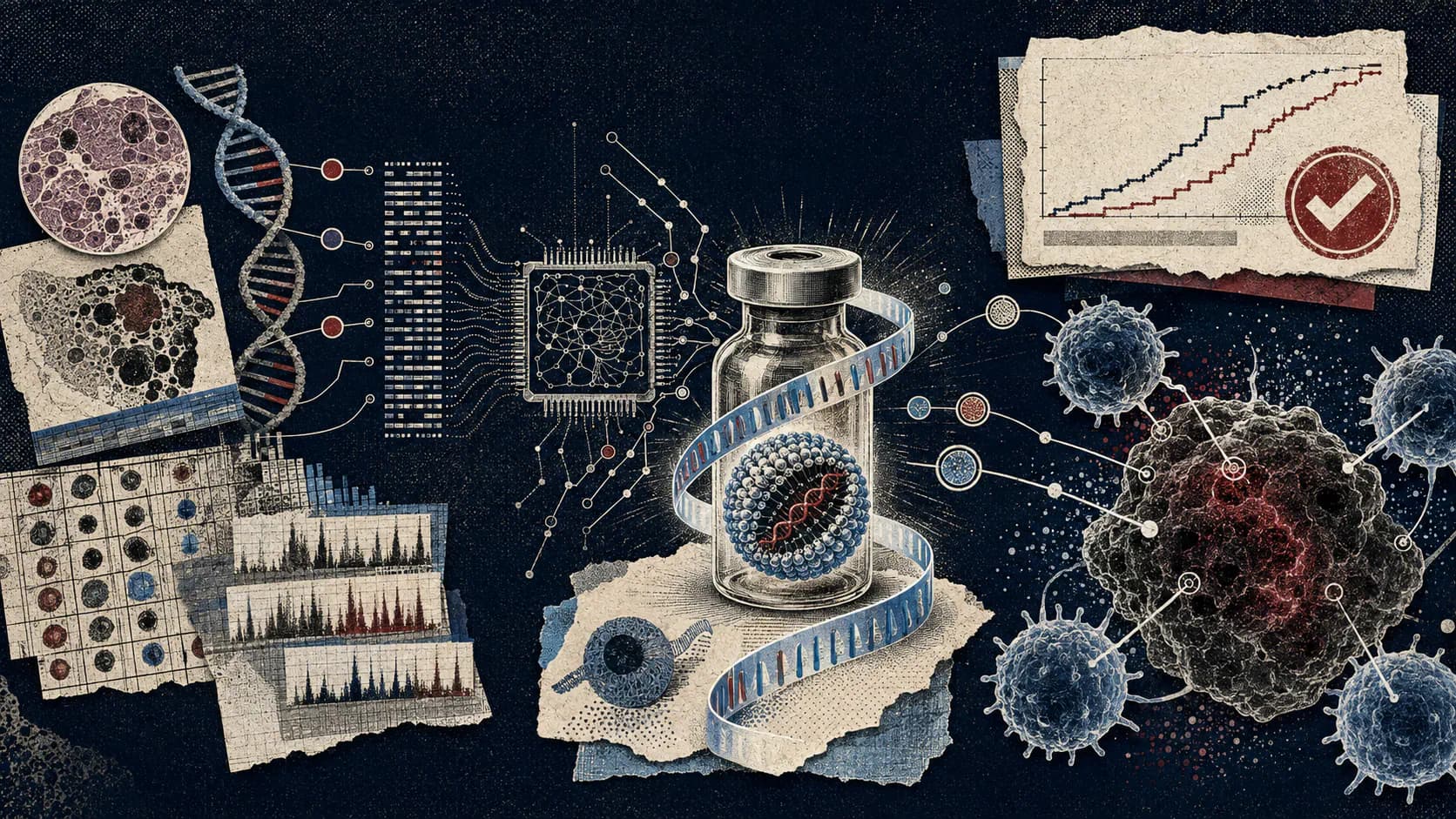
Intismeran autogene is a novel, potential first-in-class investigational mRNA-based individualized neoantigen therapy jointly developed by Merck and Moderna. It is designed and produced using a patient's tumor sample to identify the unique mutational signature, or "fingerprint," of their cancer and generate an anti-tumor immune response.
In plain terms: every patient gets a different drug. There's no off-the-shelf formula. The treatment is built from scratch for each person's specific tumor.
Intismeran is designed using a sample of each patient's tumor to identify the unique mutational signature of their cancer, then generating a synthetic mRNA that codes for up to 34 neoantigens specific to that individual. The therapy is intended to train the immune system to recognize and attack those cancer markers, working alongside Keytruda, which is already a standard of care for resected melanoma.
How AI Drives the Whole Process
The AI component here isn't a buzzword. It's doing the hard computational work that makes personalization at scale even possible.
AI plays an important role in simplifying these processes and helping move with speed and precision, especially when confronted with thousands of patient batches. On the design end, a series of fully integrated AI algorithms takes next-generation sequencing data from tumor and blood samples, reviews their genetic mutations, and predicts up to 34 of those neoantigens that are most likely to elicit an immune response.