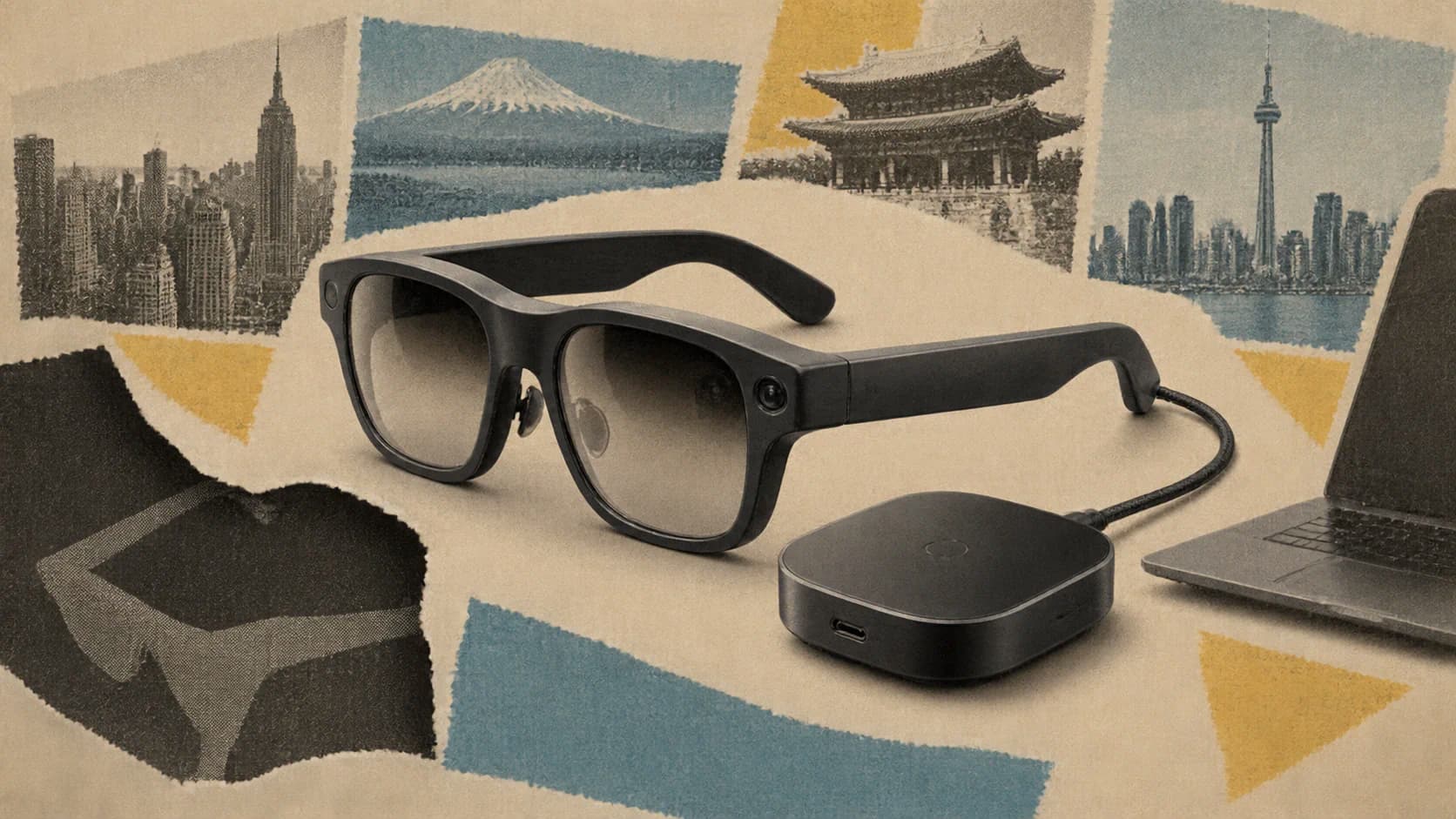
Google and XREAL launched XREAL AURA on October 28, 2026, opening public orders for wired Android XR glasses with Gemini built into the experience. The starting price is $1,099 through the end of 2026, and shipments begin in mid-November, according to Google’s launch announcement.
That timing marks the shift from reservation-gated preorders to public ordering, not confirmation that customers already have shipping notices. The United States, Canada and South Korea can order from October 28; Japan follows on November 2.
Google describes AURA as the first wired XR glasses powered by Android XR. The system combines transparent display glasses with a separate computing puck containing the battery and main processor. Gemini can help with Android XR apps, a mirrored laptop screen and things in the wearer’s surroundings when they share their view.
The interesting change is how those pieces fit together. AURA is a wearable Android computer with its own apps, plus a video input for bringing a laptop into the same workspace.
Public Orders Replace Reservation-Only Preorders
XREAL’s original October 7 announcement opened preorders only to customers who had already paid a reservation deposit before that date. Other buyers could still place a deposit for priority delivery, but public ordering was scheduled for later.
The October 28 launch is that next step.
| Market | Public ordering opens |
|---|---|
| United States | October 28, 2026 |
| Canada | October 28, 2026 |
| South Korea | October 28, 2026 |
| Japan | November 2, 2026 |
Google names XREAL’s website and BestBuy.com as ordering routes. Buyers should follow their local store’s instructions, particularly if they have an existing reservation or redemption code.
XREAL’s October 11 purchasing guide makes an important distinction: a reservation deposit is not a completed purchase. Reservation holders still need to choose their configuration and finish paying through the applicable checkout process.
Shipments begin in mid-November, according to Google. That is a dispatch window, not a promised delivery date for every address. The launch materials do not provide order-specific arrival dates or detailed stock availability by country. XREAL’s earlier announcement also places additional markets in 2027, without naming a complete expansion schedule.
I’d treat the mid-November window as useful planning information, but wait for an order-specific delivery estimate before relying on AURA for a trip or holiday gift.
The $1,099 Offer Changes the Starting Price
The new introductory price is $180 below the $1,279 US starting price XREAL announced on October 7, a reduction of roughly 14%. Google says the $1,099 starting offer runs through year-end.
The earlier announcement listed two memory and storage configurations, with different regional prices:
| Market | October 7 price: 12GB RAM / 256GB storage | October 7 price: 16GB RAM / 512GB storage |
|---|---|---|
| United States | US$1,279 | US$1,499 |
| Canada | CA$1,829 | CA$2,149 |
| Japan | ¥229,800 | ¥269,800 |
| South Korea | ₩1,990,000 | ₩2,290,000 |
These are historical announced prices, taken from XREAL’s October 7 release. They should not be read as a current promotional checkout table.
Google’s launch announcement establishes the new $1,099 starting point, but the supplied launch information does not specify a revised promotional price for every configuration and market. It would therefore be premature to subtract $180 from every model or convert the US offer into other currencies.
Memory, storage and glasses fit are also separate choices. XREAL offers two interpupillary-distance sizes, referring to the spacing between the wearer’s pupils:
- M: 60–66 millimeters.
- L: 66–72 millimeters.
Buying more storage does not change the optical fit. I’d settle the IPD choice before the storage upgrade: XREAL says the correct size helps avoid blurred edges, image cutoff and visual distortion, all of which matter more to everyday usability than unused capacity.
A Compute Puck Keeps the Glasses Light
AURA moves the main processor and battery into a wired puck, leaving the glasses at approximately 95 grams. Google describes them as weighing under 95 grams; XREAL’s specification page lists 95 grams.
The puck runs Android XR on Qualcomm’s Snapdragon Reality Elite platform, which Google says debuts with AURA. XREAL lists these specifications:
- Memory and storage: 12GB/256GB or 16GB/512GB, with UFS 4.0 storage support.
- Battery energy: 34.84 watt-hours.
- AI processing: 48 TOPS, or trillion operations per second.
- Glasses connection: a dedicated USB-C port supporting USB 3.1 and up to 5 volts at 2 amps.
- Charging and video input: a second USB-C port supporting DisplayPort Alt Mode input and charging at up to 57 watts, with QC 3.0 and USB PD 3.0 PPS support.
- Input: the puck doubles as a trackpad; Bluetooth keyboards and mice are also supported.
The split design removes the main battery and processor from the frame, but it leaves the wearer carrying another device and managing a cable. The glasses’ weight alone is therefore not the weight of the complete system.
The 48-TOPS figure is XREAL’s hardware specification, not a measurement of Gemini response speed. Likewise, a 57-watt maximum charging input does not establish a full-charge time. These are published vendor specifications and feature descriptions, not independent performance, comfort or battery-life measurements.
Transparent Optics Have a Finite Viewing Area
AURA uses optical see-through lenses, so the wearer sees the real world directly instead of through a camera-fed display. XREAL lists Sony Micro-OLED panels at 1920 × 1200 pixels per eye, a 70-degree field of view and refresh rates up to 120Hz.
A spatial coprocessor in the frame handles tracking-related work. The listed sensors support hand tracking and six-degree-of-freedom positioning, meaning the system can track both rotation and movement through space.
The distinction between workspace size and field of view is useful here. Android XR can place windows around the wearer, but the glasses show only a portion of that surrounding workspace at once. More virtual windows do not give each window the full panel resolution simultaneously.
My view is that window placement and text readability will matter more for desk work than the size of an advertised virtual screen. The published specifications describe the display hardware, but they cannot settle how comfortable a dense spreadsheet will be for a particular wearer.
Gemini Can See Apps and a Mirrored Laptop Window
Google says Gemini can understand what the wearer is viewing across Android XR apps, real-world surroundings and a mirrored laptop window.
The launch examples include asking Gemini to rearrange windows, discuss material on screen and help with something visible nearby. When the wearer shares their view, Gemini can also highlight an area of interest on a screen or in the surrounding room.
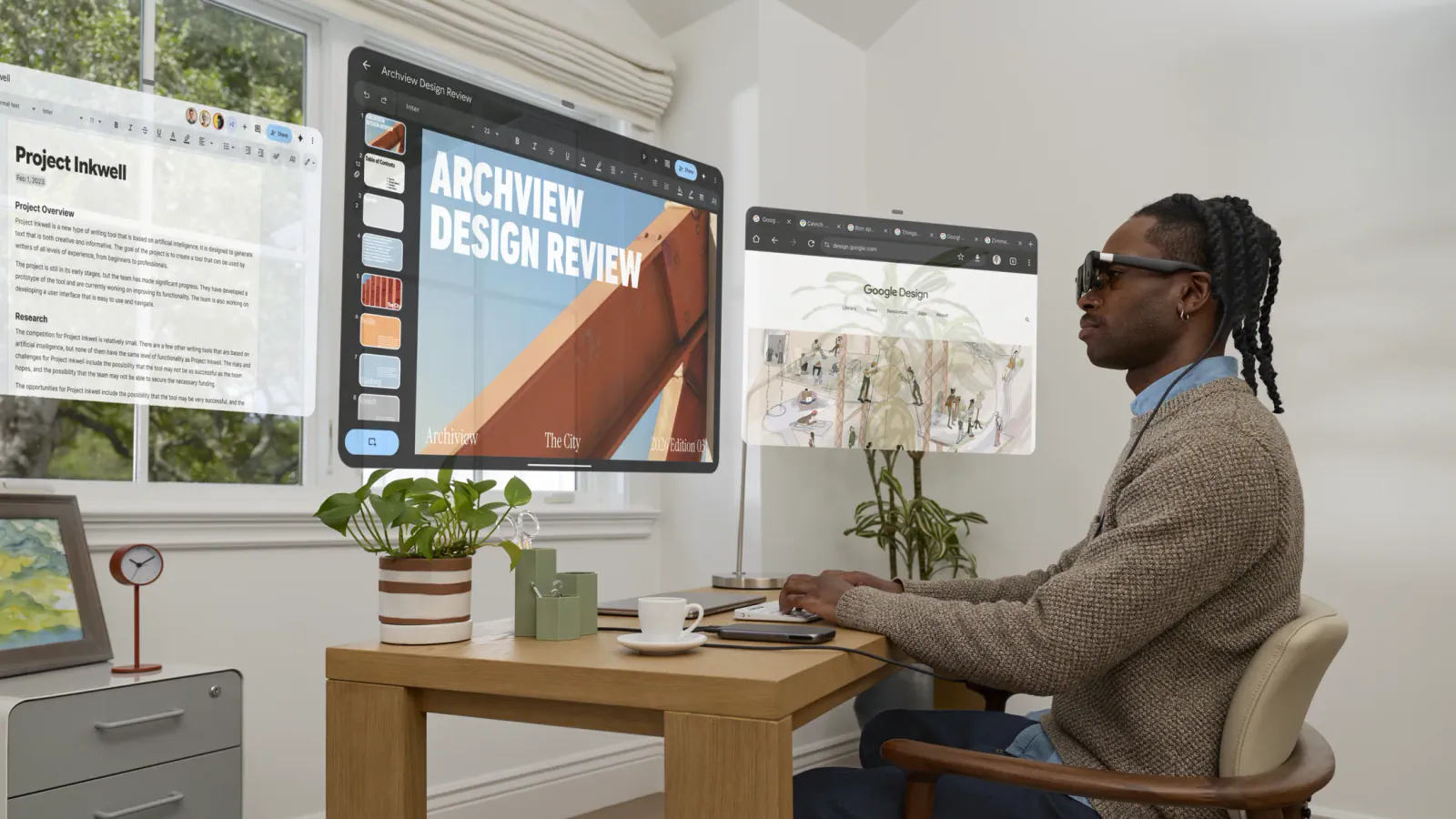
That highlighting feature gives the assistant a more precise way to direct attention. An answer can point to the relevant part of a document or scene instead of relying entirely on spoken descriptions.
Google’s launch post says this assistance extends to Wired Mirroring. Connecting a compatible laptop brings its screen into Android XR as a window that can be resized and positioned beside native apps, without installing additional laptop software.
Frequently Asked Questions
4 questions
1Is XREAL AURA Already Shipping?
Public orders opened on October 28 in the US, Canada and South Korea. Japan opens on November 2. Google says shipments begin in mid-November; individual delivery dates will depend on the order.