President Donald Trump said on October 27, 2026, that he would ban the term artificial intelligence, extending a campaign to replace it with his preferred label, super intelligence. His statement targeted language in documents and more broadly, but the accompanying reporting identified no new order, regulation, penalties or implementation timetable.
The distinction matters because an earlier federal naming directive is already part of the story. The Hill reports that Trump signed a September executive order directing executive-branch use of super intelligence instead of AI. His latest statement goes further rhetorically, without explaining how a broader prohibition would work.
What Trump Said and Why
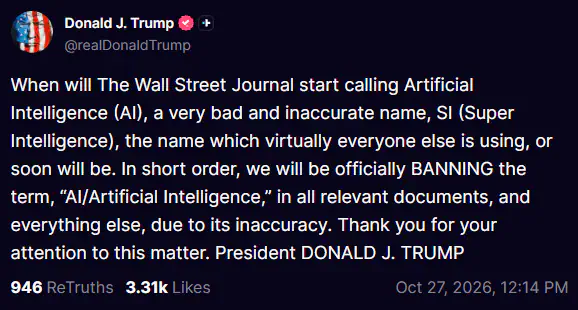
Trump made the announcement on Truth Social while criticizing The Wall Street Journal for continuing to use AI. According to The Hill’s October 27 report, he wrote:
“In short order, we will be officially BANNING the term, ‘AI/Artificial Intelligence,’ in all relevant documents, and everything else, due to its inaccuracy,”
The post combined two claims: that artificial intelligence is an inaccurate name, and that the government would prohibit its use. It did not identify which documents would be covered, who would have to comply or what would happen if they continued using the term.
Trump’s criticism of the Journal puts private publishing directly into the context of the statement. He was asking a newspaper to adopt his terminology, not simply telling federal employees how to label an internal program.
The Hill also reports that Trump discussed the switch during his September appearance at the United Nations General Assembly. There, he framed artificial as making the technology sound fake and described a change to super intelligence in U.S. documents. The October post therefore continues an existing naming campaign; it is not the first announcement of that preference.
I’d read the expansive wording as the consequential part of this latest statement. A president choosing language for government communications is one issue. Suggesting that the same restriction reaches newspapers, companies and ordinary speakers raises a different set of legal and practical questions.
The Existing Federal Directive Has a Narrower Scope
The Verge’s account draws the central distinction: Trump can direct executive-branch agencies to change their terminology, but that authority does not give him a general power to make everyone else stop saying AI.
The reported September executive order belongs on the government side of that divide. An instruction to executive agencies could affect the wording of federal websites, reports and communications, depending on its actual terms. It would not, by itself, rename a private company’s products or compel a newspaper to change its style guide.
The original Truth Social post and the September order’s text were not available in the reviewed evidence. This account relies on reporting by The Hill, The Verge and HuffPost, which limits conclusions about the earlier directive’s precise coverage, exceptions and implementation requirements.
That limitation is particularly important for legal documents. A government communications preference and a change to a regulatory definition are different actions. If a rule uses a defined term to determine which systems it covers, an agency would need to explain whether a terminology update preserves that scope or changes it.
For readers, the useful distinction is between renaming government communications and changing obligations attached to technology. A new label alone tells us little about the second.
What Would Turn the Statement Into an Operative Policy?
The strongest evidence of a broader policy would be a published instrument explaining who must do what, under which authority and by when. The October 27 reporting supplies no such mechanism for the new statement.
Different targets would require different evidence:
| Area affected | What readers should look for | What it would clarify |
|---|---|---|
| Executive-branch documents | The order or agency instruction, including scope and deadlines | Which materials must change and whether older documents are covered |
| Regulations and compliance | A published action identifying the affected provisions and legal authority | Whether duties or definitions change, beyond surface wording |
| Federal contracts | Specific solicitation or contract language | Whether a naming requirement applies to a vendor’s government deliverables |
| Private publishing and products | A concrete legal measure and its asserted authority | Whether the administration is attempting to reach private speech |
| Technical standards | A revision issued through the relevant standards process | Whether terminology changes in the documents engineers actually use |
These are evidence tests, not announced steps. A hypothetical contract requirement covering a report delivered to an agency, for example, would need to be read on its own terms. It would not automatically show that a vendor must rename its entire commercial product line.
A broader restriction on private speech would also face constitutional scrutiny. Passing legislation or issuing a regulation would not, on its own, resolve that problem.
HuffPost reports that its question to the White House about possible penalties received no immediate response. It also recounts Mediaite asking how a ban could work given the First Amendment. According to that account, the White House replied:
“Refer to the truth.”
That response supplied no legal rationale or enforcement details. It points back to the statement without explaining how the proposed prohibition would operate.
Super Intelligence Is Not a Neutral Replacement for AI
Frequently Asked Questions
3 questions
1Has Trump enacted a nationwide ban on saying AI?
The October 27 reporting identifies no new mechanism establishing such a ban. His statement promises a prohibition but does not explain its legal authority, penalties or implementation.