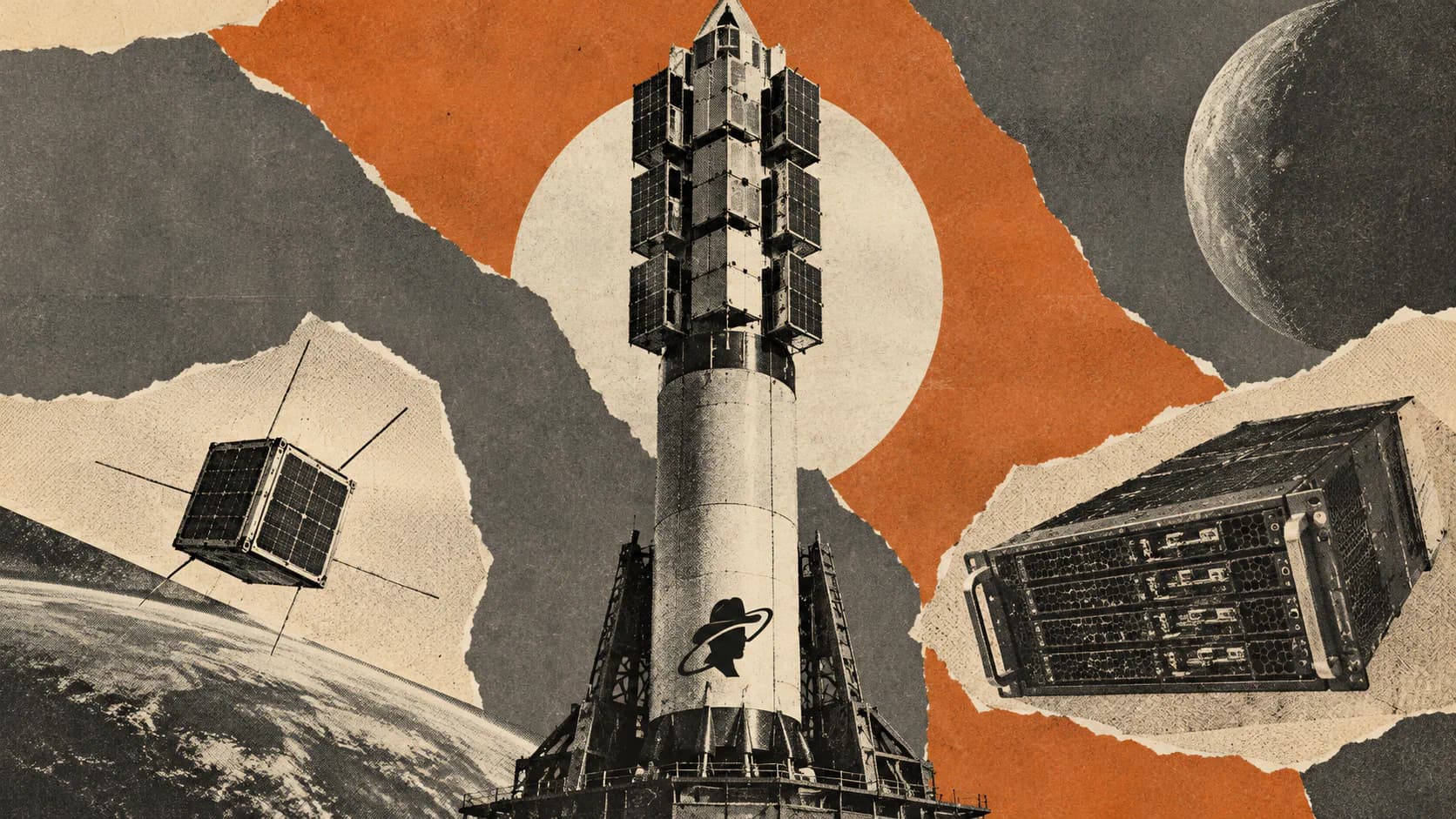
Cowboy Space unveiled Big Iron on October 26, 2026, outlining an 86-meter rocket whose upper stage would remain in orbit as a megawatt-class AI data center. The company, led by Robinhood co-founder Baiju Bhatt, wants to use that design to build Stampede, a constellation of up to 20,000 satellites in low Earth orbit. Each launch would add one data-center satellite. Space.com reports that the rocket and the resulting spacecraft share the Big Iron name.
The engineering proposal has a distinctive feature: hardware needed for launch would take on new jobs in orbit. The upper stage becomes the spacecraft, while launch structures become part of its cooling system. Cowboy Space is targeting a first flight in 2028, according to Payload’s reporting.
The company’s existing orbital hardware is much smaller in scope. Reason-1, launched on October 1, is a laser power-beaming demonstration satellite. At the time of the unveiling, its first beaming attempt was still expected in the following weeks.
Those are three different levels of maturity: a satellite already launched, a proposed launch-and-compute system, and a constellation requiring tens of thousands of successful deployments. The useful way to assess Big Iron is to keep them separate.
How Big Iron Would Become a Data Center
Big Iron is designed as a two-stage, stainless-steel rocket measuring 86 meters tall and 4.7 meters wide. Nine Clydesdale engines would power the first stage, with one powering the upper stage. The engines would burn liquid oxygen and liquid methane, a combination commonly called methalox. Space.com describes a reusable first stage, with the company’s presentation showing a landing on a ship at sea.
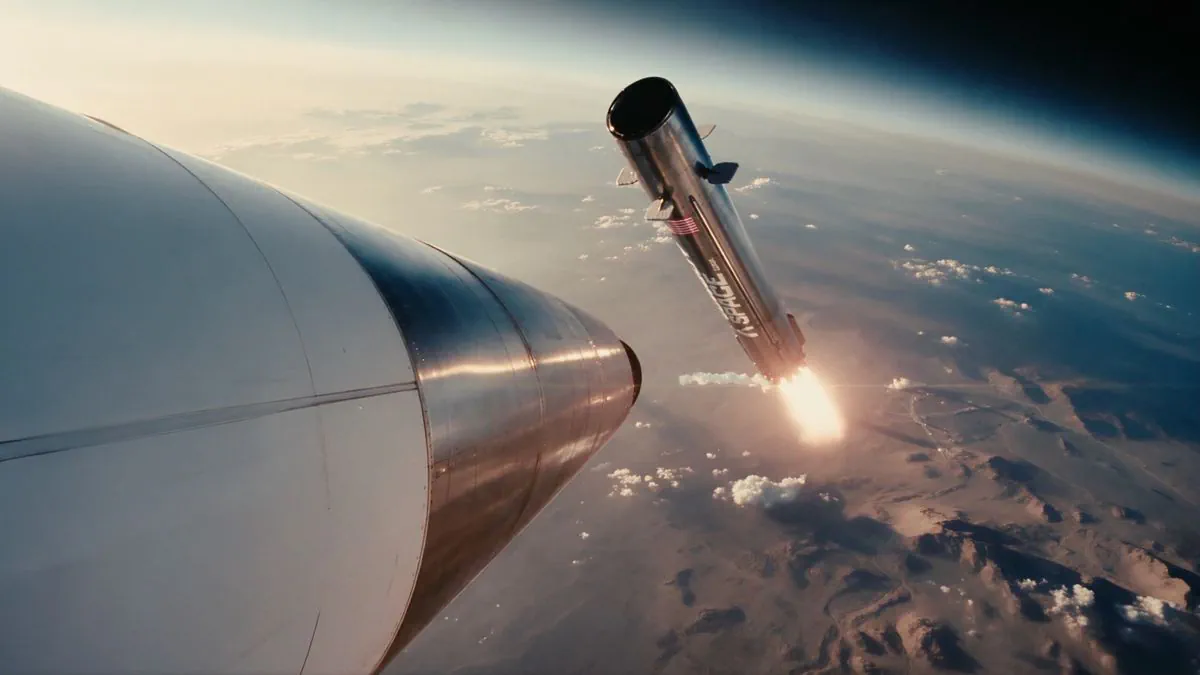
The upper stage would stay in orbit. According to the two reports, the proposed spacecraft would have:
- About 15,000 kilograms of mass, according to Space.com.
- Deployed dimensions of roughly 132 by 73 meters, according to Payload.
- Five racks of NVIDIA Vera Rubin GPUs, according to Payload.
- A megawatt-class power allocation for its computing payload, as described in the company’s proposal.
These remain design specifications, not measurements from a flying Big Iron spacecraft.
Cowboy Space’s most interesting engineering choice is the reuse of launch hardware after orbital insertion. Space.com reports that the payload fairing would become a radiator. Payload describes the rocket’s skin becoming part of the cooling system, with ammonia also serving as coolant and nitrogen used to pressurize the second stage later deploying the solar wings. Payload’s account presents this as a way to avoid carrying separate structures for every task.
That approach has a clear mass-saving rationale. A conventional payload needs protection during launch, electrical power in orbit and a way to reject heat. Giving one structure multiple jobs could reduce the amount of hardware that must be lifted.
It also couples those jobs together. A fairing optimized to withstand launch loads has different requirements from a radiator optimized to emit heat over years. The proposal’s value depends on making that shared structure perform both tasks reliably.
My view is that this dual-use architecture deserves more attention than the headline satellite count. It is a concrete design decision with an understandable engineering benefit. Whether it delivers that benefit will depend on thermal performance, structural durability and the mass of the complete system.
Big Iron would also be available to outside customers through a program called Big Iron Express, which Payload says is intended for payloads needing up to a megawatt of power. That is a proposed service offering, not evidence of available launch capacity.
Reason-1 Is an Early Demonstration
Reason-1 reached orbit aboard SpaceX’s Transporter-18 mission on October 1, according to Payload. Its mission is to demonstrate laser power beaming.
At the time of Payload’s report, Cowboy Space chief operating officer and chief legal officer Joseph Yaffe said the first beaming attempt would likely happen within a few weeks. The report therefore supports a successful launch and an ongoing test mission, but not a completed power-beaming demonstration.
Cowboy Space’s next planned satellite, Reason-2, is scheduled for 2027. Payload reports that it would operate GPUs in orbit for commercial and government customers, including a NOAA effort to process weather data in space.
That progression matters:
| Project | Reported purpose | Status at the unveiling |
|---|---|---|
| Reason-1 | Laser power-beaming demonstration | Launched; first beaming attempt still ahead |
| Reason-2 | GPU computing in orbit | Planned for 2027 |
| Big Iron | Integrated rocket and megawatt-class computing satellite | First flight targeted for 2028 |
| Stampede | Up to 20,000 Big Iron satellites | Proposed constellation, pending FCC approval |
Reason-1 may help the company learn how its hardware behaves in orbit. It cannot, by itself, validate Big Iron’s launch vehicle, megawatt-class thermal system or ability to deliver a commercial AI service.
Rocket development is also at an early stage in the supplied reporting. Payload says Cowboy Space tested part of the Clydesdale engine at NASA’s Stennis Space Center, with a roughly 30-person team building and testing its combustion chamber in 90 days. Those are company-reported development milestones. A combustion-chamber test is a useful step, but a complete engine, an integrated stage and an orbital flight each introduce additional requirements.
The Launch Arithmetic Behind 20,000 Satellites
One Big Iron satellite per launch means a fully deployed Stampede constellation would require 20,000 launches, before accounting for failures or replacement spacecraft.
The following calculations use the announced constellation size and assume an uninterrupted average launch rate throughout deployment. They are arithmetic scenarios, not Cowboy Space forecasts.
| Average launch rate | Launches per year | Time to launch 20,000 satellites |
|---|---|---|
| One per day | 365 | About 54.8 years |
| Two per day | 730 | About 27.4 years |
| Five per day | 1,825 | About 11 years |
| Ten per day | 3,650 | About 5.5 years |
Even a ten-year deployment would require an average of approximately 5.5 launches every day. That average would have to include the initial production ramp, maintenance, weather interruptions and any periods when flights are paused.
A reusable booster could help reduce the number of first stages required. It would not eliminate the need to manufacture a fresh upper stage and computing satellite for every mission, because that hardware stays in orbit.
At the reported mass of about 15,000 kilograms per spacecraft, 20,000 satellites would amount to roughly 300,000 metric tonnes of orbital hardware. This calculation excludes first stages, launch propellant and supporting ground infrastructure.
The distinction between deployment and maintenance is equally important. Once satellites reach the ends of their useful lives, maintaining a fixed constellation requires replacements. As an illustration, a mature 20,000-satellite fleet with a ten-year average service life would need about 2,000 replacements annually, or 5.5 launches per day. A five-year life would double that rate. Neither service life is established by the supplied reporting.
The practical consequence is that launch cadence becomes a permanent operating requirement, not simply a construction phase. Factories, engine production, launch sites, booster recovery and spacecraft commissioning would all have to support it.
I’d read the 2028 target as a first-flight milestone. The reporting provides no basis for treating it as the arrival date of a fully deployed orbital AI platform.
A Megawatt Is a Power Claim, Not an AI Benchmark
Cowboy Space describes each Big Iron satellite as a megawatt-class computing platform carrying five GPU racks. That tells readers something about its intended electrical scale. It does not provide a standardized measure of AI performance.
A megawatt is one million watts of power. It is not a count of floating-point operations, generated tokens or completed training runs. Actual AI throughput would depend on the installed chips, numerical precision, memory, interconnects, software and workload.
The distinction is especially important for the five-rack claim. Dividing one megawatt by five produces an average of 200 kilowatts per rack, but that is only a simple allocation of the announced power figure. It does not establish actual rack consumption or explain how much additional power the spacecraft would need for communications, control and electrical losses.
At constellation scale, the same arithmetic produces striking totals:
- 20,000 satellites × 1 megawatt = 20 gigawatts of nominal computing-payload power.
- 20,000 satellites × five racks = 100,000 GPU racks.
Those figures describe the proposed system at full size. They are not installed capacity or independently measured performance.
For an AI customer, the missing comparison is useful computation delivered at a specified price and reliability. Five orbital racks and five terrestrial racks would need to be compared using the same hardware configuration and workload, including the cost and delay of moving data.
The supplied reporting contains no such benchmark or demonstrated cost advantage. The proposal establishes an intended scale, not a demonstrated competitive position in the AI industry.
Cooling and Connectivity Remain Central Challenges
Frequently Asked Questions
4 questions
1Has Cowboy Space Launched Big Iron?
No Big Iron flight is reported in the supplied coverage. Cowboy Space is targeting its first flight in 2028. Reason-1, a separate power-beaming demonstration satellite, launched on October 1, 2026.