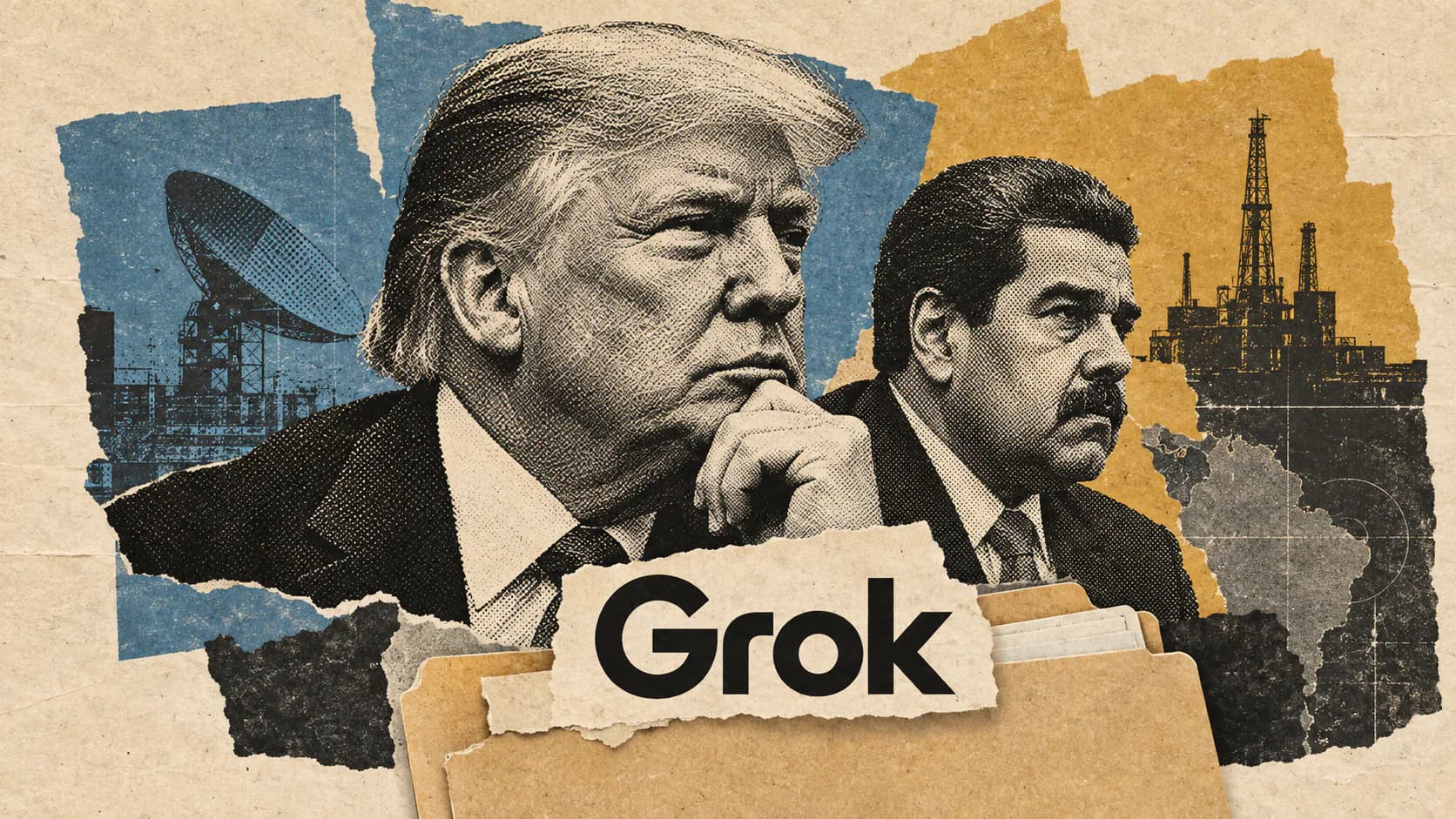
President Donald Trump reportedly asked xAI’s Grok how Venezuelans would react if the United States captured Nicolás Maduro before ordering the mission. The account comes from TIME’s Trump profile, which attributes the exchange to an unnamed official who was present. Zeniteq has not independently verified it.
According to TIME, the chatbot predicted that many Venezuelans would celebrate Maduro’s downfall. The reporting also attributes a later favorable impression of Grok to Trump.
The allegation is striking, though it does not establish that Grok recommended the operation, changed Trump’s plans, or caused the capture decision. Asking about public reaction is narrower than seeking military advice.
The account raises questions about the evidence behind chatbot answers, the uncertainty they communicate, and the responsibility of leaders who consult them. Those questions deserve scrutiny without treating an anonymously sourced exchange as a proven explanation for a military action.
What TIME’s Source Says Happened
TIME places the reported exchange in December 2025, during a private meeting between Trump and Elon Musk. According to the unnamed official, Trump spent hours asking Grok questions about his presidency and legacy.
One question concerned how Venezuelans would respond if the United States captured Maduro. TIME says Grok described Maduro as deeply unpopular and predicted that many Venezuelans would likely celebrate his downfall.
TIME published its account on October 1, 2026, months after the December meeting it describes. It was not reporting a newly observed conversation.
TechCrunch’s summary places the consultation roughly a month before the January 3, 2026 operation. Drawing on TIME, it says Trump subsequently regarded Grok favorably after celebrations followed Maduro’s capture.
The reported sequence includes a consultation, a prediction, a later operation, and a favorable assessment attributed to Trump. It leaves the complete discussion and the intervening decision-making process unknown.
The duration of the Maduro discussion is unclear, too. Trump reportedly spent hours talking to Grok about his presidency and legacy; that does not establish that he spent hours discussing Venezuela.
TechCrunch’s Coverage Is Not Independent Corroboration
TechCrunch explicitly attributes the account to TIME. Its coverage helps identify the story’s significance for the AI industry, but offers no separately sourced confirmation of the December meeting or chatbot exchange.
As a report circulates, two publications carrying the same account can look like two independent confirmations. Here, the underlying sourcing remains the unnamed official cited by TIME. Anonymous sourcing does not automatically invalidate reporting, though readers must rely on the publication’s assessment of a source whose identity and account they cannot inspect.
The reporting available for this article provides no transcript, prompt log, screenshot, or direct statement from Trump, Musk, or xAI confirming the alleged exchange. It also includes no response from those parties to the account. That absence should not be described as a refusal to comment: the available material does not establish whether a response was requested.
A conversation record would help establish what Trump asked, what Grok answered, and whether important qualifications disappeared in the retelling. Without one, the exchange remains attributed reporting rather than an independently verified reconstruction.
A Forecast About Public Reaction Is Not a Military Recommendation
TechCrunch’s headline says Grok “reportedly encouraged” Trump to capture Venezuela’s president. The exchange described in its article supports a narrower formulation: Trump reportedly asked about Venezuelans’ likely reaction, and Grok offered a favorable prediction.
Predicting celebrations does not, by itself, recommend a capture operation. It leaves the operation’s legality, feasibility, risks to civilians, diplomatic consequences, and prospects for a stable political transition unaddressed. Even an accurate forecast of one response would leave those questions unanswered.
How much weight Trump gave the answer is also unknown. He might have regarded it as reassurance, a curiosity, an additional opinion, or an important input. The available evidence does not distinguish among those possibilities.
Establishing influence would require more than showing that the consultation preceded the operation. Relevant evidence could include a contemporaneous statement that the answer changed Trump’s assessment, records showing how he used it in subsequent discussions, or testimony explaining its place alongside other advice.
Trump’s reported favorable reaction afterward offers limited evidence on that point. Appreciating a chatbot’s apparent prediction after an event does not demonstrate that the prediction drove the earlier decision.
The forecast’s scope also needs scrutiny. Celebrations by some Venezuelans could be consistent with the reported answer without establishing that it accurately represented Venezuelan opinion overall. A prediction about “many” people needs a defined population and a method of assessment before it can be evaluated rigorously.
The Answer’s Provenance and Uncertainty Are Unknown
The central technical questions concern the particular answer Trump reportedly received, not Grok’s reputation in general.
Provenance means the origin of the information supporting an answer. The available reporting does not identify what evidence Grok used, whether it searched for current information, or whether it supplied citations. The model version and settings are also unknown.
These gaps prevent a meaningful assessment of the forecast. An answer grounded in recent public-opinion research would warrant a different evaluation from one based on commentary, selected news coverage, or unsupported synthesis. The reporting does not establish which, if any, of those sources informed Grok.
A defensible assessment of Venezuelan reactions would also need to distinguish among groups. People living in Venezuela, members of the diaspora, opposition supporters, government supporters, and people concerned about foreign intervention need not respond alike. These are relevant distinctions, not findings about what any group actually believed during the reported conversation.
The exact prompt and preceding conversation would help readers assess how Trump’s question shaped the response. A neutral request for a range of possible reactions differs from a question framed around the expectation that people would celebrate.
Potential bias requires the same caution. The account does not demonstrate that Grok favored Trump, reflected Musk’s preferences, or selectively presented information about Venezuela. The identities of the people reportedly involved are not enough to support those conclusions.
The answer itself would help clarify its sources, counterarguments, alternative scenarios, and treatment of conflicting evidence. It would also show how Grok conveyed uncertainty. The reported prediction includes the word “likely,” but the available account does not show whether Grok explained its confidence or the limits of its evidence. A qualified word alone tells readers little about how firmly a forecast should be trusted.
Frequently Asked Questions
3 questions
1Did Trump ask Grok about capturing Nicolás Maduro?
TIME reports that he did, citing an unnamed official present at a private December 2025 meeting with Elon Musk. According to that account, Trump asked how Venezuelans would react to Maduro’s capture. Zeniteq has not independently verified the exchange, and the available reporting provides no transcript or prompt log.
2
Sources
- TIME’s Trump profiletime.com
- TechCrunch’s summarytechcrunch.com