The AI Engineering Skills Map According to Andrew Ng | Zeniteq
Loading
Loading article
The AI Engineering Skills Map According to Andrew Ng
Andrew Ng’s framework turns agentic coding from a prompting trick into a disciplined workflow built on planning, supervision, review, and software fundamentals.
Andrew Ng’s AI Engineering Skills Map argues that coding agents are now a core engineering capability requiring disciplined planning, supervision, review, and software fundamentals.
DeepLearning.AI published the broader four-part map on August 14, 2026, followed by a coding-agent map on September 4. Its five skill groups cover directing agents, managing autonomy, reviewing output, customization, and software fundamentals. Ng recommends bounded tasks, pre-edit plans, checkpoints, deterministic tests, narrow permissions, and tools such as AGENTS.md and Model Context Protocol integrations.
Andrew Ng’s AI Engineering Skills Map makes a clear claim about software development in 2026: using coding agents is no longer an optional productivity trick. It is a core engineering capability that belongs beside application development, deployment, product judgment, and traditional software skills.
DeepLearning.AI published the broader AI Engineering Skills Map on August 14, 2026. On September 4, Ng followed it with a more detailed map focused on coding agents, covering how engineers should direct, supervise, review, and customize them.
The useful part is not a list of fashionable tools. Ng describes a repeatable development process in which people define the objective, delegate bounded work, inspect the results, and give the agent an environment that supports reliable execution.
The Skills Map Puts Coding Agents Beside Core Engineering
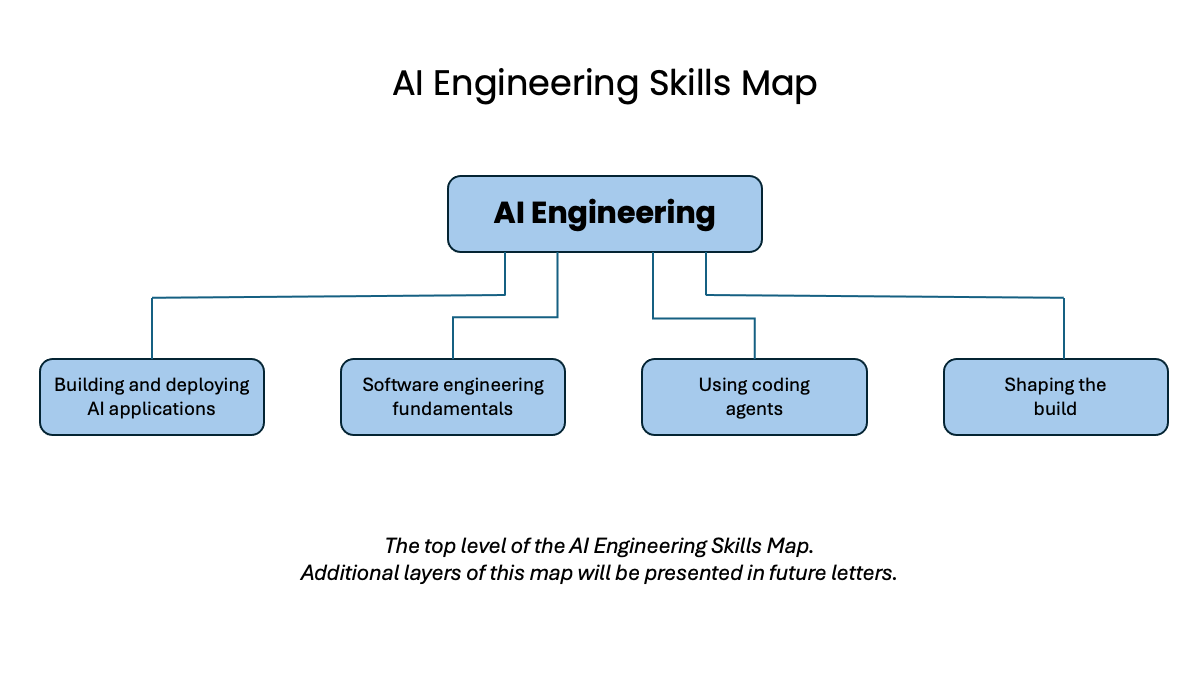
The top-level map divides modern AI engineering into four related areas:
Building and deploying AI applications
Software engineering fundamentals
Using coding agents
Shaping the build
That arrangement is significant. Coding agents are not presented as a replacement for engineering knowledge or as an isolated prompt-writing specialty. They operate within a larger process that still requires someone to identify the right problem, design the system, manage implementation, and evaluate whether the result works.
Ng also warns against treating the map as a fixed curriculum. The recommended learning mechanism is project work: build something, identify the gaps in your knowledge, study the relevant concepts, and apply them in the next iteration.
The map therefore works best as a diagnostic tool. An engineer can use it to ask where a development workflow is weak. The problem might be poor agent direction, but it could just as easily be inadequate testing, unclear requirements, bad API boundaries, or an inability to review generated code.
Work with Zeniteq
Let’s work together
We’re open to thoughtful collaborations with teams building in AI. Explore the ways we can work together.
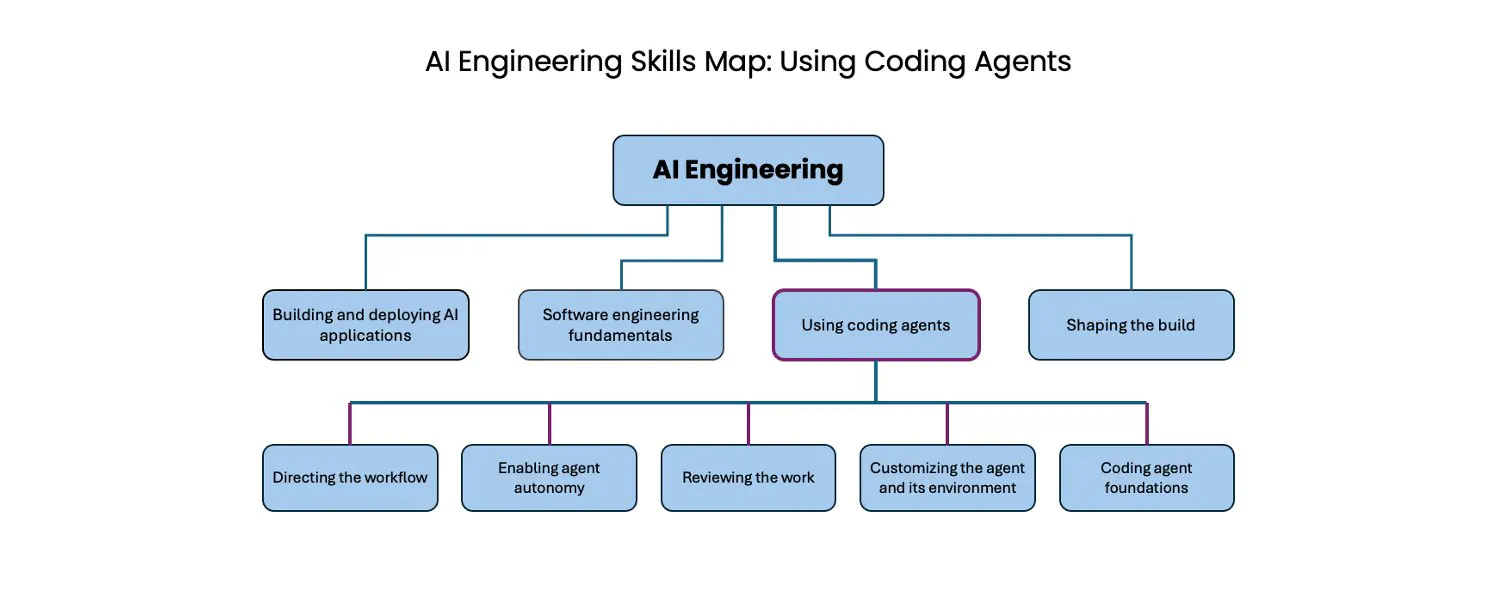
Ng’s detailed coding-agent map organizes the work into five skill groups. Together, they describe something closer to supervised delegation than automated code completion.
Skill group
What the engineer needs to do
Directing agents
Write appropriately scoped prompts, break large goals into manageable tasks, and supply relevant context
Managing autonomy
Use plans, checkpoints, context management, and parallel sessions without losing control of the work
Reviewing output
Inspect proposed plans and code, issue corrective prompts, run tests, and keep changes small enough to evaluate
Customizing agents
Configure instructions, permissions, tools, subagents, hooks, and reusable workflows
Applying software fundamentals
Use version control, code review, testing, API design, scoping, and refactoring judgment
This is a more demanding definition of agent skill than knowing how to ask a model for a function. The engineer remains responsible for the control points around generation.
The pattern resembles a feedback system. The person specifies the desired behavior and constraints. The agent investigates and proposes an approach. The person checks that approach before approving execution. Tests and code review then provide evidence about whether the implementation matches the intended result.
Better models can improve individual steps, but they do not remove the need for that loop. A capable agent given a vague objective can still produce a technically plausible implementation that solves the wrong problem.
The Recommended Workflow Starts Before Code Generation
Ng’s example begins with design rather than prompting. The human first decides what should be built, including the desired behavior, system constraints, and definition of success.
The agentic development loop then looks like this:
Phase
Agent responsibility
Human responsibility
Design
None initially
Define the feature, constraints, and expected behavior
Repository analysis
Inspect the existing codebase and relevant dependencies
Confirm that the agent examined the right areas
Planning
Propose an implementation plan
Review, question, and revise the plan
Execution
Implement the approved plan in stages
Monitor progress and intervene at checkpoints
Verification
Run tests and report failures
Review the code, behavior, and remaining risks
Integration
Prepare a focused change
Approve, commit, and send it through normal review
Planning matters because it exposes misunderstandings before they spread across a large code change. If an agent proposes modifying the wrong service, introducing an unnecessary abstraction, or ignoring an existing API, correcting the plan is cheaper than untangling the completed implementation.
Incremental execution also preserves review quality. A huge generated diff may appear productive, but it can exceed the reviewer’s ability to understand what changed. Smaller batches make it easier to connect each modification to the approved plan, test its behavior, and reverse it when necessary.
Autonomy Depends on Context, Permissions, and Feedback
Ng distinguishes managing an agent from simply starting one. Effective supervision can include planning modes, checkpoints, real-time steering, context compression, fresh sessions, and several agents working in parallel.
Each technique addresses a different constraint. A checkpoint limits how far an agent can travel in the wrong direction. Starting a new session can remove stale information. Context compression preserves important decisions while discarding an expanding transcript. Parallel sessions increase throughput, but they also require careful task boundaries so that agents do not make conflicting changes.
Autonomy should therefore expand only when the surrounding controls can support it. An agent that can edit files, run commands, access credentials, or interact with external services needs narrower permissions than one that merely explains a code sample.
Customization provides those controls and gives the agent better project knowledge. Ng’s map mentions persistent instructions, permissioning, sandboxing, subagents, skills, hooks, Model Context Protocol integrations, and reusable command-line tools or APIs.
The open AGENTS.md format gives repositories a predictable place to record build commands, testing procedures, code conventions, and security considerations for coding agents. The Model Context Protocol provides a standardized way to connect AI applications with external context and tools. These mechanisms can reduce repeated prompting, but they still need maintenance as a project changes.
The goal is not to give the agent every available capability. It is to supply the smallest useful set of instructions, tools, and permissions for the assigned task.
Software Fundamentals Become More Valuable, Not Less
The skill map includes software engineering fundamentals twice: once as a top-level area and again inside the coding-agent branch. That repetition reflects the central limitation of generated code. Producing an implementation is not the same as determining whether it belongs in a maintainable system.
Version control creates an auditable history and a way to reverse failed changes. Code review checks assumptions that tests may not capture. Good task scoping gives the agent a boundary it can reason about. API design prevents a local feature from creating unnecessary coupling elsewhere. Refactoring judgment helps an engineer decide whether the agent is repairing a problem or covering it with another layer of code.
Testing is especially important because it converts part of the specification into an executable check. Tests do not prove that a system is correct, but they give both the agent and the reviewer faster feedback about expected behavior, regressions, and edge cases.
Coding agents shift some engineering effort away from manually producing every line. They increase the value of being able to specify behavior, inspect architecture, find hidden assumptions, and recognize code that is convincing but wrong.
How to Turn the Skill Map Into a Development Plan
Ng does not present the map as a sequential course, but engineers can still use it to structure practice. The safest progression starts with bounded tasks and increases autonomy only after the review process works.
Choose a small change in an existing repository. A focused bug fix or minor feature reveals whether the agent can navigate real project conventions without creating an unreviewable diff.
Require analysis and a plan before edits. Ask the agent to identify relevant files, dependencies, assumptions, and proposed tests. Review the plan as carefully as the eventual code.
Approve work in small stages. Give the agent a checkpoint after each meaningful part rather than authorizing an entire project in one prompt.
Run deterministic checks. Use tests, type checking, linting, builds, and other project-specific validation. Then perform human review for architectural and product concerns those checks cannot measure.
Record recurring instructions. If every session requires the same setup commands, style rules, or test procedures, move them into repository documentation or agent configuration.
Expand autonomy gradually. Introduce parallel sessions, subagents, external tools, and longer tasks only when failures can be detected and contained.
Teams should measure time to a verified, accepted change rather than the amount of code an agent generates. Rework, review defects, test failures, and abandoned implementations reveal more about the quality of an agentic workflow than raw output volume.
Final Thoughts
Andrew Ng’s AI Engineering Skills Map is valuable because it removes coding agents from the novelty category. The detailed branch treats them as participants in a controlled development system built around clear intent, bounded autonomy, feedback, and verification.
The predictable failures are rarely limited to weak code generation. They emerge when the task is vague, the context is stale, the permissions are excessive, the change is too large to review, or nobody verifies that the result solves the intended problem. Coding agents can accelerate engineering work, but the quality of that acceleration depends on the engineering system around them.
Frequently Asked Questions
4 questions
1
What Is Andrew Ng’s AI Engineering Skills Map?
Andrew Ng’s AI Engineering Skills Map is a framework for identifying the capabilities needed to build AI products in 2026. Its four main areas are building and deploying AI applications, software engineering fundamentals, using coding agents, and shaping what gets built. DeepLearning.AI presents it as a guide for identifying learning gaps rather than a fixed curriculum.
2
What Coding-Agent Skills Does Andrew Ng Recommend?
Andrew Ng groups coding-agent proficiency into directing agents, managing autonomy, reviewing output, customizing the agent environment, and applying software engineering fundamentals. These areas cover task decomposition, context management, planning, checkpoints, testing, code review, repository instructions, permissions, external tools, version control, API design, and refactoring.
3
Do Coding Agents Replace Software Engineering Fundamentals?
No, coding agents make software engineering fundamentals more important. Engineers still need to scope tasks, design interfaces, review changes, write or evaluate tests, manage versions, and judge architectural tradeoffs. The agent may generate much of an implementation, but the engineer remains responsible for the system’s behavior, maintainability, security, and integration.
4
How Should an AI Engineer Start Using Coding Agents?
Start with a small, clearly defined task in an existing repository. Ask the agent to inspect the codebase and propose a plan before making changes. Review that plan, approve incremental implementation, run deterministic checks, and inspect the final diff. Add persistent instructions and greater autonomy only after this basic workflow produces reliable, reviewable results.