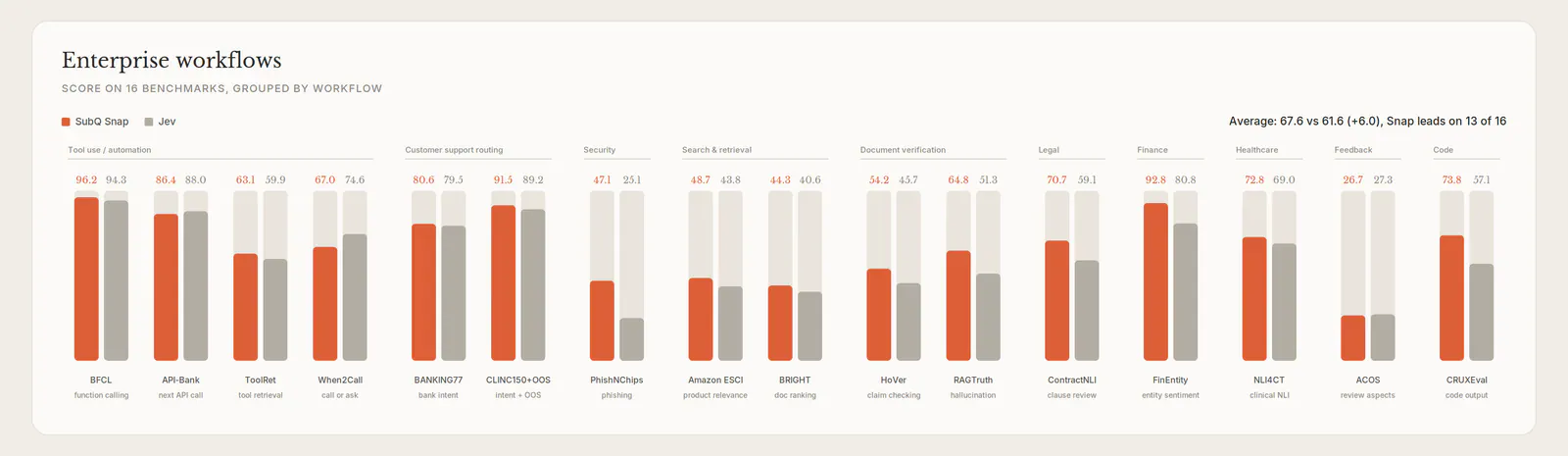
SubQ Snap is entering a capacity-limited public preview with support for up to 384K tokens of text and images. Its job is narrower than that of a general-purpose LLM: choose a tool, score an option, classify a result or decide whether an agent should continue.
In its October 12, 2026 announcement, SubQ lists a price of $0.05 per million input tokens, with outputs free, and says Snap can process 100K tokens and return a decision in about one second. These are company-published specifications and performance claims, not independently verified measurements.
Snap is intended for repeated decisions inside an agent workflow, leaving the final written response to a generative model. If those calls are sufficiently accurate, cheap and fast, builders could reserve larger generative models for work that needs generation. The preview gives them a service to test that proposition, though access is first-come, first-served and constrained by available capacity.
Snap Makes Choices Beside the Generative LLM
A coding agent may need a generative LLM to write a patch. Choosing which files to inspect, which tool to call next or whether a test result warrants another attempt can involve much smaller answer spaces.
SubQ describes Snap as a decision model that takes context, a question and application-defined answers, then scores those possibilities. Its output might be a choice, a score or a label instead of open-ended text. That interface places it in the control logic surrounding an agent’s generative work.
The company identifies four roles:
- Routing: Decide which task, model or workflow should receive a request.
- Tool picking: Select an appropriate tool from the available options.
- Checking: Evaluate an output or result against a defined condition.
- Stopping: Decide whether to continue, finish or escalate.
These roles overlap, but each raises different evaluation problems. A routing mistake might send an easy request to an unnecessarily expensive model. An incorrect check could approve faulty work, while a premature stopping decision could leave a task unfinished.
For example, a builder could ask Snap to choose between inspecting another file, running tests or handing a difficult debugging step to a larger model. The larger model would still generate the patch; Snap would handle a bounded decision around that work.
Restricting the answer space makes the output easier for software to consume. It doesn’t make the selected answer correct. Applications still need deterministic permission checks and appropriate escalation paths. A model’s decision that a tool is suitable should not, by itself, authorize the tool to perform a sensitive action.