Embedding Gemma Transcribe reports transcribing an hour of audio in 12.6 seconds on a base M3 MacBook Air with 8 GB of memory. The independent project turns Google’s EmbeddingGemma 2 audio representations into written words.
The free Mac app offers file transcription and push-to-talk dictation, with processing that its creators say runs entirely on-device. It requires Apple silicon, macOS 14 or later, and a roughly 715 MB model download on first launch.
This is not a Google product. The project explicitly says it is neither affiliated with nor endorsed by Google. Its reported speed, accuracy, and local-processing behavior remain project claims, not independently audited results.
Beyond the headline number, the technical experiment deserves attention. The developers say they left the base model unchanged and trained a small reader to extract words from its existing audio representations. That offers a concrete example of adapting an embedding model to a new task, although it does not establish that the app beats dedicated speech systems.
A Small Reader Turns Audio Representations Into Words
Google describes EmbeddingGemma 2 as an embedding model, not a transcription application. Its official model card says it maps text, images, video, and audio into a shared 768-dimensional vector space.
An embedding is a numerical representation used to compare inputs. A shared space allows comparisons across media: an audio input can be compared with text as well as other audio.
Embedding Gemma Transcribe builds on that capability. According to the project, its pipeline works like this:
- EmbeddingGemma 2’s audio encoder processes the speech and remains unchanged.
- A small trained reader moves each short audio slice into the model’s text space.
- The system selects the closest match from approximately 229,000 English words.
- The slices become a transcript, and a separate tiny model adds punctuation and capitalization.
The reader supplies the adaptation. A shared embedding space alone does not make a model a usable speech recognizer; the project adds a learned mapping that makes those representations useful for selecting written words.
The published description centers on matching short audio slices to a word inventory, unlike asking a generative model to produce a transcript token by token. It does not provide enough implementation detail to reconstruct the complete process for aligning slices and assembling the final transcript.
Google’s model card lists EmbeddingGemma 2 under the Apache 2.0 license. That supports reuse of the base model, but it does not establish that the independent Mac application or its reader is open-source.
Short Training Does Not Mean Training on a Mac
The creators say they trained only the transcription reader, leaving the base model unchanged. They report completing that training in under two hours on eight H100 GPUs, using openly licensed English speech.
The approach gives developers a way to preserve an existing model’s representations and learn a smaller task-specific component on top. If those representations already contain the information needed for the task, adapting the reader can avoid updating the full base model.
Two qualifications limit what can be drawn from the training claim. The published description gives no reader parameter count to quantify “small,” and eight H100 GPUs are substantial training hardware. The short reported run is not evidence that readers can reproduce it on the MacBook Air used for inference.
The project describes an adaptation strategy, but does not yet provide a complete reproducible training recipe. Assessing how readily another developer could reproduce or extend the result would require details such as the training corpus, data volume, reader architecture, and evaluation procedure.
What Mac Users Can Try Now
The project page lists version 1.6 as a free download with these requirements:
- macOS 14 or later.
- An Apple-silicon Mac.
- Approximately 715 MB of models downloaded on first launch.
Users can drop an audio file into the app for transcription. For dictation, the project says users can hold Right Option, speak, and release the key to enter text into another application.
The available evidence does not establish support for Intel Macs, Windows, Linux, or older macOS versions.
Language support has a similar limit. Google’s base model is multilingual, but this transcription project describes training on English speech and matching against an English word inventory. The base model’s broader language capabilities do not establish multilingual transcription support in the app.
The creators say inference runs on the Mac’s Neural Engine and that audio never leaves the machine. If accurate, users could process recordings without sending them to a remote transcription service or waiting on network-dependent processing.
That privacy claim has not been established by a security audit. Downloading models on first launch is compatible with local transcription afterward, but “on-device” is not proof that an application never makes any network requests. Anyone handling confidential recordings should verify the software’s behavior and their organization’s requirements before relying on it.
The 288× Figure Measures Throughput, Not Dictation Delay
The project’s performance table reports approximately 288× real-time processing, alongside the 12.6-second result for one hour of audio on the base M3 MacBook Air.
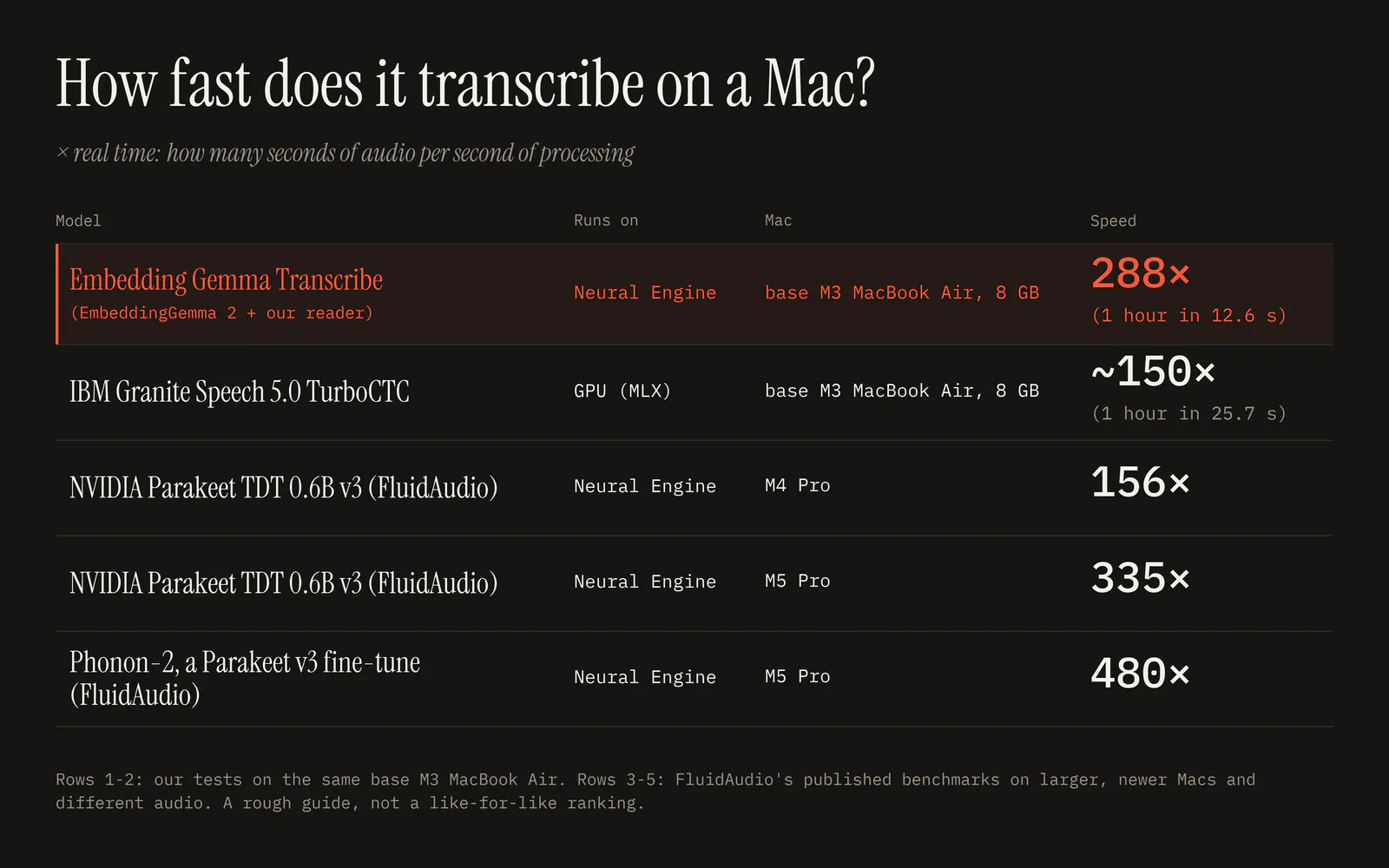
“Times real time” expresses throughput: how many seconds of recorded audio a system processes per second of computation. It is especially useful for estimating how quickly an existing recording can be transcribed.
Live dictation involves other delays. App startup, model loading, waiting for speech to finish, and inserting the transcript can all affect responsiveness. The published hour-long timing does not separately quantify those delays or say which overheads it includes.
The table also reports IBM Granite Speech 5.0 TurboCTC processing an hour in 25.7 seconds on the same base M3 MacBook Air, using GPU execution through MLX. On those reported timings, Embedding Gemma Transcribe takes roughly half as long. Using the same hardware makes this comparison more relevant than results from different Macs, though it does not establish equivalent transcription quality or fully matched testing conditions.
Other rows reproduce reported results for NVIDIA Parakeet and Phonon-2 through FluidAudio, using M4 Pro and M5 Pro machines. The project explicitly says those figures involve larger, newer Macs and different audio, and labels the table a rough guide rather than a like-for-like ranking.
With those limits, the evidence supports a narrow claim: the creators report high transcription throughput on one modest Mac configuration. It does not establish a universal winner across models, hardware, and workloads.
The Accuracy Claim Leaves Important Questions Open
The project reports approximately 5% word error rate, compared with 2% to 3% for leading speech models. It says a better-trained reader may close that gap in a future iteration.
Sources
- Embedding Gemma Transcribeeg2.haku.sh
- official model cardai.google.dev