Sprinklr opened a beta for six connected Marketing AI Agents on October 27, 2026, covering work from campaign ideation to budget optimization. Interested customers are directed to contact their account team to participate. This is a beta announcement, not a general-availability launch, and Sprinklr has not announced pricing or a general-release date. (Announcement)
The agents are designed to work across shared campaign context, data and governance, or to be deployed for specific needs. Sprinklr’s pitch is that connecting these stages can reduce the delays involved in passing work between planning, creative, localization, activation and approval teams.
The consequential detail is where preparation becomes action. Sprinklr says people retain control over strategy, creativity, approvals and brand decisions. Its product page also describes autonomous campaign launches. Understanding how those two promises fit together should be a priority for customers evaluating the beta.
What the Six Marketing AI Agents Do
Sprinklr’s announcement assigns each agent a distinct part of the marketing lifecycle. The roles extend beyond generating copy or images: they include interpreting media plans, checking requirements and recommending spending changes.
| Agent | Role described by Sprinklr |
|---|---|
| Ideation Agent | Connects performance, listening, audience, competitive, web and other signals to suggest campaign ideas. It can also recommend changes to content already planned or scheduled as conditions change. |
| Creative Agent | Extends approved creative through editing, variations, localization and A/B testing, using brand and campaign context. Sprinklr emphasizes adapting approved ideas and assets. |
| Campaign Execution Agent | Translates media briefs and plans into campaigns, audiences and creative across channels. It can identify inconsistencies, including a mismatch between a target market and the language of an asset. |
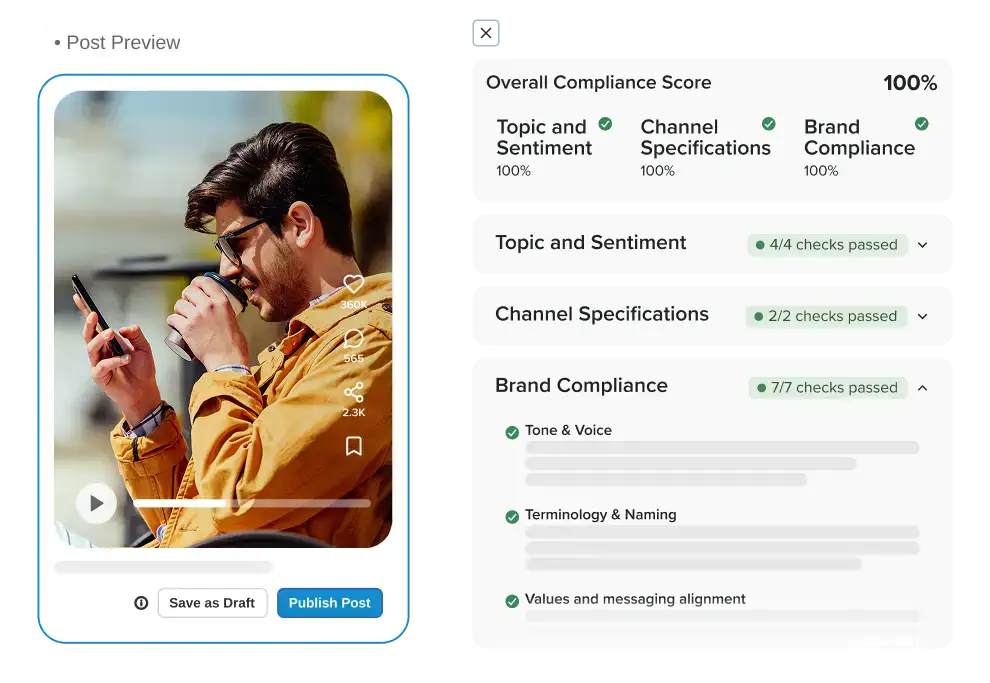
| Compliance Agent | Checks content against brand standards, organizational policies, regulatory requirements, channel requirements and market context. It automates repeatable checks and flags exceptions for human review before activation. |
| Community Agent | Helps identify relevant conversations and supports responses at scale, using context and guidance tailored to each channel. The product page also describes generating personalized responses. |
| Budget Optimization Agent | Uses campaign objectives and performance to recommend budget allocation across channels before launch and adjustments while campaigns are running. |
These are Sprinklr’s published capability descriptions, not independently verified results. The announcement and product page provide the underlying descriptions.
The connected workflow is the more interesting part of the proposal. A creative variation has limited value if it arrives in the wrong language for the target market or sits outside the approval process. Sprinklr specifically identifies language mismatches as something the execution agent can catch, then describes connecting execution with compliance checks before launch.
My view is that this handoff deserves more attention than the number of agents. It addresses a concrete coordination problem: carrying the same campaign intent through several operational stages. The published material describes that intended coordination, although it provides little technical detail about how agents exchange context or resolve conflicting recommendations.
Where Human Decisions Remain
Sprinklr says the system is designed to keep “people in control of strategy, creativity, approvals, and brand decisions.” Its clearest example is the Compliance Agent, which flags exceptions for human review before activation. (Announcement)
The six roles reveal different decision boundaries:
- Strategy: The Ideation Agent surfaces opportunities and suggests changes. Choosing which opportunity deserves a campaign remains part of the human strategic role Sprinklr describes.
- Creative direction: The Creative Agent works with approved ideas and assets. That places the emphasis on adaptation and scale while preserving human responsibility for the underlying creative direction.
- Release approval: Execution can prepare campaigns and connect them with compliance checks. Human review is explicitly described for compliance exceptions before activation.
- Brand judgment: Community responses and localized assets carry brand consequences. Sprinklr promises human control over brand decisions, but the materials do not detail approval requirements for every response or asset.
- Spending decisions: The Budget Optimization Agent is described as recommending allocations and adjustments. That wording supports an advisory role; automatic authority to move money is not specified.
The distinction becomes important on the product page, which says the Campaign Execution Agent “autonomously launches campaigns,” tests creative variations and optimizes delivery.
That wording is stronger than the announcement’s description of translating briefs into campaign components and connecting them with prelaunch checks. The two descriptions could fit a system that executes after authorized approvals, but Sprinklr does not explain the precise approval sequence, permission settings or exception rules in these materials.
I’d make that the first item in a beta discussion. Permission to build a draft campaign and permission to publish it are different operational powers. A useful demonstration would show exactly when an agent can proceed, when a person must approve, and what happens when a compliance check raises an exception.
The same distinction applies to community engagement. Generating a suggested reply and sending that reply are separate actions. Sprinklr describes response generation and engagement at scale, while leaving the detailed publishing controls unspecified.
How Customers Can Participate
Sprinklr says the beta is open and tells interested customers to contact their account team. The investor announcement gives that participation route, while the product page explicitly labels the feature “Limited Availability.”
An open beta announcement should therefore not be read as unrestricted access for every customer. The materials do not establish a public self-service enrollment process or specify which accounts qualify.
Customers considering participation should ask their account team to confirm:
- Which agents and channels are included in their proposed beta scope.
- What brand assets, campaign context and connected data are needed.
- Which actions require approval and which can run automatically.
- What access, commercial terms and support apply during the beta.
- Whether existing governance requirements can be enforced throughout the workflow.
Those are evaluation questions, not published eligibility rules. Sprinklr has not supplied detailed setup instructions, beta pricing or a general-availability timetable in the cited materials.
A narrow pilot looks more useful than enabling every stage at once. For example, a team could evaluate adaptations of already-approved creative before considering campaign publication. That recommendation follows from the different authority levels involved: preparing an asset exposes a smaller operational surface than releasing a campaign or changing its spending.
Frequently Asked Questions
4 questions
1Is Sprinklr Marketing AI Agents Generally Available?
No. Sprinklr announced a beta, and its product page labels the offering limited availability. Interested customers should contact their account team.