
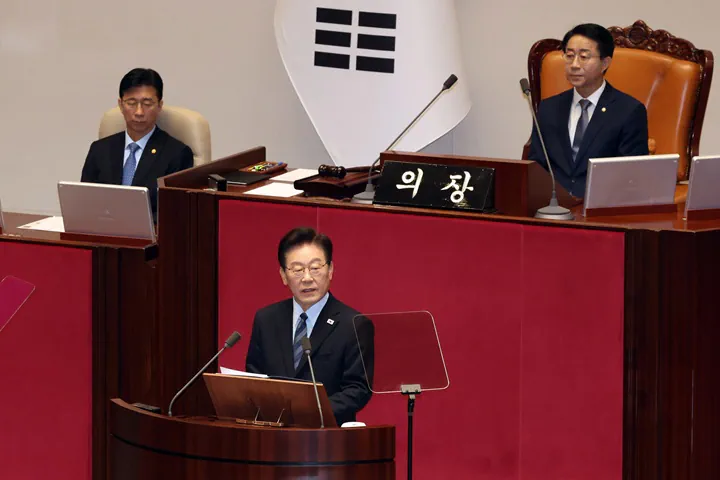
South Korea’s proposed 2027 budget directs 21.3 trillion won toward three technology megaprojects and broader AI support, spanning semiconductor production, physical AI and domestic AI data centers. President Lee Jae Myung urged the National Assembly to approve the spending plan on November 2, 2026, according to Yonhap’s report on his budget speech.
Lee also outlined a separate 4.6 trillion won allocation for a high-performance sovereign AI model, Yonhap reported. The budget remains a proposal requiring parliamentary approval.
Official September budget summaries provide more detail than the November speech, including funding for component testing, physical AI demonstrations and electricity infrastructure. They also expose an accounting problem: the published headings do not form a clean, additive breakdown of the 21.3 trillion won headline. Readers should avoid treating every figure as a separate pot of money.
What the 21.3 Trillion Won Covers
The government’s September 2 budget announcement already identified 21.3 trillion won for the three megaprojects and AI support. A more detailed September 23 policy briefing compared the proposal with 10.8 trillion won in 2026.
That is an increase of 10.5 trillion won, or approximately 97%, calculated from the government’s published figures. Against the proposed overall budget of 820.9 trillion won, the headline package represents about 2.6% of government spending.
The September briefing lists these major headings:
| Published budget heading | 2026 | Proposed 2027 | Main focus |
|---|---|---|---|
| Semiconductor competitiveness | 1.3 trillion won | 3.4 trillion won | Production infrastructure, technology and talent |
| Physical AI | 0.9 trillion won | 3.1 trillion won | Field demonstrations, core technology and data |
| Domestic AI data center ecosystem | 0.9 trillion won | 3.1 trillion won | Component validation, commercialization and R&D |
| Frontier AI models and broader AI access | 8.4 trillion won | 12.2 trillion won | Independent models, agents and education |
Figures come from the September 23 government briefing. These are published headings, not a reconciled spending ledger.
The four proposed amounts add up to 21.8 trillion won, already 500 billion won above the headline package. The briefing also lists 2.1 trillion won for supporting infrastructure without fully explaining how the categories fit together.
The useful reading is therefore a map of government priorities, not an exact allocation chart. The opened summaries leave category boundaries, possible overlap and some funding periods unresolved. The sovereign-model figures also differ between sources, as detailed below.
Semiconductor Funding Includes the Infrastructure Behind Chips
The semiconductor heading rises to 3.4 trillion won. Within it, the government lists production-base construction increasing from 200 billion won to 2 trillion won, while ecosystem support rises from 1.1 trillion won to 1.3 trillion won. The briefing also identifies technology and workforce development as priorities. These selected subitems are not a complete reconciliation of the heading. Source: government policy briefing
Production capacity depends on more than manufacturing equipment. Semiconductor facilities need reliable electricity, water supplies, transport connections and suitable industrial land. The same briefing identifies 2.1 trillion won in infrastructure support:
- 1.5 trillion won for electricity infrastructure, including power supply to semiconductor complexes and renewable-energy support.
- 400 billion won for water supply and water-resource facilities.
- 200 billion won for industrial infrastructure at Saemangeum, including rental land and roads.
I’d give these enabling investments considerable weight when judging the proposal. A manufacturing project cannot produce chips simply because its factory equipment has been funded. Power and water connections can determine whether that equipment becomes productive on schedule.
The figures indicate support for expanding the industrial base. They do not provide a chip-output target or establish how much additional AI computing hardware will become available.
Physical AI Funding Moves Toward Field Demonstrations
The government proposes increasing the physical AI heading from 900 billion won to 3.1 trillion won. Its September briefing highlights demonstrations across eight core fields in public- and private-sector settings.
Physical AI generally refers to AI systems that perceive and act in the physical world, such as robotic or automated equipment. Deploying those systems creates different demands from running a text model: sensors, control systems and software must work together under real operating conditions.
The official briefing identifies:
- 2.6 trillion won in total for field demonstrations across eight core areas.
- 1.5 trillion won in total for securing core physical AI technologies.
- 144 billion won for data training centers, factories and library use.
Those figures exceed the 3.1 trillion won heading when added together. The summary does not supply enough accounting or timing detail to treat them as independent annual allocations.
The emphasis on demonstrations is still consequential. A system that performs well in a controlled environment may struggle with changing lighting, unfamiliar objects or interruptions on a working site. Field deployment can reveal those failures and generate data for improvement.
My view is that deployment quality will matter more than the number of demonstration sites. Evidence of repeatable performance under specified conditions would say more about industrial competitiveness than a successful showcase.
AI Data Centers: Domestic Components and Validation
The proposed 3.1 trillion won AI data center heading, up from 900 billion won, targets a domestic industrial ecosystem. The published measures extend beyond constructing buildings or purchasing computing hardware.
Two specific items in the September briefing are:
| Measure | Published amount |
|---|---|
| Test laboratories for core AI data center components and commercialization support | 87.8 billion won |
| R&D covering materials, components, equipment and cloud performance | 154.5 billion won |
Frequently Asked Questions
3 questions
1Is the 21.3 Trillion Won Package All for AI Models?
No. It covers semiconductor-related investment, physical AI, domestic AI data centers and broader AI support. Model development is one part of the agenda.