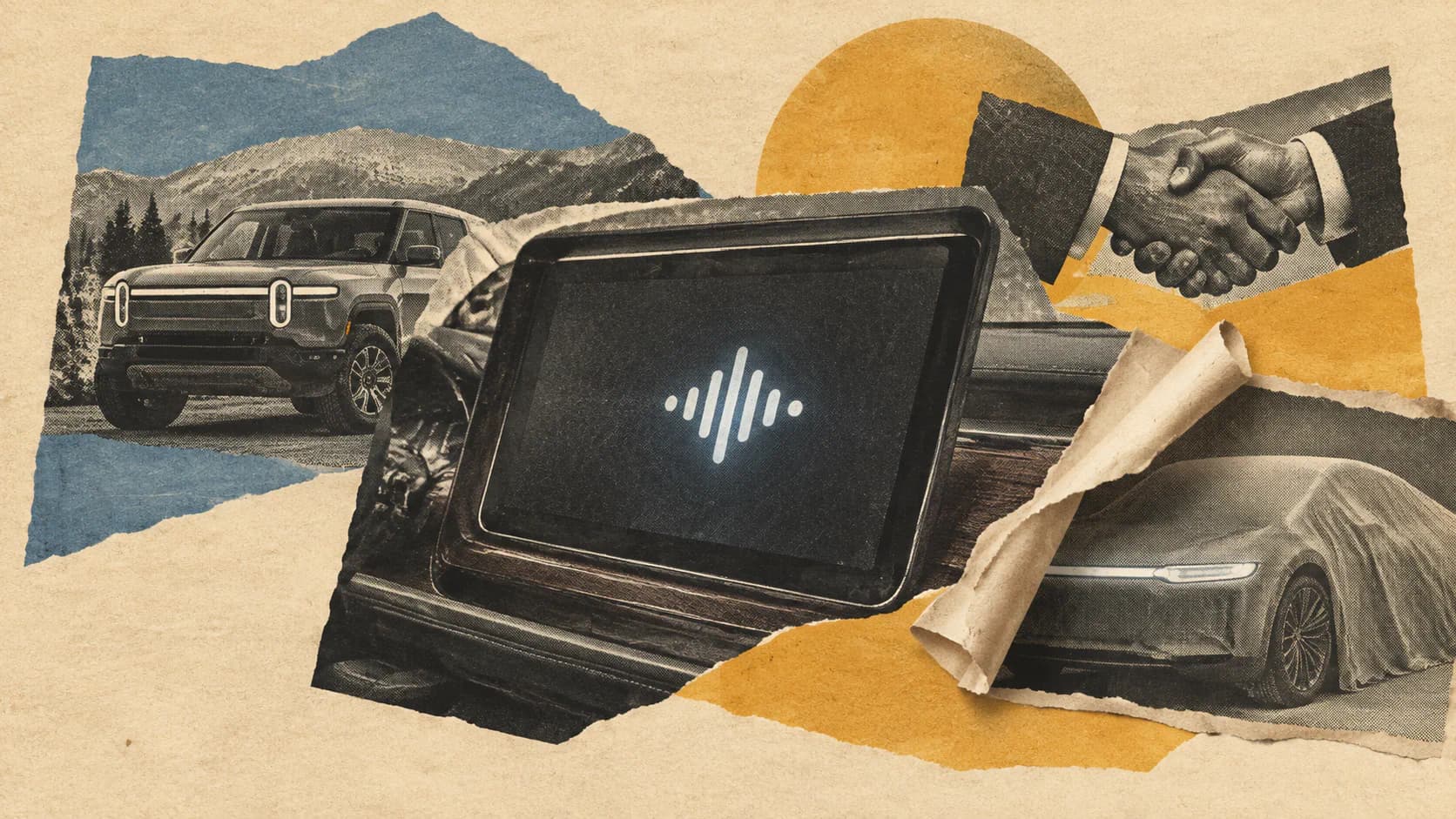
Rivian is licensing elements of its in-car AI voice assistant to Volkswagen Group through their joint venture, expanding a partnership worth up to $5.8 billion beyond its original electrical-architecture and vehicle-software scope.
The disclosure appeared in Rivian’s third-quarter investor presentation on October 29, 2026, according to TechCrunch’s report that day. It brings technology already deployed in Rivian vehicles into the companies’ shared development program: the assistant rolled out to the R1S SUV and R1T pickup in May 2026, followed by the R2 SUV in October.
The distinction worth drawing is between licensing technology and announcing a finished Volkswagen product. Rivian has confirmed the former. The disclosure leaves the assistant’s commercial terms, licensed components and eventual Volkswagen destinations unspecified.
For Rivian, the agreement gives an internally developed AI product a potential market beyond its own vehicle sales. For Volkswagen, it adds another software capability to an existing partnership, although the public details do not yet show how much of Rivian’s assistant will reach drivers.
A Software Partnership Gains an AI Layer
Rivian and Volkswagen established their joint venture in 2024, with the independent company beginning operations that November. The arrangement initially focused on bringing Rivian’s electrical architecture and software to Volkswagen’s next generation of vehicles. Its announced value grew from up to $5 billion to up to $5.8 billion, TechCrunch reports.
The assistant license expands that technical scope. It is part of the broader partnership, not a separately announced AI venture.
Rivian described the expansion in its investor presentation as:
“a proof point for the extensibility of the platform we’ve built in-house.”
That wording, reproduced by EV’s reporting on the earnings disclosure, captures the strategic argument. Rivian wants software developed for its own vehicles to become reusable technology for another manufacturer.
Its electrical architecture provides useful context. In an earlier overhaul of the R1T and R1S, Rivian reduced the number of electronic control units, the computers responsible for vehicle functions, from 17 to seven. The redesign also reduced wiring. Rivian presents that more integrated hardware-and-software foundation as a way to support increasingly demanding software and vehicle-wide updates, according to TechCrunch.
An AI assistant sits above that foundation as another way for occupants to interact with the vehicle’s software. Licensing it extends the partnership from underlying computing infrastructure toward a feature drivers can directly use.
I’d read this as a concrete extension of Rivian’s vertical-integration strategy. Building more of the technology itself gives Rivian something it can license as well as install in its own cars. Whether that becomes a substantial business depends on adoption and terms that have not been published.
The scope remains specific: EV reports that the assistant license brings an AI product into the partnership without including Rivian’s self-driving software. Voice interaction and automated driving should not be treated as the same technology transfer.
How Rivian’s Agentic Assistant Works
Rivian’s assistant lets drivers and passengers interact with the vehicle and control certain functions through speech. The company’s description puts an in-house agentic framework at the center of that process.
Speaking at TechCrunch Disrupt 2026, CEO RJ Scaringe said the framework understands what action someone wants to take and routes that request to the appropriate part of the car’s software, according to TechCrunch’s account.
At a conceptual level, that describes three connected jobs:
- Interpret the request: Work out the action intended by the spoken input.
- Select the destination: Identify the relevant vehicle software responsible for that action.
- Route the action: Pass the request to the appropriate software component.
The consequential feature is the connection to vehicle functions. A conversational system can produce an answer; an action-routing framework connects a request to software that can carry out a supported task.
That distinction also helps explain why the existing joint venture matters. An assistant intended to control vehicle functions needs connections to the underlying software. Volkswagen is already working with Rivian on that underlying platform, creating a plausible integration path for the assistant technology.
This is an architectural implication of the published description, not evidence of a completed Volkswagen implementation. The available disclosure does not provide a component-level breakdown, identify the language models involved, or explain which processing happens inside the vehicle versus elsewhere.
Scaringe also described the possibility of eventually running agents from other companies, including Anthropic. That remains a future ambition. It should not be read as confirmation that Anthropic technology powers the shipped assistant or forms part of the Volkswagen license.
The useful takeaway is narrower: Rivian has shipped an assistant built around its own action-routing framework, and Volkswagen is licensing elements of that technology. The announcement does not promise every capability of Rivian’s current interface or its future agent plans.
Why the ID EVERY1 Is the Plausible First Candidate
Volkswagen’s ID EVERY1, a small, lower-cost four-door electric hatchback, is the clearest potential route for the assistant into a VW vehicle.
TechCrunch reports that it is slated to be the first Volkswagen using Rivian’s software and electrical architecture under the partnership. That makes it a logical candidate for the newly licensed assistant technology.
The reasoning has two steps. The ID EVERY1 is expected to receive the underlying architecture. The assistant now sits within the broader partnership supplying that architecture. Those facts make an integration plausible, but they do not turn it into a confirmed product plan.
For buyers, the distinction matters. An architecture commitment does not specify every feature that will run on it. Volkswagen could use licensed components in an assistant with different branding, interface choices or capabilities. Those are implementation possibilities, not announced decisions.
The current product timeline therefore has three different levels of certainty:
- Rivian R1S and R1T: The assistant rolled out in May 2026.
- Rivian R2: The assistant rolled out in October 2026.
- Volkswagen vehicles: Elements of the technology are licensed, but no receiving model or assistant launch date has been named.
My view is that a named production vehicle with a defined feature set will be the most useful next milestone. That would show how the license translates into a customer-facing product. Until then, the ID EVERY1 is a credible candidate, not an assistant launch announcement.
What the Financial Milestones Actually Tell Us
The $5.8 billion figure describes the broader Rivian–Volkswagen arrangement. It is not a disclosed price for the assistant technology.
Several financial milestones help explain the scale and duration of the existing relationship. EV’s report on the companies’ third-quarter disclosures provides the following details:
| Item | Reported detail | What it tells readers |
|---|---|---|
| Broader partnership | Worth up to $5.8 billion | The overall relationship is much larger than the newly disclosed assistant license |
Frequently Asked Questions
4 questions
1Is Volkswagen Getting Rivian’s Entire AI Assistant?
Rivian says it is licensing elements of the technology. The disclosure does not identify the components or promise the same interface and features found in Rivian vehicles.