Qwen has released open weights at both ends of the Qwen3.8 scale. The 2.4T-A95B checkpoint appeared on August 11, 2026, followed by Qwen3.8-27B on August 14. Both are now listed in Qwen’s official Hugging Face collection and ModelScope collection.
The pairing is more interesting than a routine parameter-count expansion. Qwen3.8-27B is a dense, native multimodal AI model intended for realistic self-hosting. Qwen3.8-2.4T-A95B is a mixture-of-experts model derived from the same foundation model as the hosted Qwen3.8-Max. citeturn2view0turn1view3
That creates a useful split for builders: a comparatively manageable LLM for local coding and office agents, and a Max-class checkpoint for organizations with serious distributed infrastructure. The important caveats are storage, long-context costs, company-reported benchmarks, and different licenses.
Two Releases Target Very Different Builders
Qwen3.8-27B and Qwen3.8-2.4T-A95B share the same model family, multimodal focus, and 262,144-token native context window. Their deployment requirements are nowhere near the same.
| Model | Architecture | Total Parameters | Active Parameters | BF16 Weight Size | License |
|---|---|---|---|---|---|
| Qwen3.8-27B | Dense | 27.8B | 27.8B | About 55.6GB | Apache 2.0 |
| Qwen3.8-2.4T-A95B | Mixture of experts | 2.446T | About 95B | About 4.89TB | Qwen3.8-Max License |
The 27B checkpoint is “lightweight” only in comparison with frontier-scale models. Its full-precision weights still exceed the memory available on most consumer GPUs, although quantization, CPU offloading, or multi-GPU serving can make local deployment practical.
The 2.4T model presents a different problem. Activating roughly 95 billion parameters per token reduces inference compute compared with a dense 2.4-trillion-parameter model, but it does not remove the need to store the remaining experts. The full checkpoint is an infrastructure-scale release, not something that becomes workstation-friendly because it uses an MoE architecture. citeturn8view0turn10view0turn10view1
Qwen3.8-27B Is the Practical Release
The Qwen3.8-27B model card describes a 64-layer dense transformer with approximately 27.8 billion parameters. It uses dense attention in its first and last three layers, with Qwen’s DSA mechanism across the middle layers to reduce the cost of processing long sequences. The model also supports multimodal understanding across text, images, and video. citeturn2view0
“Native multimodal” matters for agent workflows. A coding agent may need to interpret screenshots, architecture diagrams, or rendered interfaces alongside source code. Office automation can involve slides, spreadsheets, charts, scanned documents, and visually structured PDFs. Qwen3.8-27B can accept those inputs within one model rather than relying on a separate vision system, although it remains a multimodal understanding model rather than an image generator.
Qwen’s benchmark table shows the clearest gains in coding and computer-based office work. Against Qwen3.7-Plus, the 27B model scores 72.2 versus 70.0 on SWE-bench Verified and 58.1 versus 51.5 on Terminal-Bench 2.0. Its reported advantage grows on office-oriented evaluations: 42.3 versus 31.5 on GDPval-AA and 76.5 versus 60.4 on MS-Suite. It also reaches 87.5 on GPQA Diamond, compared with 82.7 for Qwen3.7-Plus.
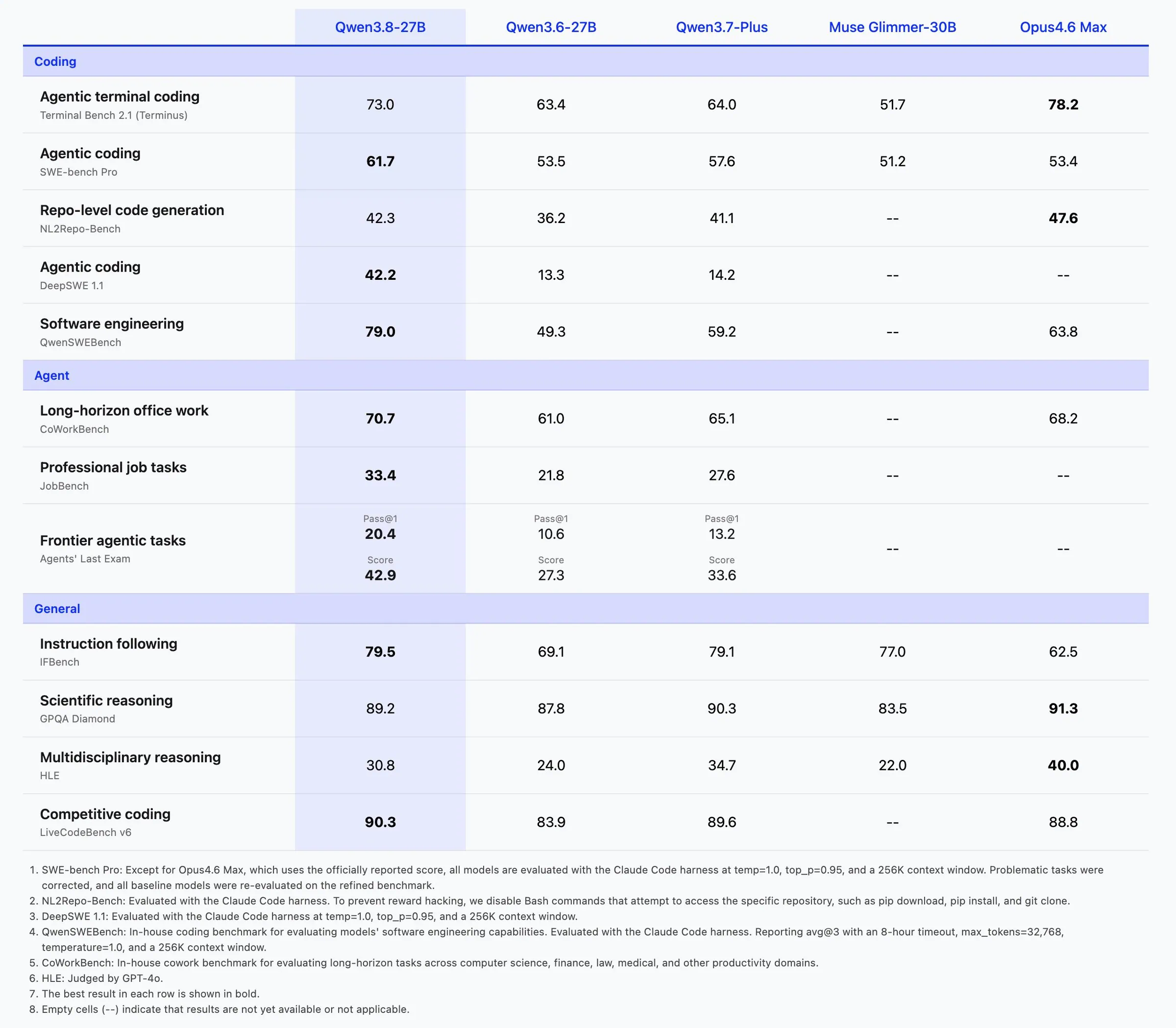
Those numbers make Qwen3.8-27B more compelling than a generic small frontier model. Its training appears aimed at tasks where an LLM must inspect mixed inputs, plan several actions, interact with software, and preserve state across a longer workflow.
Deployment still requires planning. The official BF16 checkpoint contains about 55.6GB of weights before accounting for the KV cache, runtime overhead, visual encoder activity, and batching. A 4-bit conversion would theoretically reduce the raw weights to roughly 14GB, but real memory consumption depends on the quantization format, context length, inference engine, and workload.
“Better Overall” Does Not Mean Better Everywhere
Qwen’s claim that the 27B model outperforms Qwen3.7-Plus overall is broadly supported by its published table, but Qwen3.8-27B does not win every individual test. It scores 57.6 on Vibe Coding compared with 58.3 for Qwen3.7-Plus, while its LiveCodeBench result of 79.3 is effectively tied with the older model’s 79.4.
The evaluations are also company-reported. Qwen says it retested comparison models under consistent environments and hyperparameters for several long-context and agent evaluations, which is better than combining unrelated leaderboard numbers. Independent testing is still necessary before assuming the same ranking will hold for a specific repository, office suite, language, or tool configuration.
Agent benchmarks are particularly sensitive to scaffolding. Prompt structure, retry policies, available tools, execution time, and error recovery can materially change the result. The defensible interpretation is that Qwen3.8-27B has become stronger at practical agent work, not that a 27B checkpoint will automatically outperform every larger model in production.
Qwen3.8-2.4T-A95B Opens the Max Tier
The Qwen3.8-2.4T-A95B release exposes the foundation model behind Qwen3.8-Max at a scale rarely made available as downloadable weights. It has 60 transformer layers, 512 routed experts, 10 activated experts per token, and one shared expert. Its active parameter count is approximately 95 billion, while the complete model contains more than 2.4 trillion parameters.
Qwen’s results place the open model close to the hosted Max variant rather than making them identical. Qwen3.8-2.4T-A95B scores 81.9 on SWE-bench Verified, compared with 82.4 for Qwen3.8-Max. Both score 63.3 on Terminal-Bench 2.0. The open checkpoint slightly leads on GDPval-AA, at 50.9 versus 50.5, while trailing on Tool-Decathlon, at 46.2 versus 46.9.
“Max-level” is therefore a fair description of the model’s reported capabilities. It should not be read as a guarantee that downloading the checkpoint reproduces the complete hosted service. An API product can include optimized serving, system prompts, tool orchestration, safety layers, routing, and other infrastructure that is not contained in model weights.
The release will be most useful to AI laboratories, cloud providers, and large organizations that can operate multi-node inference systems. It also creates opportunities for controlled evaluation, domain adaptation, distillation research, and specialized agent platforms. For most individual developers, using hosted inference or choosing the 27B model will remain far more practical than serving nearly five terabytes of BF16 weights.
The Million-Token Option Has Real Costs
Both models support a native context window of 262,144 tokens. Qwen documents a YaRN configuration that extends the effective limit to approximately 1.01 million tokens, giving builders room for large repositories, document collections, extensive agent histories, or lengthy multimodal inputs.
The million-token figure is an extension rather than the default training context. Qwen recommends enabling YaRN only when an application needs it, warning that permanent static scaling may reduce performance on shorter inputs.
Long context also consumes memory and time. The model must prefill the prompt, manage a larger KV cache, and find the relevant evidence among far more tokens. Sparse-attention techniques reduce that burden, but they do not make million-token inference free or guarantee reliable recall across every position. Retrieval, context filtering, and structured memory remain valuable even when the model technically accepts the entire dataset.
Licensing introduces another operational distinction. Qwen3.8-27B uses the permissive Apache 2.0 license. The 2.4T model instead uses a custom Qwen3.8-Max License alongside an acceptable-use policy. Teams should not assume that the Apache terms attached to the 27B release also cover the Max-scale checkpoint. citeturn10view0turn10view1turn10view2
Which Qwen3.8 Model Should Builders Choose?
- Choose Qwen3.8-27B for self-hosted AI applications, multimodal assistants, coding agents, office automation, experimentation, and deployments where quantization can bring memory use within reach.
- Choose Qwen3.8-2.4T-A95B when near-Max performance matters and the organization already has the distributed hardware, inference expertise, and legal review process required for a multi-terabyte model.
- Use hosted Qwen3.8-Max when the goal is accessing the capability rather than owning and operating the underlying infrastructure.
The 27B release offers the more accessible starting point. The 2.4T checkpoint is better understood as a foundation for serious model-serving platforms and AI research than as a larger drop-in replacement.
Final Thoughts
Qwen3.8-2.4T-A95B is the more dramatic release, but Qwen3.8-27B may prove more consequential for everyday builders. It combines multimodal input, long context, permissive licensing, and strong reported agent performance at a scale that can be quantized and self-hosted without a data center.
The next test is not another Qwen benchmark table. It is whether independent evaluations, optimized quantizations, and production inference engines preserve those gains across real repositories, documents, and computer-use workflows. If they do, Qwen3.8-27B could become one of the most useful open-weight AI models in its size class.
Frequently Asked Questions
4 questions
1What is Qwen3.8-27B?
Qwen3.8-27B is a 27.8-billion-parameter dense multimodal AI model from Qwen. It accepts text, image, and video inputs, supports a native 262,144-token context window, and targets coding, office automation, reasoning, and agent workflows. Qwen released its open weights under the Apache 2.0 license. citeturn2view0turn10view0
2Can Qwen3.8-27B run locally?
Yes, Qwen3.8-27B can run locally with suitable hardware and an optimized inference configuration. Its BF16 weights occupy about 55.6GB, so most single consumer GPUs will require quantization, CPU offloading, or multiple devices. Long contexts and multimodal inputs add further memory requirements beyond the model weights.
3How long is the Qwen3.8 context window?
Both open Qwen3.8 models have a native context window of 262,144 tokens. Qwen provides a YaRN configuration that can extend this to approximately 1.01 million tokens. The company recommends activating the extension only for workloads that require it because static scaling may reduce performance on shorter inputs. citeturn1view5turn7view0
4Is Qwen3.8 open source?
Qwen3.8 is more precisely described as open weight. Qwen3.8-27B uses Apache 2.0, giving developers broad rights to use, modify, and distribute it. Qwen3.8-2.4T-A95B uses a separate Qwen3.8-Max license and acceptable-use policy, so organizations should review those terms before commercial deployment or redistribution. citeturn10view0turn10view1turn10view2
Sources
- Hugging Face collectionhuggingface.co
- ModelScope collectionmodelscope.cn
- Qwen3.8-27Bhuggingface.co
- Qwen3.8-2.4T-A95Bhuggingface.co
- Apache 2.0 licensehuggingface.co
- Qwen3.8-Max Licensehuggingface.co
- acceptable-use policyhuggingface.co