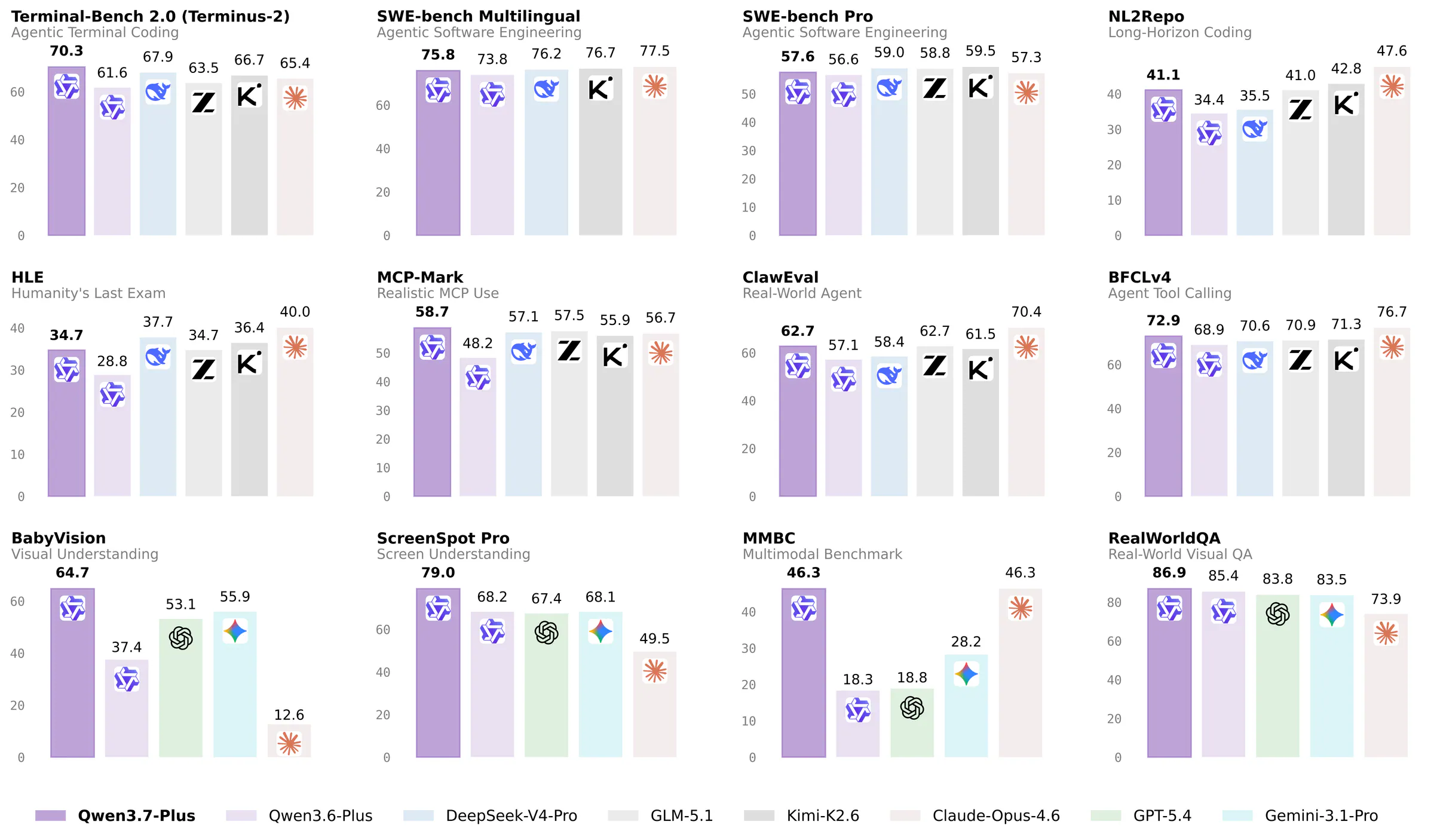
The Qwen 3.7 generation is led by two preview models: Qwen3.7-Max-Preview, the text-only reasoning flagship, and Qwen3.7-Plus-Preview, a balanced multimodal variant that accepts vision input. While most of the early attention went to Qwen3.7-Max and its long-horizon coding benchmarks, the Plus variant is where Alibaba's multimodal agent story actually lives.
If you need the model to read diagrams, screenshots, charts, or video frames, you reach for Qwen3.7-Plus, which handles vision and multimodal inputs and is described as a high-performance balanced preview focused on reasoning and logical expression, with its toolchain opening up gradually. That toolchain is the point. This isn't a vision model with a chat wrapper on top. It's an agent foundation where visual perception and language reasoning are fused from the ground up.
Qwen 3.7 is the newest generation of large language models from the Qwen team at Alibaba Cloud, formally announced at the 2026 Alibaba Cloud Summit in Hangzhou on May 20, 2026, alongside a self-developed AI accelerator chip and a broad slate of agent products. Qwen3.7-Plus is now available via API on Alibaba Cloud Model Studio.
What Qwen3.7-Plus Actually Is
Most vision-language models treat image understanding as a feature bolted onto a text backbone. Qwen3.7-Plus uses early fusion training on trillions of multimodal tokens, achieving cross-generational parity with Qwen3 and outperforming Qwen3-VL models across reasoning, coding, agents, and visual understanding benchmarks. Early fusion means the model doesn't see an image and then "think" in text. Vision and language are processed together from the first layer forward.
The efficient hybrid architecture combines Gated Delta Networks with sparse Mixture-of-Experts, delivering high-throughput inference with minimal latency and cost overhead. That architecture matters for agents specifically. Agent loops are iterative. A model that burns compute on every visual token at inference time will stall in production. The sparse MoE design keeps per-step cost manageable even across long multi-turn sessions.
Where earlier chat models were optimized to give a strong answer in a single pass, Qwen 3.7 is pitched less as a chatbot and more as an engine for long-running, multi-step work. Qwen3.7-Plus extends that framing into the visual domain.
Key Technical Highlights
- Unified vision-language foundation via early fusion training on trillions of multimodal tokens, outperforming prior Qwen3-VL models on reasoning, coding, and visual understanding.
- Efficient hybrid architecture: Gated Delta Networks combined with sparse Mixture-of-Experts for high-throughput inference with low latency overhead.