
Recursive’s optimized Mac setup for Flint requires a supported Apple chip and at least 48GB of unified memory. For developers with that hardware, the 40-billion-parameter coding LLM offers a way to work without sending code to a hosted model.
Recursive’s announcement describes a mixture-of-experts model that activates approximately 2.5 billion parameters per token. The company says it supports up to 512K tokens of context, although it recommends staying within 256K for best results.
The October 21 release carries another claim: Recursive says its Eureka Machine automated research system contributed throughout development, helping a small team build Flint from scratch in under four months.
For developers, the immediate question is whether Flint delivers useful coding assistance on hardware they own. Its benchmark leadership, inference speeds, and automated-development results are vendor-reported. The downloadable weights make those claims testable; they are not independently established results.
Local Coding Requires More Than a Small Active Count
Flint is designed to investigate repositories, fix bugs, implement features, and write tests. Its weights are available under Apache 2.0, according to both the announcement and the Hugging Face model card.
Developers can use it as an alternative to paying a hosted service for model inference, keeping code and prompts on their own machine in a fully local workflow. Hardware, electricity, and maintenance still cost money, but local operation removes the hosted model’s per-token API bill.
Flint has approximately 39.8 billion parameters in total, rounded to 40B in its release branding. Only about 2.5 billion participate in generating each token, reducing the active computation compared with using the entire model every time.
For memory planning, though, Flint is not equivalent to a 2.5B model. The other experts still belong to the model and need storage and a suitable memory-management strategy. The BF16 checkpoint is roughly an 80GB download; the model card distinguishes it from separately prepared quantized variants for NVIDIA and Apple Silicon runtimes.
Recursive’s local setup documentation specifies an M4 Pro, M5 Pro, or M5 Max with at least 48GB of unified memory for its optimized rec Mac engine. That is a much more useful purchasing constraint than the phrase “runs on a laptop.”
The engine can configure Pi or OpenCode as the coding harness. Flint generates text and tool requests; the harness executes commands and returns results. Keeping inference local does not automatically make every connected tool offline or private. Developers still need to inspect their harness, network access, and tool configuration.
The 512K Context Claim Comes With a 256K Recommendation
Recursive advertises support for context windows up to 512K tokens, but its deployment guidance is more conservative. The announcement recommends staying within 256K for the best coding and general-task results. The model card documents a 262,144-token configuration, and the usage documentation describes that same size for the hosted configuration.
A stated maximum, a recommended operating range, and a documented configuration are different claims. Developers should not assume that downloading Flint enables a usable 512K window on their machine.
For local inference, Recursive says the effective limit depends on the runtime, available memory, quantization, and cache settings. Its guidance is to retain the context and output settings supplied by the rec launcher.
That budget covers the prompt, conversation history, tool definitions, tool results, reasoning, and the answer, as well as source files. A long debugging session can consume substantial space even without loading an entire repository.
The appeal is room for extended coding sessions and larger collections of relevant files. The available evidence does not establish equally strong performance at every context length, and Recursive’s own recommendation argues against treating 512K as the everyday target.
Fast Generation Is Not the Same as Fast Task Completion
Recursive reports generation rates above 125 tokens per second on an M4 Pro MacBook Pro and above 150 tokens per second on a 64GB NVIDIA RTX Spark at short contexts, using its optimized inference engine.
Those figures apply to specific hardware and software. They should not be carried over to another Mac, a different quantization, or an unrelated serving stack without measurement. Recursive also claims speeds up to twice those of comparable models on its targeted hardware, and more than five times those of dense 25B–40B models with similar coding benchmark scores. These remain vendor comparisons.
The announcement’s speed-chart methodology adds a qualification: it reports average generation speed over a 128K-token session and excludes prefill, the stage in which the model processes the supplied prompt. Excluding prefill makes the chart less informative about the wait after handing an agent a large collection of files.
Useful coding-assistant performance includes time spent reading context, generating reasoning, executing tools, running tests, and correcting failed edits. Token throughput measures one part of that process. A faster model can still take longer to finish a task if it needs more attempts.
Recursive acknowledges a capability tradeoff. It advises users to split complex work into smaller subtasks and provide explicit instructions, saying Flint may require more guidance than larger closed-source coding models.
Focused repository work is therefore a sensible evaluation starting point: a contained bug fix, a clearly specified feature, or tests for an existing function. That does not establish that Flint can replace every workflow built around a larger hosted agent.
The Coding Scores Need Their Harnesses Attached
Recursive’s model card reports the following release results:
- Terminal-Bench 2.1: 54.9%.
- SWE-bench Pro v2: 89.7%.
- SWE-bench Verified: 74.2%.
The company says Flint leads mixture-of-experts models below 50 billion total parameters on its highlighted agentic coding benchmarks. This is narrower than claiming leadership across all coding AI models, and it depends on the evaluation conditions.
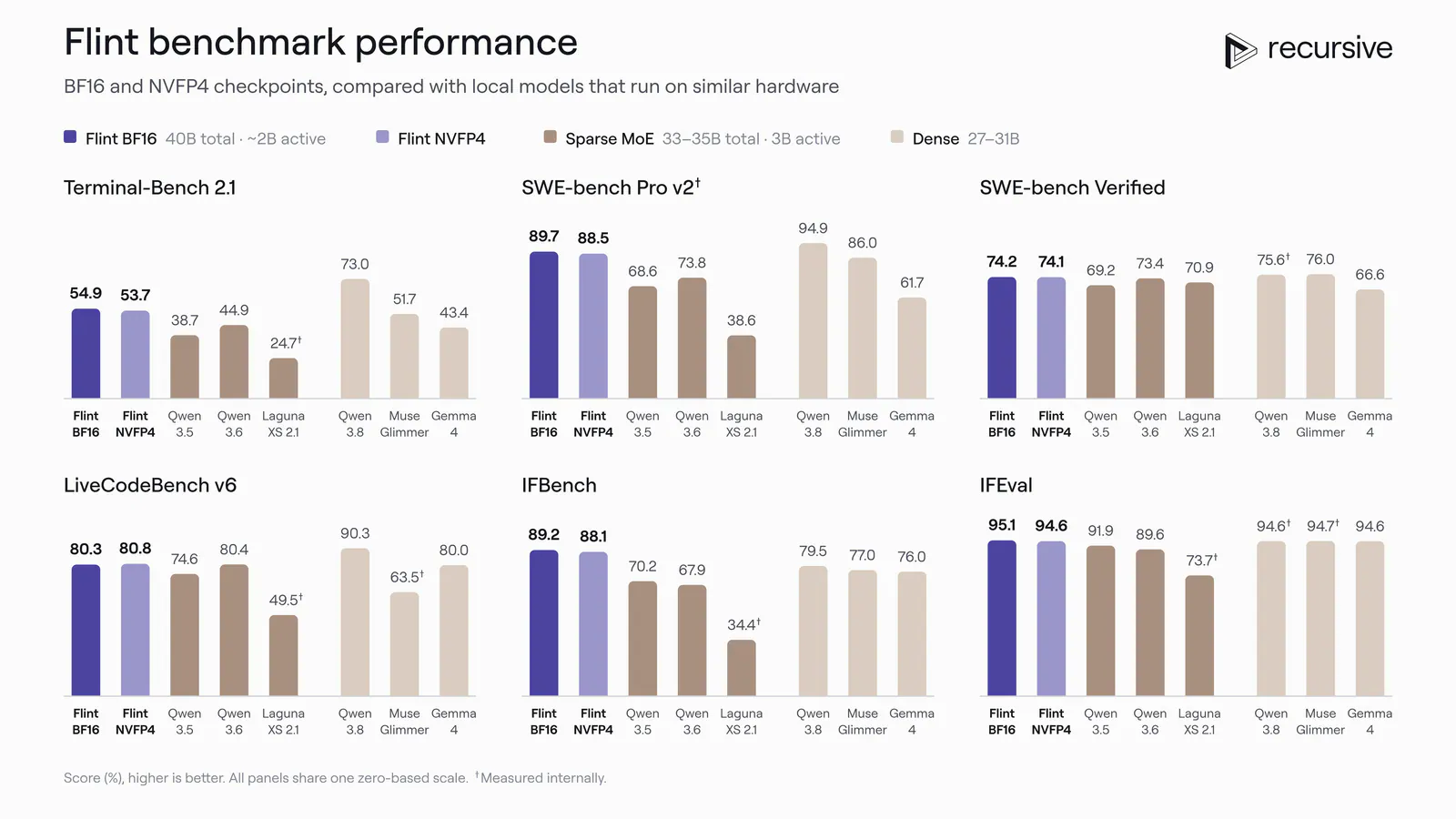
Recursive used Terminus 2 for Terminal-Bench and mini-swe-agent for the SWE-bench evaluations. Agentic results are reported as average pass@1 over at least five attempts, with agent timeouts of up to five hours. Averaging repeated single-attempt outcomes is not the same as giving an agent five chances and counting any eventual success.
Network conditions differed, too. Terminal-Bench allowed internet access, but Recursive counted solutions obtained through retrieval as unsuccessful. The SWE-bench evaluations ran without internet access.